On-Demand
20 AI Use Cases for eComm Founders
A recent publication from McKinsey & Company named seven imperatives for rethinking retail, and every single one could be supported by some type of AI-informed technology.
As we talk, AI for ecommerce is already delivering more than a 25% improvement in customer satisfaction, revenue, or cost reduction for thousands of eCommerce stores.
HOWEVER -
Poorly run implementations of traditional or generative AI in commerce—such as models trained on inadequate or inappropriate data—lead to bad experiences that alienate consumers and businesses.
To avoid this, it’s crucial for businesses to carefully plan automation initiatives that prioritize the needs and preferences of their customers.
And this is what we are discussing in our next live session:
- Top areas where you should use AI—ones that’ll have the most impact on your conversion rates
- Real-world successful applications of AI on eComm stores, and what we can learn from them


About the speaker

Shekhar Kapoor
VP, Marketing
Convertcart
Shekhar Kapoor (VP at Convertcart) has worked with 500+ online brands, including Squatty Potty, Prep Expert, and USA Hockey Assn., and helped them boost sales exponentially.
Shekhar Kapoor
VP, Marketing
Convertcart
SESSION REPLAY: 20 AI USE CASES FOR ECOMM FOUNDERS
Okay perfect. I hope that woke some of you up. I know we have people logging in from all over, and I'm really excited to walk you through some of the great insights we have here today.
So I'm so happy that I can see a lot of repeat people. Thanks so much for joining everyone. We have a lot of interesting things to talk about, but specifically, we picked this because there's a lot of buzz about it. I think we are all probably reading about it many times a day. Some of us are using it. I'm a power user as far as AI goes in all ways and forms. Convertcart is implementing AI across our product in many ways. We have ways in which our team uses it, ways in which our customers leverage it, and we’re excited about it.
The Premise
You know, I know the human survival instinct makes you think about AI in a negative way, but it's up to us whether we see it as a gift or a risk. And at Convertcart we see it as a huge gift. We're not a model-making company, but we are a company that's going to leverage a lot of these models, and so we're very optimistic about how it's going to create a lot of value for our customers, for ourselves, and of course for the end user of e-commerce who's trying to shop and find something they want to buy.
Now as far as AI goes and today's discussion goes, we're going to keep it very simple. I have 20 use cases for AI, which means these are 20 ways in which an e-commerce entrepreneur like yourself—or operator like yourself, I know we have a few operators joining us today as well—can leverage AI.
I'm not going to go into the depth of how to implement it, which tool to use, how to bring it into your business, because that's level two.
Level one is first identifying one or two use cases that you are extremely confident about making sense for you.
And so I want you to look at these 20—I won't take too long to walk you through them—and find the one or two which you feel will have the maximum impact on your business, which are going to be high priority for you.
Once you're happy with that, that's when you should actually double-click and go deeper into how you could implement it.
Originally we thought we'd also make a list of tools you can use, but I feel that would be doing injustice to the actual use case, because in a lot of cases these tools are nothing but other technology companies creating a software to sell. And when you do it that way, you're limited to what they can help you achieve instead of what use case you're trying to complete. So I want us to be very first-principles-based and very use-case-focused in this discussion.
So let's get into AI. Let's talk about AI specific to e-commerce.
But you know, one of the feedback points I already received when we launched this webinar is: “Why are you not first explaining how AI works, and how it could be brought into e-commerce?” So this is one way of doing that. I'm happy to walk you through that.
And yeah, let's jump in. Let’s start with the first few use cases and then go from there.
AI USE CASE 1: OMNICHANNEL DATA COLLECTION
While we jump into this, one quick precedent I want to set about AI and e-commerce is that if I were to put in a list all of the industries that will benefit from AI, e-commerce is up top. It's in the top five, 100%. There are so many facets in e-commerce that matter. There is of course the storefront, there is marketing, there's demand gen, there is customer support, there's logistics, there's payments. And so there are so many different areas in which AI can completely transform the e-commerce experience bit by bit — but the overall impact of AI on e-commerce is going to be very solid.
So let's get into this. I'm going to jump into the first idea, and then we can go from there.
The first one is really simple: omnichannel data collection. It's simpler said than done, because I just want to articulate something. Normally, when I see companies analyzing data using their own team, or their agency, or whoever else — somebody really smart — they're generally looking at data in a very singular or maybe one- or two-dimension way. The data is not three-dimensional. When I say three, four, or five dimensions, what I mean is normally you're looking at: okay, let me look at my conversion rate in relevance to devices. Or conversion rate in relevance to devices for maybe new users. So that’s three dimensions. And you can actually take that to the next level.
But that's not going to happen till you start collecting data from many, many different channels and bring that all into one place.
So what I really mean is: if you are an omnichannel business, you collect data and collate it for all your channels — website, your offline store, your mobile app, etc.

If you're not an omnichannel business, even for your website, there are so many pieces of data that you're missing out. For example, within the site experience, product discovery throws out a different set of data — what did people search for, what are they looking for, why did they look for that, all of those motivations. And then of course there’s chat — what are they chatting about, what are their issues, what are the pages they see, etc.
I'll give you one simple insight, and I’ve given this in an earlier webinar as well. I want you to, for example, look at your funnel of data for conversion rate. One of the things you'll find is that people who visit your website’s FAQ page and then convert — that conversion rate for that part of the journey will be extremely high. And so that's something that should really make you think, because FAQ is an extremely high-intent piece of content on your site. But that's such an easy data point that is very easily overlooked.
What we are able to do at Convertcart, for example, is throw a lot of raw data into the system, and then that tells us what are the key things that it is able to notice.
Again, as I said, we will not explain how to do this. Let's first attack what are the things that really are top of mind for you. For example, if you're not somebody — if you're not a business that has mountains of data to analyze and find these nuances — stick to the basics. Don't focus on this as a problem. There are 19 more things I'll walk you through. So you can pick something from there.
AI USE CASE 2: BETTER CUSTOMER SEGMENTATION
But the point is that generally speaking, businesses are analyzing data using Google Analytics and other tools in a very single-dimension way. And so what we want to do is have you find a way to look at clickthrough rates, look at product views, look at cart additions, look at chats, look at people visiting non-product pages, people who are coming from different channels, the kind of ad they click on, the kind of messaging they leave, the value they purchase — all of those data points collected into a single place and then giving you insights.
What that also allows you to do is mind-blowing customer segmentation. I think AI is categorically very capable of doing this. Convertcart has, over the last six months, built a very powerful segmentation engine for two reasons.
One: we have our email marketing platform called Engage. We use segmentation there very actively for our customers. And so we are able to create a lot of these out-of-the-box customer segments, including VIP customers, customers that are likely to churn in the next 20 days, customers who are likely to repeat in the next 30 days, and so on. We are able to do what is called an RFM analysis very fast, and also back it up with a lot of insights using AI.
So RFM is recency, frequency, and monetary value — how recently somebody bought from you, at what frequency they buy, and what is the monetary value that they spend with you. Those three metrics plus all of the other data that is available to you allows you to get after the most important customers in a timely way.
At the end of the day, segmentation helps you show the right product, the right message, to the right customer, at the right time. And that, in my opinion, is the Holy Grail of marketing.
With AI, it's going to become easier for smaller businesses to leverage that and put it to use. For example, campaigns generally speaking, sent to well-segmented audiences, convert a lot better. So I think the real outcome of something like this is recognizing patterns that are obvious, recognizing patterns that are not obvious, and then taking it to the next level by looking at micro-conversions and conversions.
I'll give you an example of all three.
- People who are buying items without a discount are your customers who have a high affinity to the product and a high capacity to pay. They’re not value-conscious; they are outcome-conscious.
- There could be customers exhibiting multiple visits before they actually buy — so they are showing you a different kind of behavior.
- Or even people who have a lot of micro-conversions like opt-ins and that kind of stuff, with no transactions. That’s another opportunity to attack.
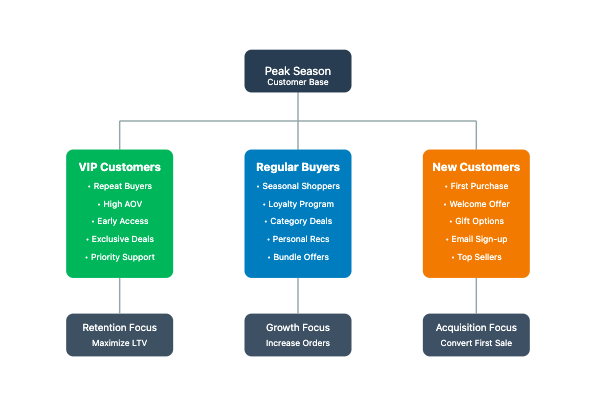
Again, the bottom line is: create these segments. It’s only when you actually create these segments that you can come up with a strategy for those segments. Because unless you do that, you don't know which segment is big enough for you to solve for.
The answer is almost always in the data.
AI USE CASE 3: DYNAMIC PRICING
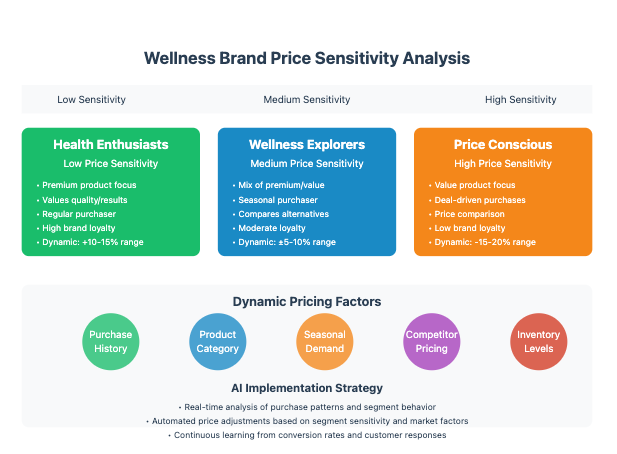
Dynamic pricing — I think this is a longstanding one. I'm not going to spend too much time on it. If you're in a very competitive space, there are a lot of platforms and tools available that do price tracking. So you can just search for "Shopify price tracking tools" or something like that. Convertcart does not do this, but this is very effective.
What it essentially does is: if you're selling a standardized product like cameras, refrigerators, appliances, fashion products, reselling stuff like watches — any of that kind of stuff — it's very important to be competitively priced. Because your Google product ads will mean the customer is going to pick you only if your price is good. And price, in this context, takes precedence over trust and all of the other things because the product is standardized.
So there are a lot of these pricing intelligence tools that help you track pricing for your competitors. You can give it the 10 websites you want to track, and the SKUs you want to track, and then it can actually come back and change your price. So you have to open up that side of the business.
I think the other way to do this is to just use AI and research AI. For example, the new ChatGPT o1 model is a research model. So if you are, for example, in the business of yoga mats, I would want that research model to do a research of the US market, come back to me with everybody who sells yoga mats, the price they sell at, what validates the price they're selling at, and why people buy from them.
You could also do sentiment analysis of yourself and your customers — I'm going to come to that in a second, what sentiment analysis is — but essentially look at it as a tool that helps you do pricing a little bit better.
Because your ability to research, scrape data from the internet, look at your competitors, continue to keep an eye on them — all of that is easier.
And I’ll just tell you why I say that, very quickly — completely off track — but a few months ago I wanted to try my hands at development. I'm through and through a marketing and sales revenue growth professional. I've always done that my entire life. And so development — software development — is more my co-founder’s forte. And so, yeah, I just wanted to play around with code. I wanted to learn to write code.
And I said, hey, you know what, I'm just going to build a Chrome application that can throw out quotes — motivational quotes — for people. And you wouldn't believe it, sitting in a cafe on a Sunday, it took me three hours to develop it, deploy it, put it on the Google Chrome Store — and it's still there. The app is called Get Back to Work Stupid. It's this muscle symbol that you see here. And every time you click on it, it throws up a quote at you. I don't know if you can see it on the screen share, but yeah — see: “Success dawns after ‘No’ has turned into a ‘Yes.’” Right? Very sales-heavy.
So the interesting thing is: that was possible because of ChatGPT and Gemini and a few other tools that I was using in tandem — and YouTube. So anything is possible.
Again, I want you to focus on solving or picking the use case that you think will matter the most for your business, and then putting all of the energy needed into implementing it for your business.
AI USE CASE 4: VOICE-FIRST PRODUCT DISCOVERY
Voice-first product discovery is going to come back. Conversational AI usage is going to go up big time. When voice happened, it was a lot like 3D printing. When voice came into being, everybody said, hey, the internet is going to completely change. Nobody's going to browse anymore, nobody's going to type anymore, everybody’s listening to voice. But that's not true, because that's not how you interface. But it's also not false.
About 40% of searches on Google are voice.
58% of shoppers use voice.
Which is incredible — and that's true for local businesses because generally the search query is: “Find me X near me.” And so you've got to be relevant to that.
I don't think you need to take it to the level where your website is fully voice-activated and you get all of that going. But I think it's about using natural language processing to be more relatable. Don’t expect customers to search for specific keywords that you want. Don’t expect customers to search for extremely difficult things — they're not going to do that.
You have to be a little bit easier.
For example, if you're selling bags and you call them “briefcases,” your customers might just be calling them a “sling” or something else. So I think it's extremely important that you are empathetic towards your customer. And I think adopting voice in some way or form is exactly that.
If you are a business that has less than 100 SKUs — less than 50 SKUs — I wouldn't want you to bother with it. We have customers with more than 200,000–400,000 SKUs. So in their case, search and discovery are everything. It's everything. It's the entire business. It's the backbone of the entire business. So that's where this becomes extremely critical.
AI USE CASE 5: HIGH-QUALITY PRODUCT DESCRIPTIONS
I cannot emphasize enough how important extremely high-quality product descriptions are. I’m a copy guy at heart. I love great copy. I just really think that the ability of someone to articulate something is, at the core, what determines their success — and how they do in life in general. That’s what I personally feel.
And I think copy is exactly that for brands. It’s how clearly a brand can explain, in a second, what they are all about and why someone should buy it.
But the thing is: once you’ve done that, it’s the second and the third and the fourth and the next 120 seconds that will convince the customer to buy the product you’re trying to sell to them. And I cannot emphasize how important extremely high-quality product descriptions are.
In fact, I have a friend who runs an agency for just copywriting. They are phenomenal. I'm happy to connect you to them. And they do only product descriptions. Can you believe there is an agency that does only product descriptions? They're based out of the US. And what they do is they A/B test product descriptions to write you one that is extremely persuasive. And I think they do a fantastic job.
But as an aside: we do more than 10,000 A/B tests for our customers a year. And naturally for A/B testing, you have to have scale, you have to have data that allows you to test in a statistically significant way. But generally speaking, one of our biggest learnings has been that you can't overlook the basics.
So there are two or three things that this helps you do.
One is: if copywriting was a weakness, that can’t be an excuse anymore, because AI is going to do a phenomenal job of doing that for you. It will at least give you a version one and a version two, and then you can — as an entrepreneur or as an operator — take it to the next level.
But the goal is to address some of the key questions your customers might have about your product — to try and convince them that you are better, and here is why you are better.
Whether you’re trying to highlight features, whether you’re trying to talk about use cases, whether you’re trying to talk about anything else that is important to your customer — it’s important that you do it in the description.
This is also one of the best ways to make AI take notice of you. AI — essentially any kind of AI, any model like DeepSeek, o1, 40, all the models that OpenAI is publishing, or even Gemini — they are, at their core, a super compressor. I might be nerding out a little bit, but I think it’s important for you as an e-commerce business owner to know this.
They are what you call a super compressor: They take a mountain of data, process it, and compress it, so that it can be processed again very fast when somebody is trying to talk to it in plain English.
So it’s important that your product description says everything that is there to say about your product.
It should explain each and every bit.
For example, if you’re selling t-shirts, it should explain the type of collar you're doing, the kind of stitching that goes in, the fabric, how it feels inside, how it feels outside, the sleeves — is it oversized, is it not oversized, how do you measure this, where is it sourced, who manufactures it.
Everything that is possible — you should actually talk about it in the description.
AI USE CASE 6: WIDER VISUAL RECOMMENDATIONS & INTELLIGENT SEARCH
Wider recommendations — so now, I already spoke about being visual with things, but I think recommendations play a big role. I want to talk about this in two or three different ways.
First is: we spoke about voice search. Visual search matters also. Google Lens is everywhere now. With AI built into the iPhone — I think in another two months, Apple promised us iPhone 16 Pro and said that AI is built in, but it's not yet come to most phones — but I think you're all seeing where I'm going with this.
For example, now with an iPhone, you can open your camera, point it at a text, and you can copy the text from the photo itself. And these uses are adopted first by people who use the latest highest-end technology — which are also people with the most income. Which means they are actually great customers. So if you are not adapting to that, you're appearing — or you're looking — like this really old-school store. Unless that's a part of your brand, I wouldn't want you to be in that department.
Integrating Google Lens into your website is very easy. It's two Google searches away. It's the easiest thing to do.
So that's one fast way to do it.
The hard way to do it is when you go to the next level. But the reason we do it is to implement something we call intelligent search. We do this for more than 200 e-commerce sites, where we deploy IntelliSearch for them. And through that we are able to throw out very visual results. We are able to throw those results out even when somebody is not searching — so that really makes life easy.
AI USE CASE 7: DEEPER EMAIL PERSONALIZATION
Email personalization — over the last year and a half, Convertcart has done email marketing for more than 100 customers. We send millions of emails out every day. That's one of the new businesses we were building, and it's going really well because we've figured out why people were not seeing success with Klaviyo, for example.
If you are getting 30% or more of your revenue from emails — fantastic, you're already winning. But if you're not getting anywhere above 10%, then there's something serious that needs to be looked into.
Personalization — we've realized — is at the core of making this happen. It sits at the center of successful emails.
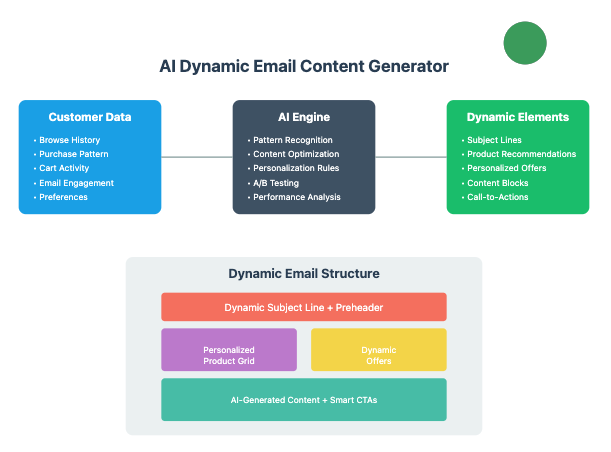
So you obviously get higher open rates, clickthrough rates — all of those things matter. But it's not just about sending product recommendations. It's about also personalizing the social proof that is being sent in the email. It's about personalizing depending on what stock statuses you are at. It's about personalizing the specific offer you want to send.
Right? If you want to do a Happy Valentine's Day campaign and do that, that's fine. Those are fine. But it's known that about 60–70% of the revenue you get from emails comes from workflows.
And I'll tell you why I say that. Klaviyo will not say that.
The reason is: Klaviyo’s revenue attribution is “open and convert,” meaning if you've sent an email to 100,000 people, and out of those 100,000 people if anybody buys in the next seven days — irrespective of whether they clicked on your email or not — it will be attributed to that campaign.
So essentially, anybody who is in your customer list that buys again will get credited — or Klaviyo will take credit for it.
Whereas it's the workflows where email revenue is directly attributable. You can actually change this setting in Klaviyo and change it to “click and convert,” but that's secondary.
The important part is: you have to make sure that your recommendations in emails are highly personalized, and that even campaigns go out to segmented customers that are very thought out.
There’s another important use case for AI here. I know that Klaviyo pricing has changed — I think effective yesterday — and so if that is happening to you as well, it's because they're trying to charge more for the same list size.
So one of the things I'm seeing businesses do is clean up the list. They're trying to reduce the list size so they don’t have to pay more. But I'm just saying — don't do that. You shouldn’t reduce your audience. We have seen emails converting six months after not opening an email. Six months later, they might open something and convert.
And the cost of keeping them on the email list is negligible.
So I think it's important that you look at it that way.
We do that — we actually do, as I said, RFM analysis on the list and then figure out if something needs to be excluded or not. But yeah, Klaviyo is getting expensive — so that's a problem they'll have to solve.
AI USE CASE 8: TARGETED REPEAT PURCHASE CAMPAIGNS
Targeted repeat purchase campaigns — so if you're in an industry where this is relevant, generally speaking 40% of the revenue should be repeat for you. And a small percentage of your customers will drive 40–50% of your revenue in any given month.
When I say targeted repeat purchase campaigns: so far, to target and send a campaign like that, you’ve had to do a lot of manual sorting through the data. With AI, you can make that a kind of repeat affair. You can essentially run a query on your Shopify sales or whatever platform you're using, so that it gives you, every month, your VIP customers — and out of the VIP customers, which ones are not following the general frequency of purchase that people are supposed to follow.
That's generally the model you want to get after.
I want to repeat once again:
The reason I'm not going deeper into any of these is because the goal of this webinar is to show you many use cases, so that you can pick the one or two that truly matter to you.
Then you go deeper into them on your own.
AI USE CASE 9: SEND-TIME OPTIMIZATION & TIMING INTELLIGENCE
The other thing that is important with marketing is timing.
For example, send-time optimization is something Klaviyo has. Most email tools have that. But I don't think it is taking into account a lot of the behavioral data that matters.
Right now, what it optimizes for is:
send the email at a time that the customer is most likely to open it.
But it has completely left out of context things like:
- customer’s likeliness to purchase
- customer’s ability to purchase
- affinity to purchase
- their current stage in the buying cycle
- browse-to-buy latency
- time zone and location nuance
All of that.
In fact, you have so much data about where the customer is, their location, time zone — all of those things. I think there's so much that can be leveraged and done right.
Generally speaking, you want to make sure you identify quiet periods. Browse-to-buy timeframes. The latency between browse and buy for higher-value products — which is generally very high. So how can you leverage emails to not just nudge and remind, but also suggest and add value?
For example:
If someone is buying a really expensive piece of jewelry, education plays an important role.
Although I think the naturally grown, natural diamond market is really taking a big hit, I think every time somebody buys a decent-sized diamond in their life for the first time, they go through that education process of:
- What’s clarity?
- What’s cut?
- What’s type and style?
- What am I actually paying for?
And that education — whichever jeweler does it best — is the one that actually closes the sale. It’s really not who gives the best price for the diamond. Because it’s the education that creates the trust.
And so that's what your emails and your communication should do. But it has to do it at the right time — when the customer is in the market for that education.
And that logic can apply to any product category.
Let’s keep going.
AI USE CASE 10: EARLY INTENT IDENTIFICATION (CONVERSION AFFINITY MODELS)
Alright, so I think this is a very interesting one. Convertcart had built a model around this where we were essentially doing conversion affinity — people who were above 80% likely to convert.
For those people, we were not showing email opt-in pop-ups.
We were not showing unnecessary offers.
Because we understood there is high intent and you don’t need to disturb their journey.
But for everybody else, we were trying to figure out a way to at least get their email — find a way to capture some information so that we can take it to the next level.
Again, a really big one.
You will have to build a model around it, but this one is actually easy to implement. There are a lot of tools that can help you do this straight out of the box. So if this is something that is relevant to your business, I would definitely want you to get after it.
AI USE CASE 11: STOCK LEVEL FORECASTING & INVENTORY INTELLIGENCE
Stock levels — I know a tool that does this really well. It's called Prediko. They're out of the UK. The marketing there is run by somebody I know very well, but I've seen the product in action, so I know for a fact that it's fantastic.
Generally speaking, they do a fantastic job of just-in-time stocks and also leveraging inventory turnover for sales and offers and that kind of stuff. Because there is a point where too much inventory sitting is cost, and there is a point where inventory not being there is cost. So both those problems should get solved. And AI — again, as I said — AI is going to touch every part of the e-commerce value chain, and inventory is one such area.
I think it's really important to try and get some kind of metrics around sales velocity, latency to purchase, frequency of purchase, so that you are just in time with stock. You're not buying too much, you're not ordering too much. At the same time, you're making sure you're not selling too much so that you run out of stock and then you don't have anything.
I remember, you know, we had done a few campaigns for our customers where we figured out a way for them to accept business even when they were not in stock. And so that really was—you could say—transformational for them. And I think that those are things that really solve fundamental business cash flow profitability issues if you can correct that in the right way.
AI USE CASE 12: REVIEW & SENTIMENT ANALYSIS
Review and sentiments — this is the easiest thing now.
I'll give you a very simple example. I was talking to this EV company owner recently — really large EV company. I'm not going to tell you who it was because when we do an audit sometimes we are asked to sign an NDA, and so I'm under NDA still. And so I wanted to kind of get a pulse check on that, and I did my research. I looked through Reddit, I did some manual research on the company, but then I used an AI platform.
I fed it a bunch of information. I said, “Hey, I want you to tell me what the internet thinks about X,” — that company. It’s not X, but yeah, using X as a variable. And then I kept querying. And what I realized is: it gave me some really specific and statistically significant insights, which actually six months ago would have taken a ton of manual research.
And so the call was extremely rich. And I think that user insight that is generally very hard to get is slowly becoming easier to get, because you can actually query just your competition or whatever space you are in.
For example, if you’re in the wedding space, you could look at the most popular men's fashion trends — wedding fashion trends for 2024 — on the East Coast. And to be honest, I tried that search. Not that I’m getting married, but I wanted to do it because we were working with a huge wedding fashion company. And there were things I read for the first time in my life. Like I have never heard those fabric names and those dress styles till I made that search.
And I think the only way I would have discovered that otherwise is maybe if I had actually gone and spoken to 50 actual customers that would probably use that.
So I’m just saying that a lot of already processed research is at arm’s length. And as a business, it’s our responsibility to leverage that.
In this case, one of the things we are doing for our customers, for example, is we are doing the sentiment analysis the day they sign up with us. And what we realized in a lot of cases is the insight is something completely different.
For example:
A lot of people that order love the packaging more than the product — but we’re not talking about it. And we’re not giving people that assurance. Because when you're selling something that could break, for example, it’s really important that you give the customer confidence that it’s not going to break because the packaging is really top-notch. And now it's your customers talking about it — so that’s obviously fantastic.
So:
- product reviews
- chat logs
- return reason data
- survey and feedback responses
All of those things will give you a solid sentiment analysis on what people like and what they don't.
AI USE CASE 13: PRODUCT IDENTIFICATION FOR SOCIAL MEDIA
This one is a little tricky. Product identification for social media — I think it's still very, very high level. It's similar to how a lot of SEO companies and tools came into existence in the last two years saying, “Hey, we are able to give you sentiment of what people really like,” but it's really high-level signals.
Product identification for social media promotions essentially analyzes:
- trends
- what kind of hashtags are popping
- what Instagram is doing
- what people are wearing, not wearing
- what’s working, not working
And it tells you what to talk about and when.
For example:
You might want to talk about oversized t-shirts on Fridays or Thursdays because people are probably going to an event on the weekend and they want to buy.
Or if you are, say, in the pet products business, you might want to talk about that on Sundays. It could be any of that.
But generally speaking, any good tool will help you get that insight on:
- what time
- what day
- which topic
…is best to post on social media.
There are many tools like this. A simple Google search will get you where to get there. Or you can just use something like Perplexity to take it to the next level.
AI USE CASE 14: SMART CART RECOVERY
Smart cart recovery — generally speaking, what I want you to have as a benchmark, forget about all the numbers on the screen. One simple benchmark:
50% of all the clicks on cart recovery emails should convert.
50% is the conversion rate you want for people who click on your cart abandonment email — or cart recovery email, as you might want to call it.
Now, whether it is email or SMS doesn’t matter.
You have to crack:
- timing
- personalization
- and a lucrative enough offer
that makes them want to go to the next level.
That’s when the 50% will actually happen.
There are many ways to do this. Some people are now sending the customer to a chatbot saying, “Hey, did you have any questions about this?” If your product is bespoke or complex in any way or form — where people are likely to have some questions about the product — it's okay to send them to chat.
Otherwise:
- bring in user-generated content
- add a lot of social proof
- let AI do some of that heavy lifting for you
And I think this is also where A/B testing and experimentation will play a very, very big role.
AI USE CASE 15: PREDICTING RETURNS (RTO & CUSTOMER BEHAVIOR MODELS)
Now, I think RTO — return to origin — is obviously one of the things we are all trying to solve for. There’s no doubt about that. But predicting returns based on customer data is something that AI is fantastic at. We’ve seen the accuracy here being very, very high.
Again, a lot of tools do this.
Is this a priority for you?
Is this a problem for you?
That's something you will have to take a call on.
But there are two things here:
a) You are trying to find the products or customer behavior that could create a return.
In those cases, maybe — like in a lot of Southeast Asian markets — cash on delivery is a very common form of payment. And there’s a way in which you can detect if the customer is likely to be a dicey purchase, and you can turn off cash on delivery as an option. Because the cost of RTO is very high in those cases.
and…
b) You are trying to identify serial returners — constant offenders.
AI USE CASE 16: IDENTIFYING SERIAL RETURNERS
You’re going through your data, understanding if somebody is trying to game the system.
If you’re at a certain scale, this is relevant, because you're bigger than small, and you're probably not able to recognize the pattern manually. Or nobody in your team can do that.
I also think that most of these AI initiatives are fantastic from a founder or e-commerce entrepreneur perspective because they could be like your special project for the rest of February. Pick up one thing, solve that problem. Hire someone who can just do this for you — maybe an intern who can set something like this up for you — and that's it. You have a system that runs for you.
AI USE CASE 17: AI-DRIVEN CUSTOMER SUPPORT AUTOMATION
This is, in my opinion, the most obvious implementation of AI.
If you are a Gorgias user, I would love to hear from you on how things are going. But generally speaking, this is the first job AI is going to replace, in my opinion. Because the similarity of experience between chat and AI is very close.
It's the first job AI is going to take.
And if anybody ever tells you that AI is not going to replace jobs — they're wrong.
AI will replace jobs.
AI will also create other jobs to offset that.
So it's not the end of the world. As I said, it's a gift. It's fantastic.
There is a lot of repetitive, non-creative work that humans are doing today that keeps them busy, but as a business, it makes the business less efficient.
So I think about 80–90% of your support should be AI-handled.
And this is an easy, easy thing to do. Very easy to do.
If this is not yet done, I think everybody should do this. This is a use case everybody should prioritize and just go after.
AI USE CASE 18: VIRTUAL TRY-ON (VTO & AR COMMERCE)
Virtual try-on — this is again super important. Anything where you're selling something in the fashion space… In fact, there’s a lot of AR try-on also now, which is when you're trying to sell something that is for home use and you're trying to let people see it in action in their own space.
Again, a very easy technology to implement now.
The only interesting thing is: with AI, this is going to become very, very cheap.
It’s going to become very, very cheap to implement something like this.
So far, there were tools that were charging on a per try-on basis, or per 100 try-ons basis. All of that is going to go out of the window. This is going to become very cheap.
I wouldn’t be surprised if in the next 6 to 12 months you would have every small fashion site having a virtual try-on because they can afford to do it now. And it’s the easiest thing to do.
I think, again, you could do multiple relevant recommendations when someone is trying something on, offer before-and-after context for bottom-of-the-funnel, so there’s so much that can be done within that.
AI USE CASE 19: BEHAVIOR-BASED AD COPY
Behavior-based ad copy — this is very simple, but I think it's easier said than done.
Generally speaking, you want to set up an ad funnel. Right? So:
- Awareness stage ad — where you’re talking about the product, showing amazing visuals, making the customer aware of this amazing black t-shirt brand you've started.
- Consideration stage — where you're asking them to now go in and take a look at it; you might be showing customer reviews, customers wearing it, talking about it, and so curiosity increases.
- Intent stage — if they click and go to the site, they move to retargeting; so now you're showing them an offer, free shipping, low stock, maybe a different color.
- Purchase / Loyalty stage — running ads rooted in loyalty, trying to get repeat purchases and cross-sells, trying all of these things.
That's like, in 60 seconds, the ad strategy you want to follow as an e-commerce brand.
But where does AI fit?
It fits everywhere.
Ad copies get stale very fast.
Most of you know that Meta has really increased the weightage on the frequency metric in your ad panel. Frequency = how many times the average person you are reaching has seen that same ad.
The closer it gets to “2,” the slower your ad delivery becomes.
So you have to switch your creative out:
- new copy
- new visual
- new angle
- new variation
And so the solution for that is: now you can actually do that at a very rapid pace because AI allows you to generate different copies one after another. It can also allow you to create different visuals one after another.
Editing stuff — product images, backgrounds, creative changes — is the easiest thing today. Canva is on fire with that kind of stuff. Smaller businesses are using it in a big way.
Otherwise, we are all using Figma very actively — we’re power users — and I think all of the AI features there are really helping.
I recommend you get your hands dirty. Because if you don’t see these features in action firsthand as a creative entrepreneur or an operator, you would never know where to use them.
So that’s really important.
AI can:
- generate platform-specific ad copy
- pick up emotional sentiments from your sentiment analysis
- bring that tone into your ads
- find patterns
- adapt for different languages
- diversify messaging for different customer groups
Understand that your customers are a diverse set of people, and it's not the same thing that you could say to everyone that's going to click. You have to have to diversify your messaging as well.
AI USE CASE 20: ADJUST LOYALTY PROGRAM REWARDS
I cannot tell you enough — I cannot explain strongly enough — how much money brands lose because of over-discounting or over-rewarding their customers. And so you want to make sure that there's some way in which you are evaluating your program, your rewards program.
Again, what you want to analyze is:
- purchase patterns
- some kind of a predictive model to understand how much money you would end up losing at different tiers of the loyalty program
- and then configure or reconfigure your loyalty program
So that it's really exciting when it gets started, and then it becomes kind of ongoing once somebody is already loyal. Because once you have driven the loyalty behavior, it shouldn't be that you're rewarding your customers extremely handsomely continuously and your margins are taking a hit.
Because it's the loyal customer that is the highest margin for you — but in a lot of cases, loyalty programs over-reward the loyal customer and take the margins away. So I think you have to be smart about it. And AI — I think that's a solid, solid use case.
This graphic explains it really well:
- What is the redemption rate?
- Time to redeem?
- Program ROI?
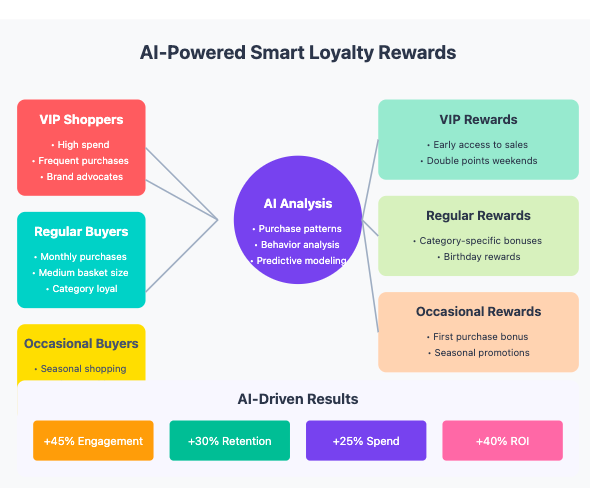
So these metrics, I feel, will help you elevate your loyalty program if that’s something your business really relies on to drive repeat and loyalty.
Once again, I think I had mentioned 20 use cases — there are 20 use cases.
I would love to hear questions, thoughts.
I'm glad so many of you stuck around till the end. If you have any questions, happy to answer them.
But yep — you've got 20 solid ways in which you can leverage AI.
Don’t forget: I would also love to get feedback from you on things you want us to talk about. Any other areas you want us to double down on. We are doing this in a very disciplined way for the last many months, and a lot of repeat people are joining us to listen to this every month. So it gives us confidence that it’s adding value.
I would love to understand:
- What do you want us to expand on?
- Do you want to learn more about models?
- Do you want to learn more about how some of the AI tooling in e-commerce is going to work?
I’m happy to expand on any of that in our consecutive sessions.
If you have any questions, I'm happy to answer them for now. Otherwise, we can close and I can give you a few minutes back.
Okay — I think some of the questions I have answered. There’s one question I’m going to take offline because it’s very specific to the business. There are actually two like that. So I'm going to take them later on.
But yep — thanks so much for joining us.
Thank you for the time you’ve taken to go through this.
I hope this was of value.
Please embrace AI — it's a gift. And it's only when you do that you'll realize how efficient it's going to make your business.
Thanks so much.
Have a fantastic rest of your week.
Happy selling.
Get Fresh ideas to boost your conversion rate
(stuff that works for hundreds of stores)
Request a Free Site Audit"Convertcart’s Audit Report was deep and insightful. We never thought they would spend so much time in building and sharing such insightful content, free of cost."


Logan Christopher
Lost Empire Herbs