On-Demand
Converting Ad Traffic — Proven Strategies For eComm Stores
While ads are great at bringing in traffic, there is a major downside involved.
People (who are seeing your site for the first time) tend to be more hesitant.
They are skeptical about your brand, product, or even pricing.
They also (probably) have short attention spans.
And close to 98% of them bounce off right away.
And this is why we are doing this session.
We want to share ways to help you get better ROI from ads.
We’ll discuss how to:
👉 Get your ads to bring in the right people
👉 Make your site/landing page more trustworthy, more compelling
👉 Prevent drop-offs and get shoppers to actually engage


About the speaker

Shekhar Kapoor
VP, Marketing
Convertcart
Shekhar Kapoor (VP at Convertcart) has worked with 500+ online brands, including Squatty Potty, Prep Expert, and USA Hockey Assn., and helped them boost sales exponentially.
Shekhar Kapoor
VP, Marketing
Convertcart
SESSION REPLAY – CONVERTING AD / PAID TRAFFIC
Hey folks, welcome. Thanks a lot for joining us.
But yeah, thanks, thanks for joining us everyone.
Now, today's topic is something that has popped up in questions in earlier webinars. People have asked us about solving for conversion rate for specific channels, and there is no channel more, you know, important, or should I say critical, than paid.
For context, we audit e-commerce websites and solve for conversion rates for a living.
The other thing we also do is email marketing, and so our exposure to data is very high, and that means our exposure to insights on how to solve for such a problem is also very high.
So what I'm going to do today is, you know, we've basically broken the webinar into two parts:
- How to solve for it even before somebody has landed on your website
- Some very simple conversion data optimization ideas that you can just go and implement straight away
I'm going to, as I said, break this into two parts.
Okay, so let's jump in.
Two Aspects of Converting Ad Traffic
I think there are two aspects of converting ad traffic. The first one is more important than the second one.
Okay, so spoiler alert, I'm not going to give you only conversion rate advice.
I'm also going to give you some ad advice because we've been… you know, Convertcart also spends a lot of money on ads.
I have been fortunate enough to see hundreds of ad platforms, of ad panels, and hundreds of ways in which people can do them right or wrong.
So my approach, and the way that I've seen these things working, has been really getting into customer psychology and then going deeper into what works and what doesn't work.
HOW TO GET PEOPLE TO ENGAGE WITH THE AD
>>> SOCIAL ADS
So let's jump into that. Let's look at social ads. We've compiled stuff that works, so we're not going to dive into what doesn't work, but I'm obviously going to add context and go from there.
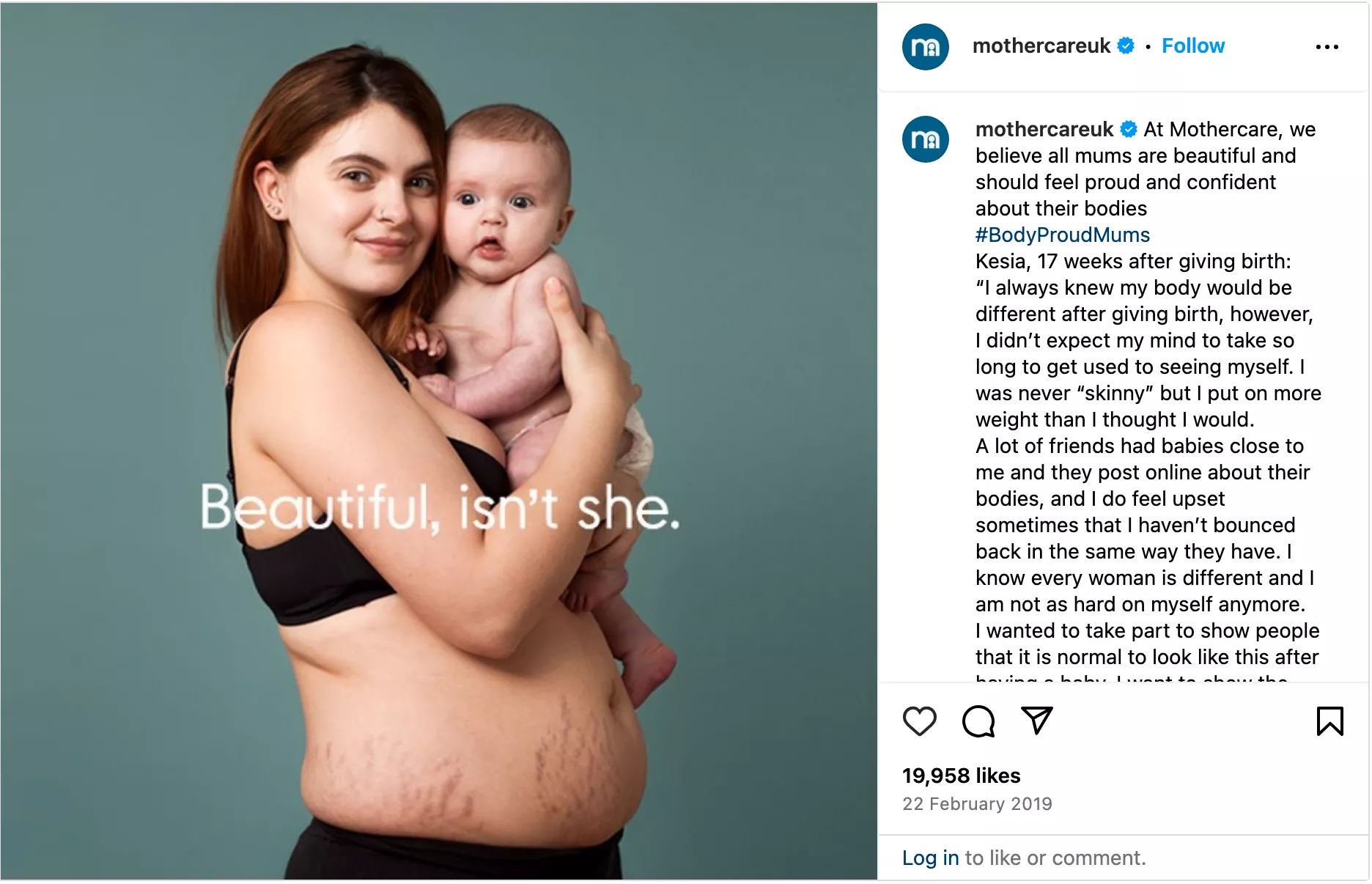
1. Tell your story
The first advice that I have for you is to tell your story.
There's so much out there that it's extremely hard to separate reality from noise, and one of the things that I've seen working extremely well for brands is when they, instead of promoting the product or the offer, spend time on promoting the story.
And I'll just tell you this as I walk you through all of the other ideas as well: if you or your agency are essentially planning your ad strategy in an extremely short-duration way, a short-term way, which is:
“Hey, let's run the best possible creative to get the most possible clicks and the lowest possible cost per transaction or cost per result,” then you're doing it wrong.
Because the way to actually achieve that is not to do it through one ad.
It's to do it through several ads over a period of time and then crack your brand's advertising journey.
Now, I don't mean to make you promote a post that is just talking about a meta-level story…
But trust me, if you're going to just do one of those monologue videos that talks about your product, or maybe like a…
You know, we know what a real customer review is and what a not-so-real customer review is… if you want to do one of those, in the short term, it will get you traction.
Over a quarter, you will see a lot of traffic.
But the fatigue for that kind of ad is very, very high.
So what that does for you is it changes a metric called frequency for you very fast, which means you're able to gain reach, but only to a certain extent. And frequency goes up, which means you've reached, say, 100K people.
Those 100K people have seen your ads three or four times, and then your engagement from ads starts to drop down.
That's what happens when your agency is great when you sign up with them, and then three months later, they are not at the level you want them to be at.
It's because they've not put a longer-term brand strategy.
So, what telling your story in ads does is that it starts the customer off small, and it gives you a lot bigger reach in a way where people who are curious and who take the two seconds to actually go through it will end up engaging with you in the long run.
That's something to think about. I'll expand on this point as I keep going.
2. Break stereotypes
The other thing is breaking some stereotypes.
At the end of the day, you might be selling a product that is extremely unique, or you might be selling a product that is extremely boring in the way that there are other people selling that product or there are similar products available out there.
But what is it that makes you unique?
What is it that stands out for you?
That's something you have to make sure shines through.
This point and the one before it connect extremely well.
For example, if you are in the business of a certain kind of fabric, or you're doing clothing,
What is the origin story of the fabric that you use?
What is the origin story of your manufacturing, even if it is happening on the other side of the world?
It's okay. It's okay to tell the story of why you started what you started and where you're coming from before you just blatantly advertise how amazing the product is and how it's running a 20% off.
The number one ad format that is currently being used is the very standard social proof ad, where your brand is running the ad, but it's someone else talking about it —
“Hey, you know what, I used this product, it changed my life,” or
“Here is a gift that I got my mom and it brought her to tears, I love how it worked out for me.”
That's the exact kind of stuff that doesn't stand out, because if you've been scrolling through your own TikTok, and if you've been scrolling through your own Instagram, that's happening everywhere.
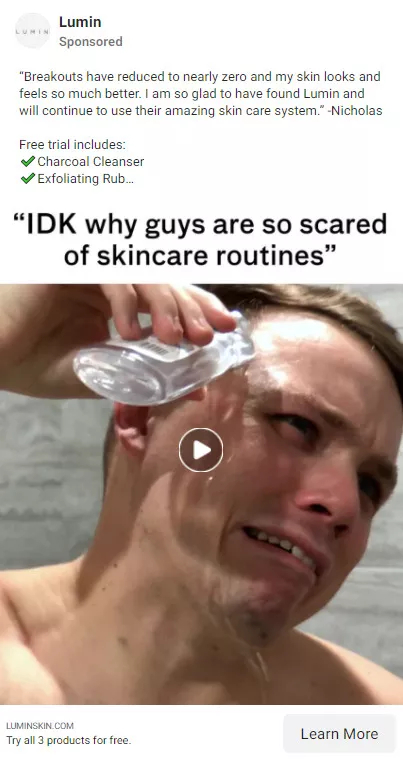
So what you have to do is, as a founder — let's say you meet somebody at a party and they say, “Hey, what do you do?” and that's your elevator pitch, as they say.
What are the two or three things or two or three adjectives that you associate with your product?
There's a lot. There's a reason you pick the ones that you do.
And then what can you do to emit that into the advertising that you're doing for your brand?
That's what will essentially help you come up with the right story and then tie that into a message that is separate from what people are just likely to hear from you or from any other brand.
3. Show them how to use your product
The other thing is the how-tos. How-tos are fantastic. In this case, I picked this example specifically because it's done in the form of a carousel.
Carousels are generally used for not-so-creative uses. I've seen them being used for testimonials, I've seen them being used for other reasons.
But here's a very interesting case of a really high-quality video about four or five steps in which the product — the beard oil — has to be used, and it's really brilliant.
What this does is, this is also a mid-funnel ad.
So now, I spoke about putting a long-term ad strategy together.
The reason I say that is because your conversion rate from ads — 80% of it depends on the intent with which you're bringing the customer to the website.
If somebody has seen you for the first time, and they are seeing this really flashy reel-type ad, which has somebody talking about your product, and they're seeing it for the first time, you do make them curious, but you don't make it last.
So they're going to give you probably a 20- or 30-second… in this case, the customer would already have engaged with content for your product.
So only the ones who have intent will actually land on the website, and that will automatically solve for conversions, because people who are seriously looking to solve a problem like this are the ones who are looking at your product.
The other thing — which I think a lot of businesses do, don't get me wrong — but I don't think it's thought out by the founder as well as it's thought out by the agency sometimes. You just leave it up to whoever is managing your ads to run it.
But here's what generally businesses do wrong: they don’t create a funnel out of their ads.
For example, in this brand’s case, their first ad will talk about what Beardbrand is — why you need to take care of your beard.
People who have clicked on that or have engaged with it, they will be the ones who will be shown this second ad.
So you don’t need to show all of your ads to all of your visitors.
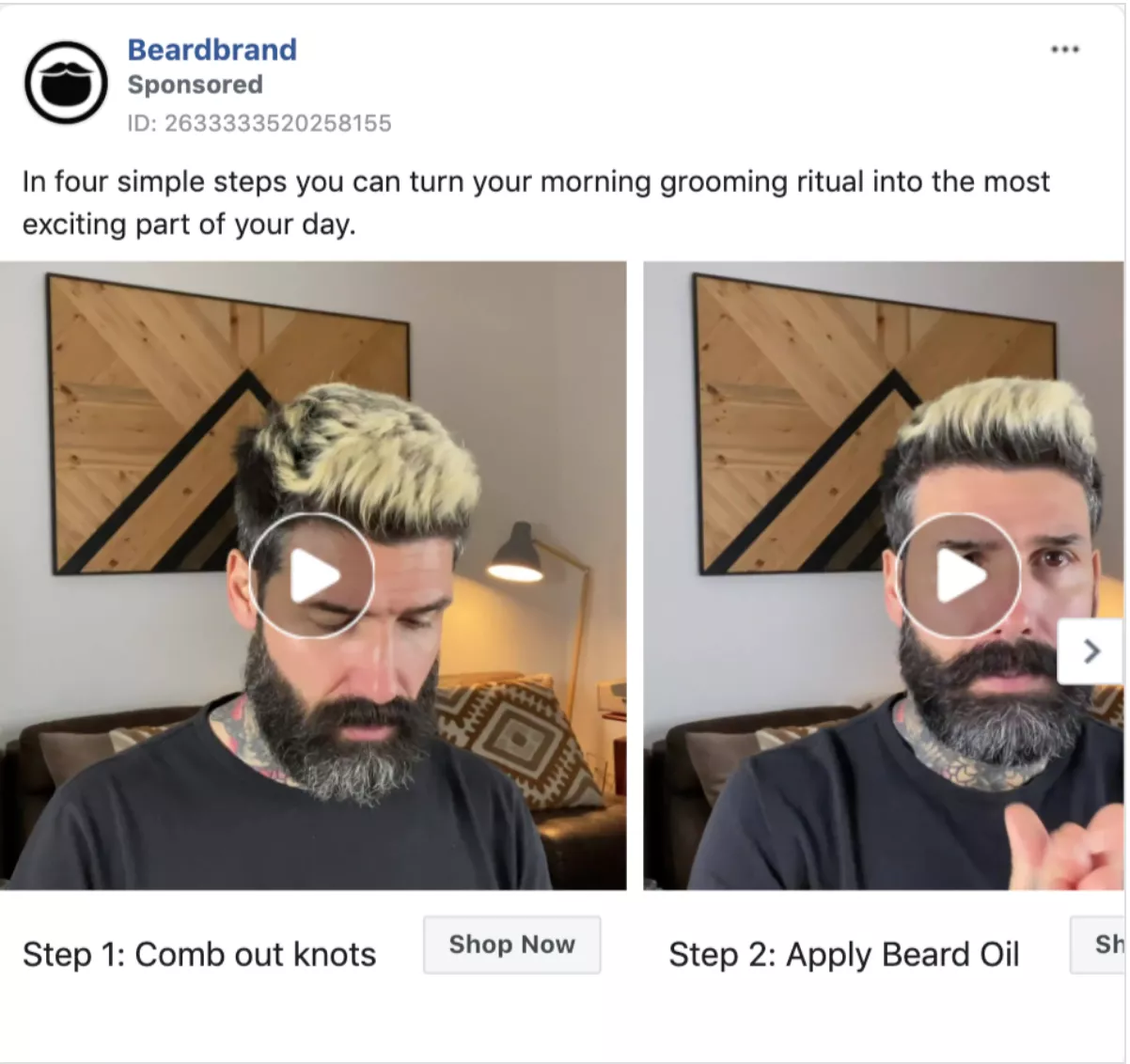
You want to make sure that you reach people who are already aware about you with an ad like this, which is essentially going to the next level. So you are nurturing people who have not even visited you or have not seen your prior ads.
4. Build an intent-layered ad funnel
This is interesting. There are audiences you would have built in your panel, and you are showing them one ad after another.
Why not plan it in a way where:
- your first ad is extremely high reach
- your second ad validates what the first one was saying
- your third ad is a call to action
So in this case, for example, I'll repeat this example:
- The first ad educates the customer about Beardbrand existing — really shocking visuals, possibly even your story, how you’re breaking a stereotype, why you’re different.
- The second ad is this how-to. “Here is how this works. Here is this t-shirt. The fit is amazing, it feels great on the skin. I really recommend it, and I think for $30 it makes a lot of sense for me.”
- And the third ad is a 30% off “Limited time only,” some festival around the corner, something on those lines… instead of doing the third one first and then hoping that people will click on it.
Think about it. You can create a funnel with your ads itself. What that does for you is it gets your people at different parts of the funnel:
- The first one: people are just checking you out
- The third one: you can be sure they've already seen the first two, and the intent with which they're clicking on the third one is really high
Open to answering questions about it later on.
5. Humor sells
Then there's, of course, humor.
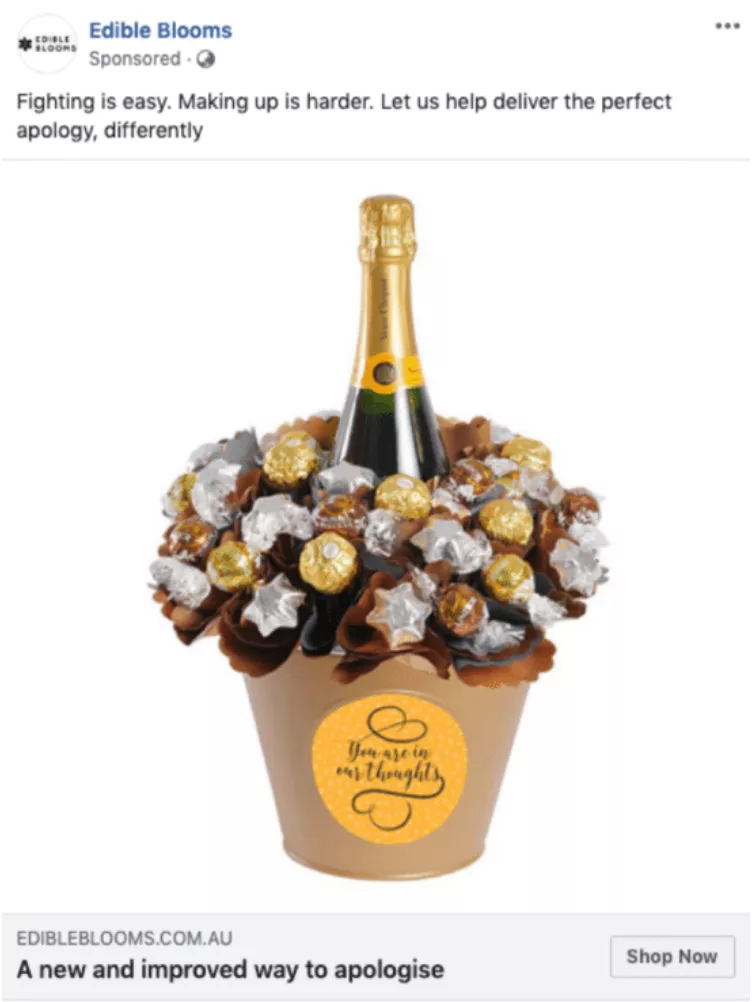
Fighting is easy, but making up is harder.
You have to understand that the reason this ad is on this slide is because of its simplicity. Sometimes we make it too hard.
I've seen ad copies having hundreds of emojis, five or ten bullet points of why they should choose the product or service. I've seen ads with overly complex creatives.
This is something a kindergarten kid can do. The copy — definitely no — but the image editing is literally nothing.
It's zero effort here.
And it's the “new and improved way to apologize.”
There's a very high chance you'll click on it to at least see,
“Hey, what is this even?”
or
“How much does it really cost?”
6. Incite curiosity
So price curiosity is what would normally get people to click on ads. I’ll talk about curiosities later on, but that’s one of the things.
People, when they click on the ad — you've got to leave something out of the advertisement for them to click.
If you give everything away in the ad itself, then why would they even click?
So always conceal something. Always leave something out of what is already part of the ad.
In this case, it's a very simple product, so if anybody has even a very low amount of intent, they would still click on it to at least find out how much it costs and how much it takes to ship.
7. Invite them to participate
Invite them to participate. So this is actually an interesting idea.
I would recommend you either ask your agency to help you execute something on these lines, or maybe even try doing it yourself.
But we did it at Convertcart, and it worked wonders.
So here's what we did in this case. For example, there are 100 lucky winners, and how you can kind of jump into the contest is: like and comment on the post, and maybe even share it.
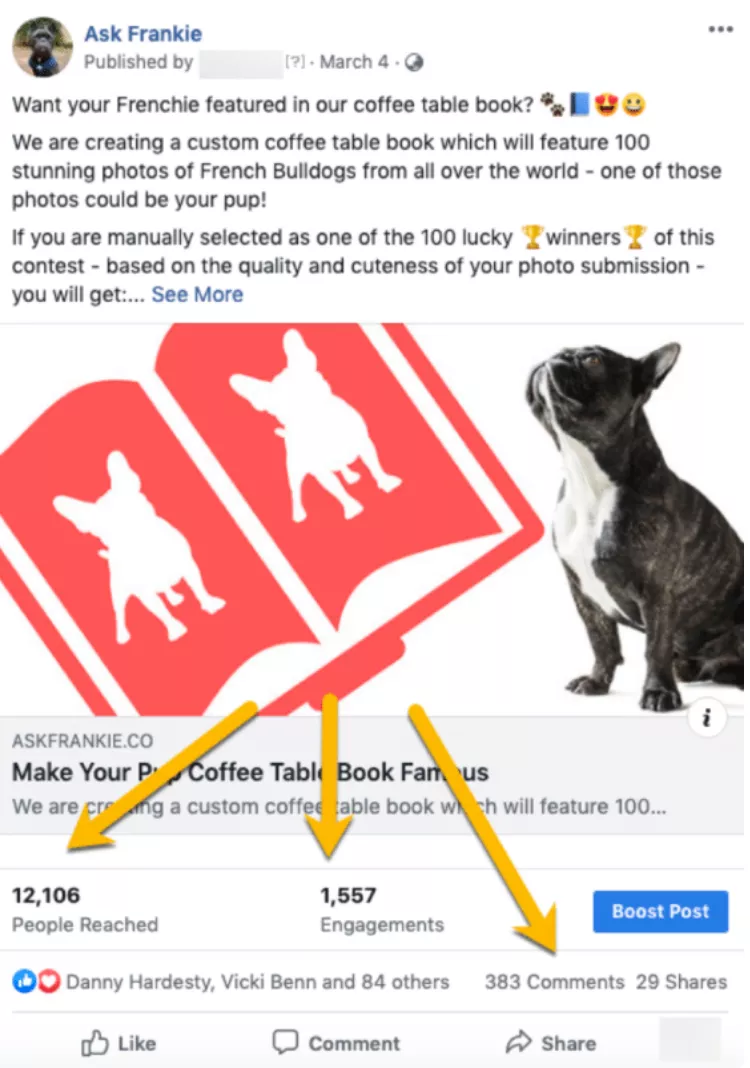
What they're doing with this is no clicks. The intention is not to go and transact on the site.
So here's what you've got to do.
Ask your agency — or if you manage ads yourself (actually, that should be another poll I should have asked for; I'll maybe make it once I’m looking at questions, I’m curious how many of you manage your own ads versus outsource it or let somebody else do it on the team)
— But generally speaking, for something like this, I would set up an engagement ad.
Where the goal is not conversions or clicks.
The goal is post engagements.
What that would do is Facebook, Instagram, whatever platform you’re advertising on, will push the ad so that more and more people like it, comment on it, and then share it.
So you have an extremely high-traction post or ad that’s available to you.
Now that ad — then after, say, 15 or 20 days — switch it out to a conversion ad.
What that allows you to do is copy all of the engagements that are already there on that ad to this new ad that you're now launching, which is a conversion ad.
So now essentially what it does for you is: you have these 400 likes and 300 comments because you've done this giveaway, but you're running a conversion ad for it.
The giveaway is over.
You've already selected your winners.
All of that is done.
But now you have a conversion ad which is extremely high engagement.
You have a conversion ad that has tons of comments and likes, and that creates a ripple effect because everybody who’s engaged with it — their networks have to see the ad.
So there's a solid… it's an interesting hack to make your ad look like it's for something really famous — which I hope we already are — but I'm just saying that's a way to make sure you're inviting people to participate and also gaining from it.
But anyway, coming back a step on the participation idea: irrespective of what you do with the engagement, engagement is always great.
I don't know why we always obsess over just either running ads for clicks or running ads for conversions.
Facebook has, I think, about 13 or 11 goals you can choose from when you're running the ad.
Nobody wants page likes and follows and all of that, but there's no harm in trying something new so that you can at least see if that gets you traction in any other way.
8. Evangelize your product’s use case
Then there's evangelizing the product’s use case.
I think I already spoke about how Beardbrand has created a funnel. This is an extension of my earlier point.
In this case, there's the fact that you can knock off hairs very easily when you are shaving through or trimming.
There's the fact that you can moisturize it, and so on and so forth.
So…different problems that you can solve with the product over a period of time.
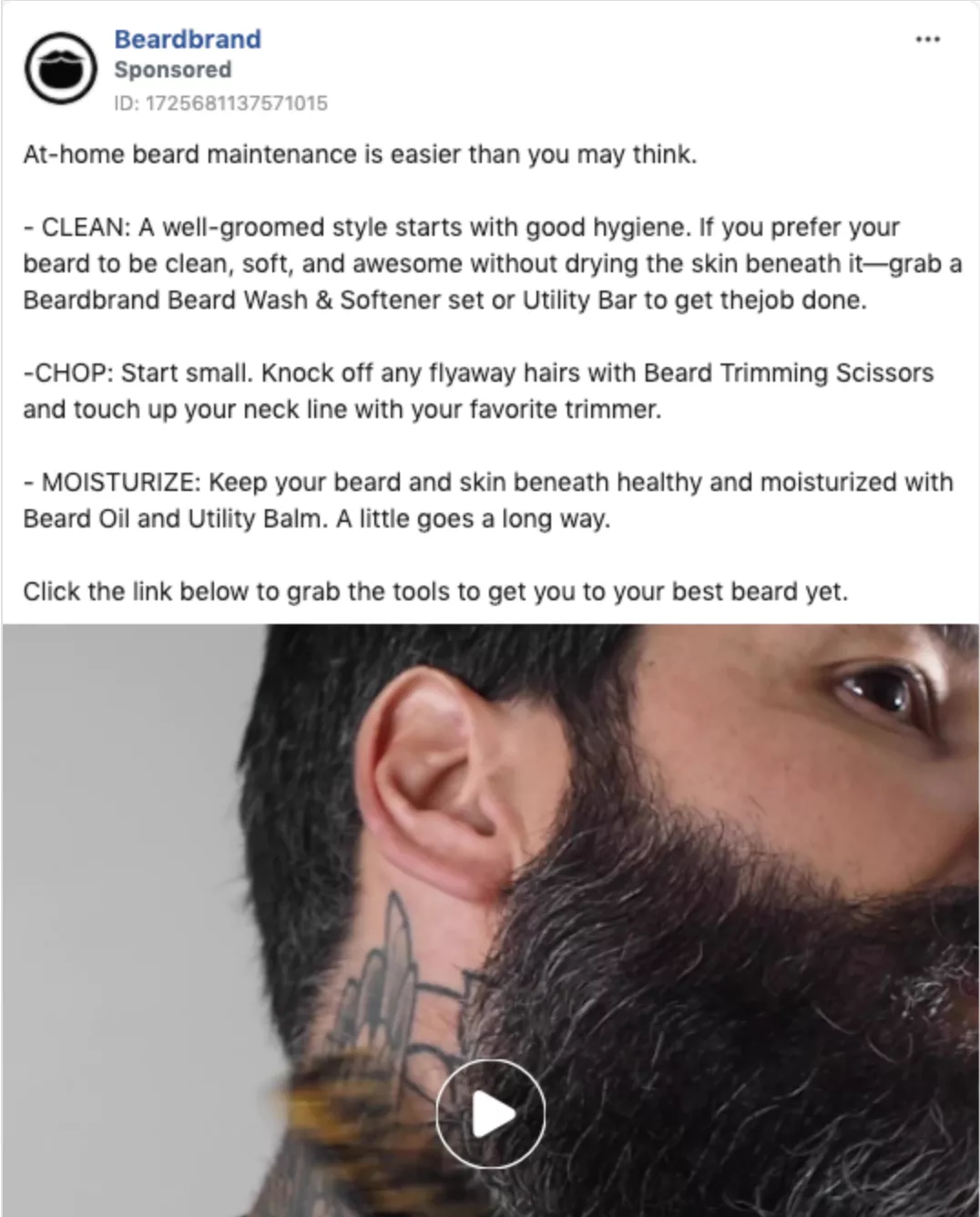
The pitch becomes clearer because everybody has the attention span of a goldfish. They’re going to give you probably five seconds. Now they have seen four consecutive ads from you:
- In one, you were talking about use cases.
- In another, a how-to.
- In another, you spoke about how somebody’s beard is feeling amazing, it’s much easier for them to manage it.
- And then the last one talks about how you’re running maybe a limited-time sale for first-time buyers.
So that’s how you’ve got to do that and achieve that outcome.
9. Project your product as a solution
Project your product as a solution.
In this case, I really like this ad for two reasons.
And as a matter of fact, I don’t know if you know — our audience today, I’m sure there are some people, because I know there are people from the UK and I know there are people from a few other countries — but I don’t know if you all are into cricket.
But in India, we have this cricket league called the Indian Premier League, and there’s a huge FMCG brand here that has been advertising.
It’s extremely expensive to advertise on IPL ads. But what they are doing is really smart.
They have these quirky ads, and they are showing four different products from completely different categories — like there’s a bag of chips, a candy, a couple of other things — in that same ad.
So they have like a 15-second slot.
Think of it like a Super Bowl.
And instead of focusing on just one product, they’re focusing on four.
And I think that just really is smart, in my opinion.
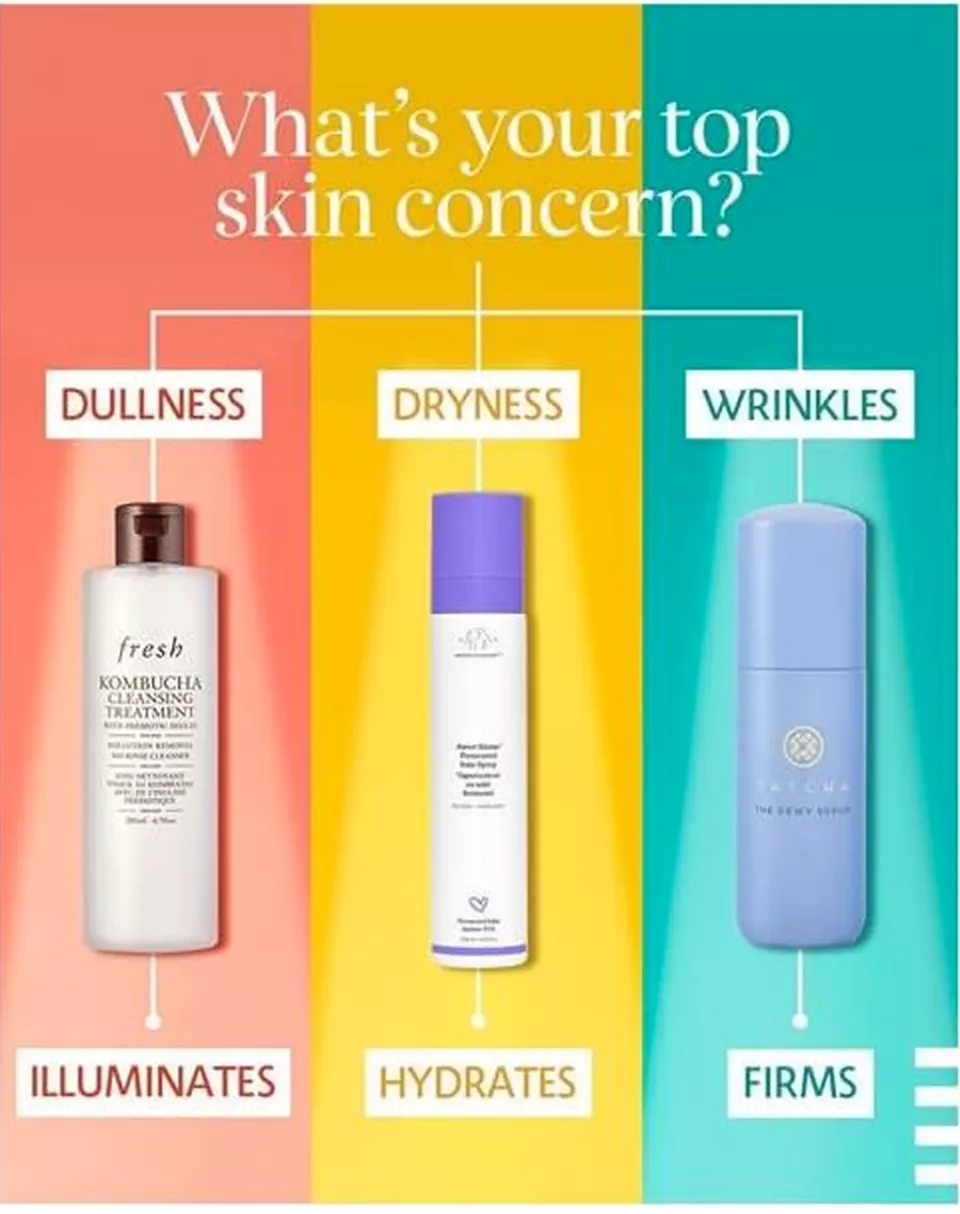
So in this case, you could see the same thing happening: dullness, dryness, or wrinkles. There are three problems you solve. We’ve got an answer for each of those, and these are three different answers. If you see, it’s not one product — they’re advertising three. So it’s really smart.
If you are, for example — and I just want to emphasize that this is not an ad that only this company can do — this is where I would need you to be creative.
For example, if you are in fashion, and you have T-shirts — just a wild example — I’m sure you have T-shirts that are different fits, right? So there’s the regular fit, there’s the slim fit, and there’s an oversized fit.
Those are three different use cases.
I, for example, am a regular sort of a person.
So you could show all three fits in a single ad.
And that way, you’re not using one ad for just one product and then…it’s unproductive, in my opinion.
And also, showing more options shows variety, and then again curiosity comes in — so they’re likely to click.
10. Show more real-life scenarios
Real-life scenario. So now we’ll go into the stuff that already works.
Real-life scenarios and real pictures.
I was listening to this influencer yesterday on a different webinar, and there was a very simple point they made: each time they’ve hired a professional photographer and taken them to an event with them, or done a really detailed photo shoot and then posted that on Instagram
— Versus if they’ve posted a picture of them just sitting in their PJs on the sofa in their own house — the second one has done significantly better.
Better in reach, in getting them new followers, in getting them more traction on their posts.
Made-up stuff is not relatable. It isn’t. It isn’t relatable for you; it doesn’t relate for anyone else. So it’s important that we accept that.
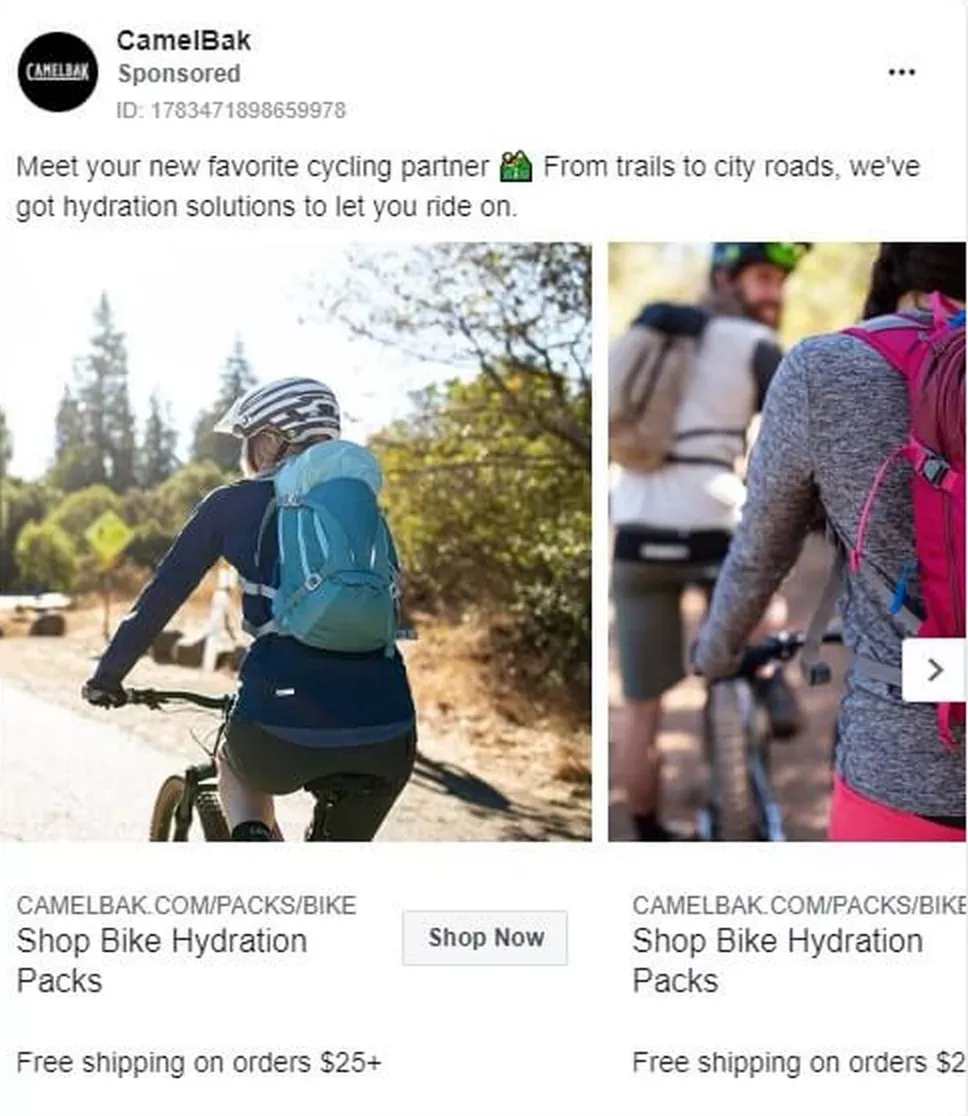
Even for a brand like CamelBak, you could see that the pictures, although they are professionally taken, they still look real enough for you to be able to imagine that product in real life.
11. User generated videos = gold
So I think extremely high-quality AI-edited images are okay — you can use them. But real people using real products goes a long way.
This is one way to use it, where your brand advertises it. And the other way of doing it is user-generated content. It is pure gold.
If your customers can generate content for you — and I mean real customers, I don’t mean somebody on Fiverr reviewing your product for you and then you running that as the ad — I don’t mean that at all.
Find your VIP customers, people who have bought from you several times. Give them a reward for doing this for you. Ask them to either record a video testimonial or maybe just record or take pictures of them using the product.
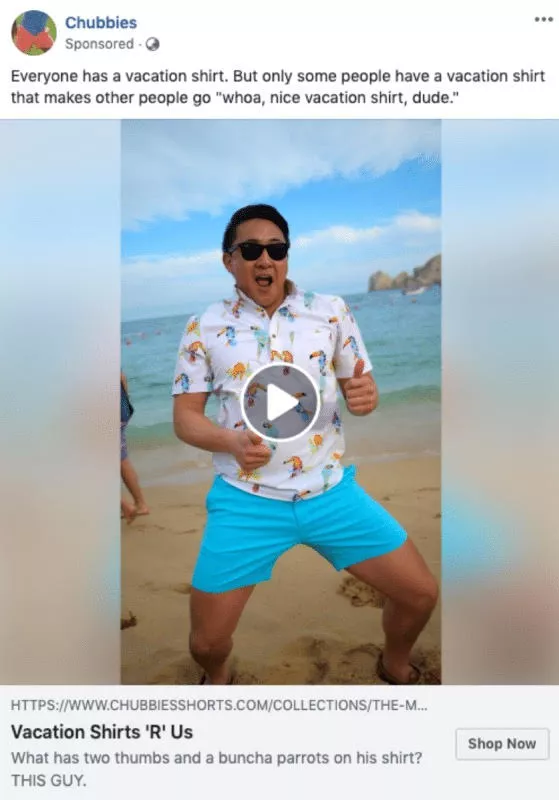
How Brands Use UGC Brilliantly
I know so many pet care brands, I know so many fashion brands that do this in a brilliant way. They say:
“Hey, thank you for buying this dog bed.
Post a picture of your puppy in the bed on Instagram, tag us, share it with friends — whatever — and we’ll refund 10% of the purchase value to you.”
So you’re rewarding them for it.
And they have hundreds of pictures of dogs using the product. And then they put an amazing gallery on their ads as well as their website of people using that dog bed.
And the psychological effect of seeing something like that is insane, because you’re seeing hundreds of dogs using a product. And you’re looking at it — it’s 100 bucks — and I don’t know if you have… I have a dog. I don’t know, I would die for my dog, right? That’s what we all think about our pets.
So, really speaking, you want to do it immediately.
So generally speaking, user-generated content is gold.
There’s no two ways about that. There are many ways to achieve it, but please motivate your customers to do it. Have a focused effort on it.
Even one good video can blow up and can really change the way your ads are working at the moment.
And then of course — dogs are amazing. It’s a good segue to that.
Puppies always work.
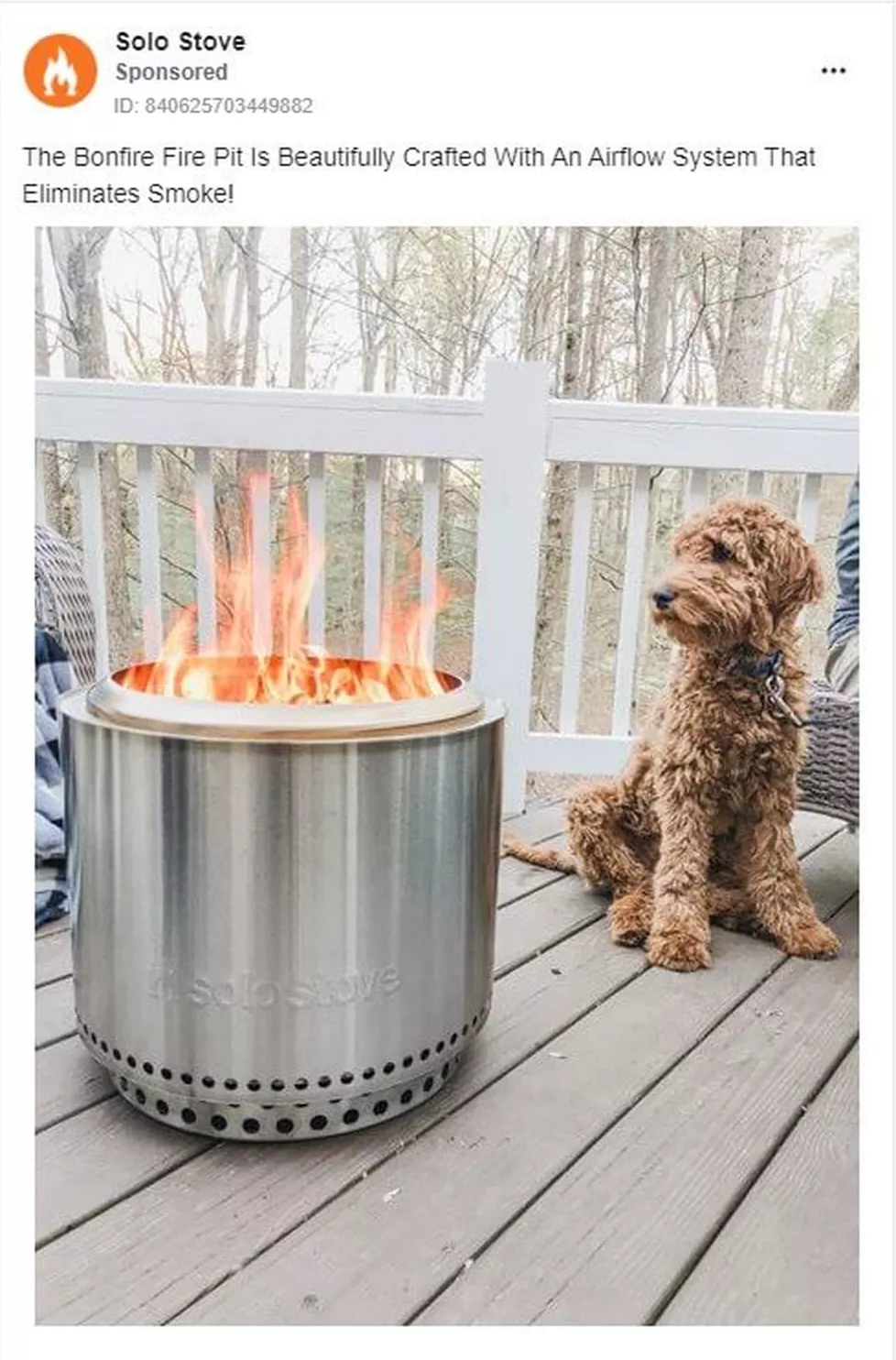
So this is interesting. It’s a bonfire pit ad, but they still put a dog in it. So dogs work. They’re brilliant.
I know a couple of people on our sales team who have a permanent picture of their dog in their email signature just so that they can get all the pet people to reply to their emails.
So yeah — it’s okay to use your dog for ads.
>>> GOOGLE ADS & TEXT-BASED ADS
Alright, so now let’s get into text ads. I think this is where messaging, copy — it really matters.
Very simple ideas here, just six or seven of them. I’m going to go through this real quick, and then we’re going to get into conversion rate, because we’re running short of time as well.
Also, please feel free to put in your questions now. In past webinars, we’ve seen that once we’ve ended, we only have a limited amount of time left and then people take a while to frame their questions.
And then we don’t want to spill over, just so that everybody can hear the answers, and I’m able to add as much value as possible.
Let’s get into Google ads.
There’s some very simple stuff. The reason — the number one reason — I thought we should still add stuff like this in is I’m just surprised with how many businesses I’ve seen spending upwards of a few $10,000, a few tens of thousands, and are still running… what is that… Performance Max automated optimization in Google ads.
I just don’t understand why.
If… will you allow ChatGPT to pitch your product to a VC?
You will not.
So why would you rely on a mass-market AI product to pitch your product or talk about your product?
I just don’t see the sense in it.
12. Turn off the AI and take control
So, really speaking, take control of your ads and messaging on Google. I really think that’s what’s missing in the cases where it’s not working for people.
Turn off the AI.
You need to take full control of the bold statements you want to be making as a company.
In this case, there’s so much that’s working for them:
- “Since 2002.”
- “First entirely plant-based pet food.”
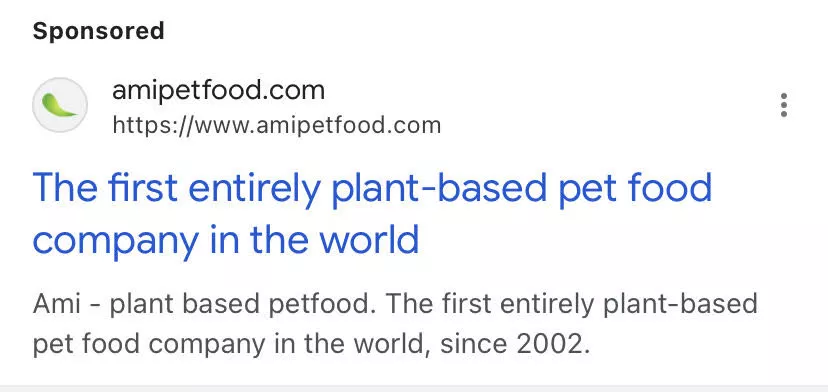
This first statement just kills it for them. If somebody is in that mind frame and is looking for plant-based pet food, this is exactly what they want to look at.
13. Flaunt those awards
If you have awards, you’ve got to show them off. So many people say “award-winning” — the reason I brought this in is: mention which award.
It’s very easy to say you have an award these days. You can pretty much get one, give one to yourself in your living room.
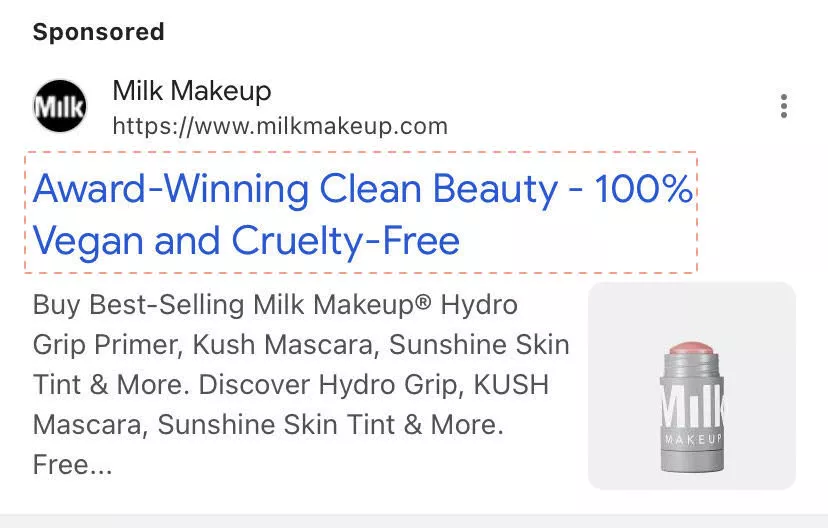
14. Resolve customer objections directly in the ad
And then the other thing is: resolve customer objections.
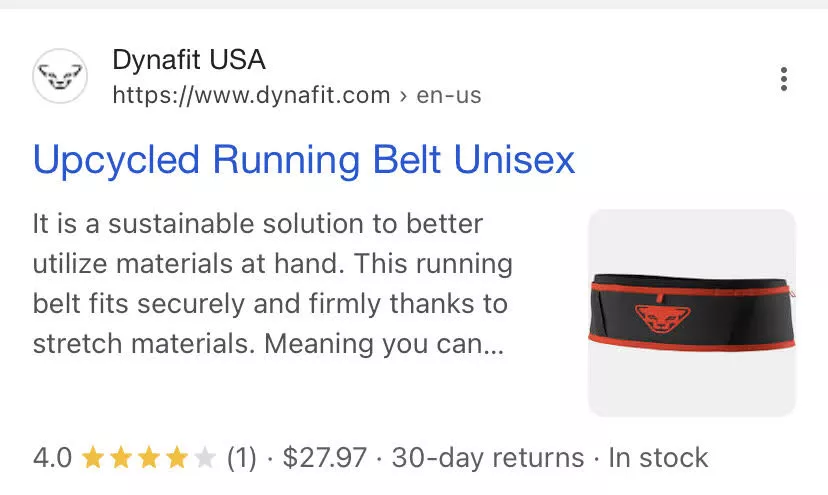
What this does extremely well is the “30-day returns” in the ad itself.
So I’m looking for a running belt, and I saw this ad with four stars and a 30-day return. Fantastic. I’m just going to go. Twenty-seven bucks, doesn’t really matter — let’s just order. If it doesn’t work out, I’ll return it.
15. Communicate benefits clearly
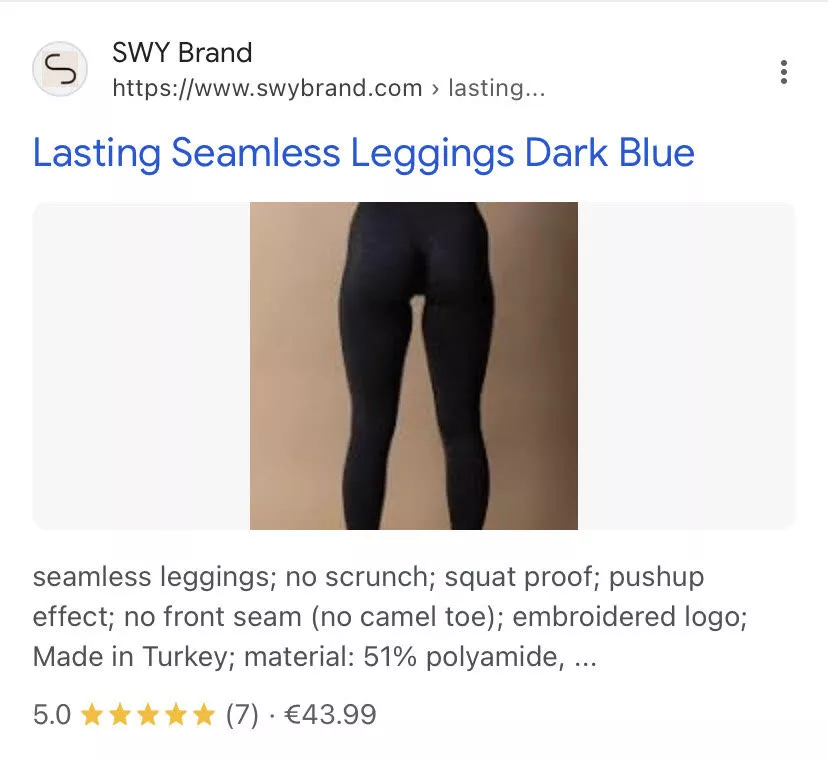
Which is why it’s important to be communicating benefits.
If you look at this, what’s happening is:
“Lasting seamless leggings. Dark blue.”
So leggings — what I was looking for.
Color — answered.
Quality — answered.
Everything is already taken care of:
- No scrunch
- Squat proof
- Push-up effect
- No front seam
- Embroidered logo
- Made in Turkey
- 51% polyamide
So it’s essentially an overload of information, and that takes care of everything.
16. Promote a quiz (if it makes sense)
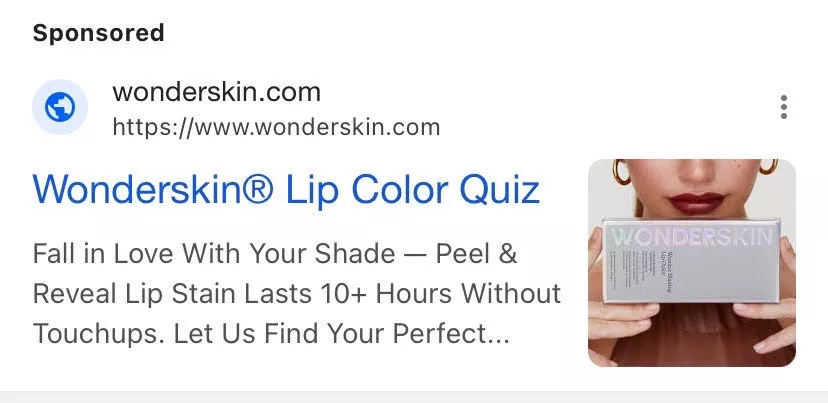
Moving further, you can always promote a quiz. Quizzes work amazingly. We’ve done so many of these for our customers. We’ve A/B tested quizzes, we’ve improved on them.
But you’ve got to really be sure if that works for you. In this case, “lip color quiz” — I have a 50–50% reaction on that. When I’m looking for lip color, I’m not really looking to dive into somebody else kind of figuring it out for me.
But quizzes — especially around health-related stuff, around stuff that I’m not really sure of (“here are my symptoms, what will work for me?”) — that sort of thing works super well.
17. The last resort: Nudge them with a *coupon code*
And then the last resort always is a coupon with a limited-time offer of some sort. It could be Mother’s Day or something on those lines. But generally speaking, I think offers and coupons are… lastly speaking, I would keep that as the absolute last option.
👉“What plugin or product…?”
I think building a quiz out, Gavin, is really straightforward. There are plugins, but I felt they’re very limited in the way you can customize them. So I think a one-hour effort from a good developer can help you plug something in pretty fast, without much trouble.
So let’s get into part two. That’s the advice on ads. Please keep putting in your questions — I already have another one in Q&A, I’ll just answer that.
But yeah, that’s something that you’ve got to take a look at.
👉“How to pick which platform and how to allocate budget between platforms? We will have data to analyze once we’ve started, but what about when we’re just kicking it off for a new product or a new brand?”
Great question.
There’s a very simple logic:
- TikTok and Facebook are interruption-based.
- Search of any kind is intent-based.
So if you think people are already looking for what you have, you advertise on search — which means there is already demand there and you have to find a way to capture it.
If you think people are not looking for what you have, you have to interrupt them while they’re watching cat and dog videos on Instagram, and then interrupt them and tell them you have this amazing beard wax.
Nobody — except for the people who actively use beard wax — is looking to solve for beard grooming.
Beards have always been there. Right?
So it’s interesting that brands like that would obviously have to rely on interruption-based advertising.
For example, in this case — the “breaking stereotypes” one — I don’t know: why are guys so scared about skincare routines?
Men’s moisturizer is not a very high-volume search term. It isn’t.
And whereas if you were to search for, for example, La Mer — which is the most expensive moisturizing cream you can find, I don’t know if you know about it — but if you want to buy a $1,000 cream, be my guest.
The search volume is something that would be high because it’s inherently always been a feminine product.
So yeah, that’s something to kind of… an extension of that question is: “I’ve hired marketing companies only to lose my money. And… so how do I get around this?”
I would want to dive into the data, Robert, and go as deep as possible into understanding what they are spending on and why they’re spending on it.
Convertcart does very thorough audits.
We do it free of cost.
We’re happy to take a look at your data if needed.
But I would really want to understand what the strategy is, and it would really depend on your brand.
What I spoke about today is just to inspire you to tell your story to your customers, be extremely clear about what you want to say and why you want to say it, and then build your ad strategy from there.
But yeah — thanks for the question, Robert. I know there are a lot of people like that.
As a matter of fact, I’ll just give you another… see, this is me getting carried away.
We have more than 500 customers. We survey them all the time.
The average e-commerce business that does more than a million dollars or more changes their marketing or ad agency… this is an average, so there are outliers on both sides… changes their marketing agency about seven, seven and a half months.
Okay? So that’s the stickiness with that business.
And the reason for that is not that they’re not competent.
It’s hard for somebody to come in and passionately solve for advertising for your business.
So just my advice to you is: it’s your business — you solve for your ad strategy. The execution can be the agency.
You will have to tell them the message that works.
You will have to tell them why your customers want to buy what they want to buy.
You will have to tell them why it will work or not work.
And then they can figure out the way to visualize it, execute it, find the audiences.
But:
- What is your ICP (ideal customer profile)?
- What are their fears, demands, and problems?
- How do you solve them?
We call these detractors and motivators — reasons they don’t buy versus reasons they do buy.
And that is the sort of document that will help your ad agency take it from there.
If you are having them crack it for you, it will be hard because they’ve not built the product. They don’t understand. They’re not going to go speak to your customers — that’s something you’ve done for a living.
HOW TO GET PEOPLE TO BUY - ONCE THEY VISIT YOUR STORE
So how to get people to buy once they visit your store.
So this is the second half of our journey. This is where we try and figure it out.
No worries. Also, when you are putting up questions, please select Everyone so that everyone can see your question, and that way everybody gets to understand what I’m answering — although I’m trying to repeat as many questions as possible.
Coming back to how to make people buy once they visit.
18. Get them started, a compelling offer helps
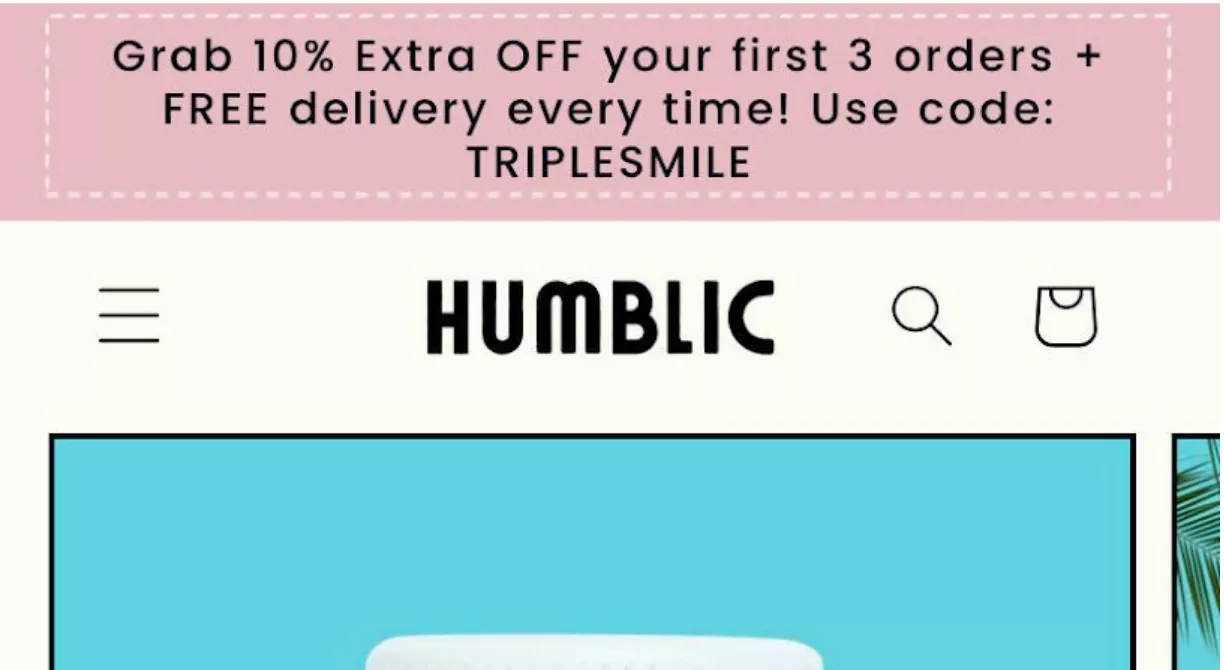
This says “first three orders.” I wouldn’t bet on it. I would say first order — there’s an offer the first time somebody buys.
If you are a repeat purchase sort of product… as a matter of fact, I was doing this understanding today. I’ll try and remember and recall as much of it. And I was talking to a consultant, very insightful individual.
He said, interestingly, we said there are four ways in which people buy.
Purchases can either be:
- Impulse — you saw something, you loved it, you bought it.
- Planned — could be a tour, could be an expensive bag you’ve been trying to get after.
- Emergency — there’s no debating that.
- Need — regular stuff, groceries sort of stuff. Things you need on a regular basis.
Which category do you fall in?
Are you:
- an impulse purchase?
- a planned purchase?
- an emergency purchase?
- a need?
And that tells you what intent you can connect to the purchase for your customers.
And your advertising and your messaging will also change. Because if you’re a planned purchase, and you’re expecting people to click on the ad and then convert in a 7-day window, it’s not going to happen.
You will have to nurture, nurture, nurture, nurture, nurture, nurture — and then hope to God that it works out.
So I’ll give you a strategy on how you make sure you attribute those people to ads.
But generally speaking, first order — if you are a need, which means they’ll come back and buy from you… or if you’re an impulse, which also has the potential that they’ll come back and buy from you — make the first transaction easy.
Acquire the customer.
Work on the lifetime value of that customer later.
Acquire them first.
That’s how startups think.
I don’t want you to burn money, but I’m just trying to kind of put you on a fast track in terms of acquiring these customers.
19. Use a bold-looking landing page - show the product in all its glory
Show your product in all its glory, front and center.
Now if you think of the ad I showed you earlier — in this case, this is a very clear product. There’s some Ferrero Rocher chocolates happening, and then there’s a champagne bottle in the middle.
Imagine if this was a much more complex hamper, right?
Which had like 15, 20 different things.
So that would create curiosity for me:
“Hey, what all is actually in this?”
Or
“Why is this $200 worth?”
I would go in, and I would want to immediately understand what all is there in that hamper.
So make that easy.
In this case, not only do they show you the product, they also break it down. They’re going to show you:
- what kind of arch support is there,
- the different insoles that are in the shoe,
- and so on,
- and, why it is $200 worth.
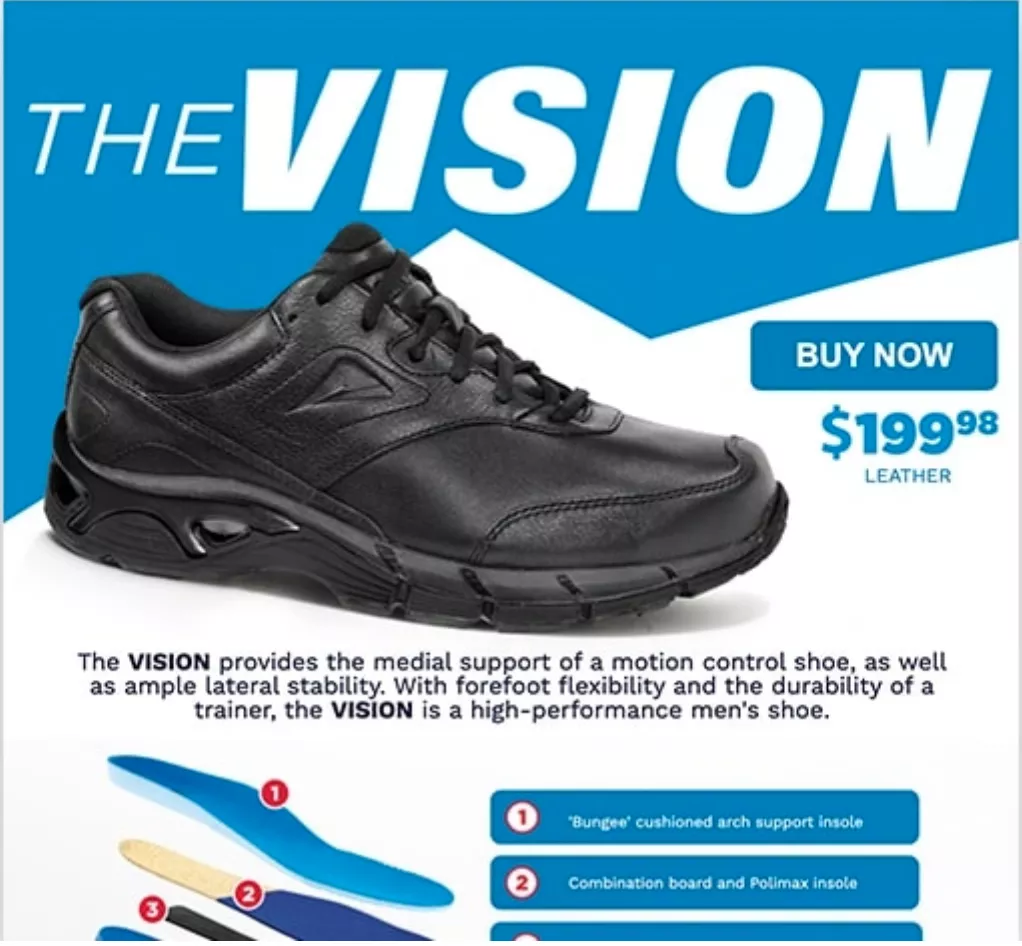
So you are satisfying that curiosity immediately, while making a solid pitch as well.
For example, back in the day when Convertcart started, we used to have — in fact, I would request you to go back and take a look at our website on archive.org — there was a point when Convertcart said:
“We are the e-commerce revenue optimization company.”
And we used to get calls from people asking if we had CFOs on hire or part-time accountants, because nobody knows what “revenue optimization” is.
And then we realized:
“Hey… really, we don’t need to call it fancy things.
We solve for conversion rates.
That’s what we solve for.”
And then we figured:
“Hey… now that we solve for conversion rates as well as email marketing, what we do is we make growing an online business easy.”
And that’s because we also have amazing experts that help do everything, so you’re not fiddling with the software on your own, and so on.
So over time, the way we communicated about our product became easier to understand, and also easier to absorb — for people who understand what we do.
Of course, if I tell that to somebody who’s… like I have a cousin who’s in manufacturing — if I tell him “conversion rate optimization for e-commerce,” that just goes above his head.
20. The next step: Drive micro-conversions
The next step is the most important step in your business’s journey.
And I know a lot of people have told this to you…
Collecting emails is the single most important thing you can do.
Single most important thing you can do if you want to build a business that grows without continuing to pour money into ads.
We call this owned media.
Ads are paid media — you pay Google, Facebook, whoever else to bring traffic to your site.
But your email list is your own asset.
You have to be extremely serious about building it.
This is a horrible-looking pop-up, by the way.
First of all, the incentive of 5% is not big enough.
Second, it asks for email and name both, which makes it even harder to fill.
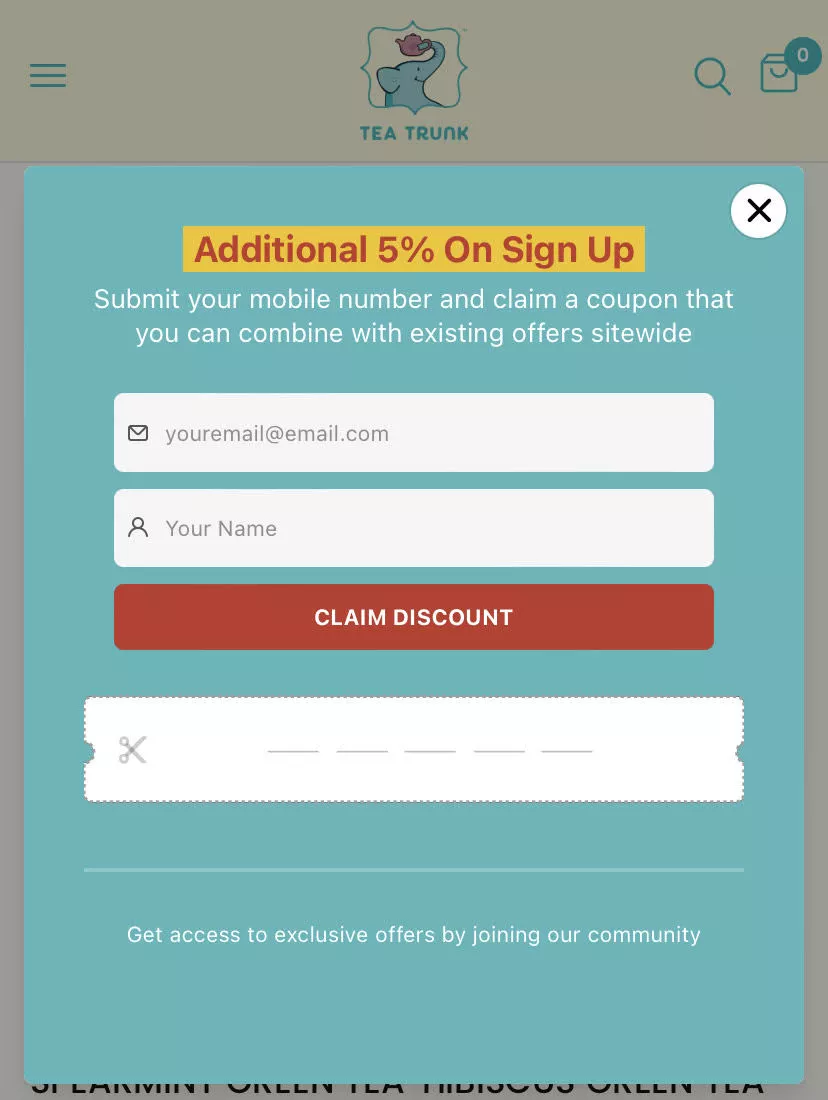
I would want to gamify it.
Figure out a way to make the incentive more exciting.
As a matter of fact, not tell them that it’s 5%.
I would ask them to discover what that incentive is — in the form of a mystery box or maybe a scratch card virtually online — and then enter their email ID, and then get the discount in their email so that they enter the right email ID.
You see what I’m saying.
So the intention is… I’m just going to put this in a way that is simple:
If you have 50,000 visits in a month, and 30,000 of them are new visits, and you collect 5% of their emails:
That’s 1,500 emails a month.
You are essentially sitting on 18,000 emails by the end of the year.
Even at a measly 1% click-through on those emails, you have 180 visits each time you send an email to that list.
You could do that twice a week, with extremely high intent, and you don’t need to pay anyone for it. Right? Emailing is cheap.
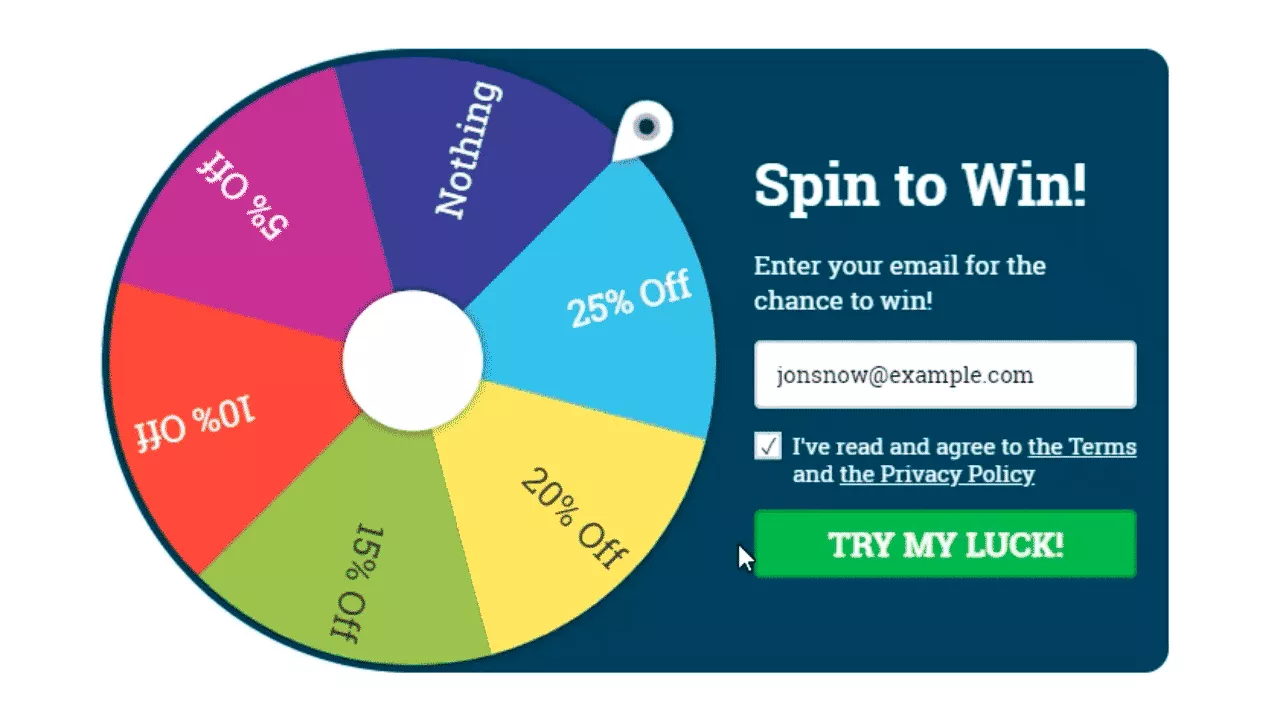
21. Gamified pop-ups work (even if you hate them)
Make it fun — spin the wheels, etc.
They look gimmicky, but they work.
There’s no doubt that they bring the results you’re looking for in terms of collecting emails.
They look gimmicky — there are other ways of doing it — but I keep emphasizing that just because you hate it, it doesn’t mean your customers hate it.
I also hate pop-ups — but not if they’re done well, because I have appreciation for it.
22. “Load of Offers” strategy (everything on sale at once)
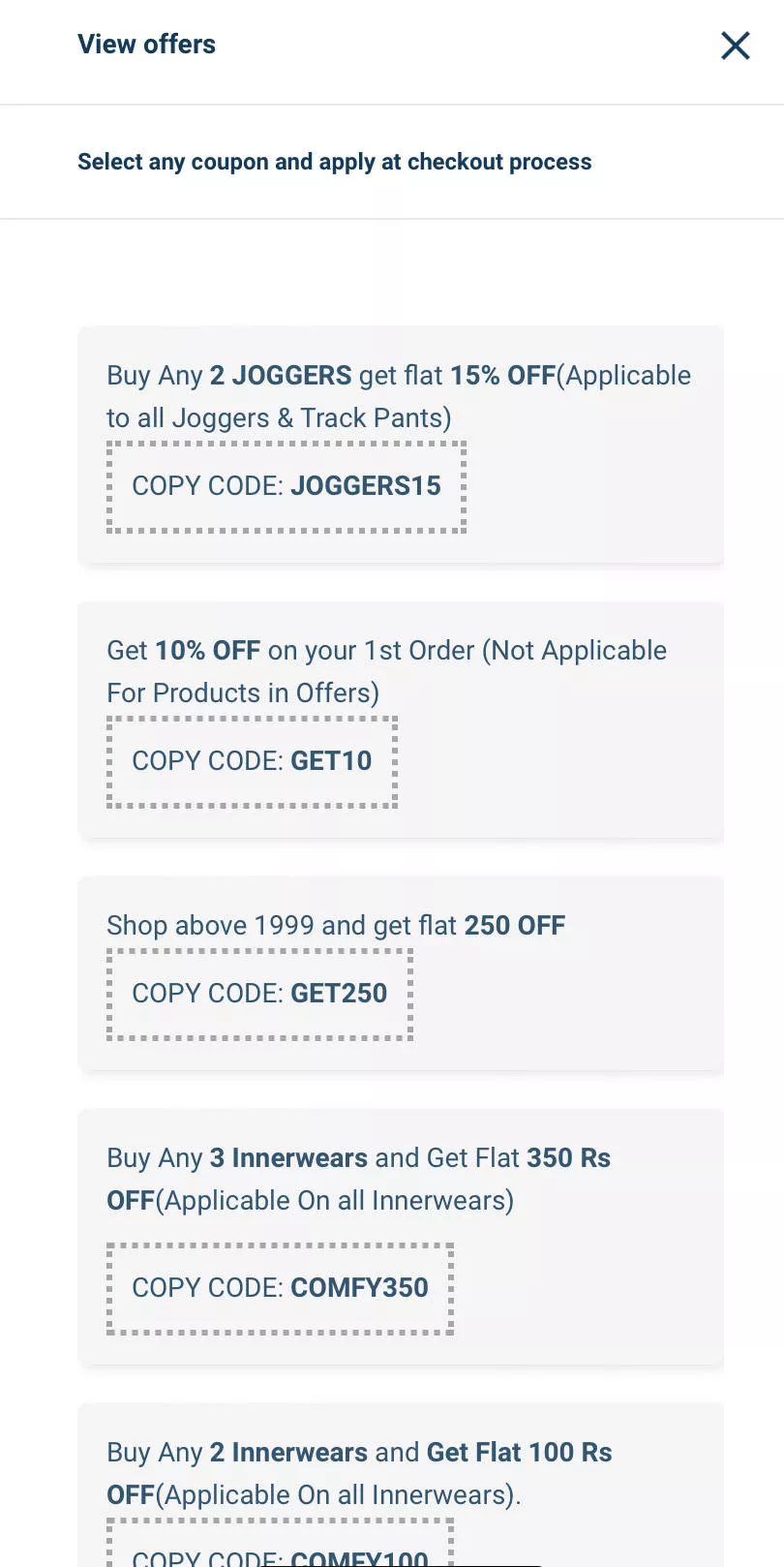
“Load of offers.” This is a new strategy that has been out there for a while now.
Essentially what I’m trying to put out there is:
Businesses, instead of doing one offer, are doing ten together.
So:
- category-level offers
- offers on specific products
- seasonal offers
- everything clustered into one
What that does is it creates a feeling of one of those stores which is on sale, and then they have buckets.
You wouldn’t believe it — but I think once in a while all of us are dumpster diving, you know what I’m saying.
All of us are looking for that deal.
So there’s no harm in it.
I was in Melbourne for 20 days last month, and there's a mall there called DFO — Direct Factory Outlet. They have all of the best brands, luxury brands included, but they’re factory outlets.
I could just see the frenzy.
I walked out empty-handed — not much of a shopper myself — but I could see the frenzy.
And this is exactly what doing that online means within your own store.
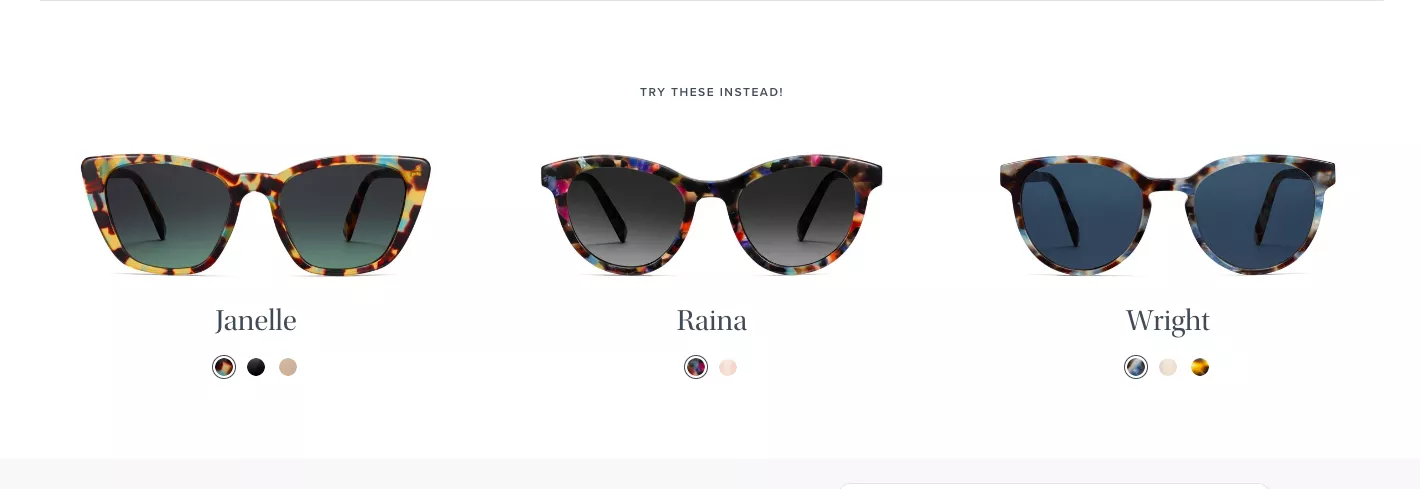
23. Reduce choice paralysis (show fewer products per scroll)
This is extremely important.
I don’t know why businesses think putting 50 products on the homepage, and then 30 products in product recommendations, and then 10 products under every product page is going to help.
It’s not going to help.
You need just two recommendations — two good recommendations.
Any good salesperson knows that you don’t want to confuse them, you want to convince them.
You know that saying where it says “If you can’t convince them, confuse them”?
That is BS.
Don’t trust it. That’s not how it works.
You have to convince them.
So show fewer recommendations.
There is no reason for you to show more.
24. Pop that chat (Don’t wait for them to ask a question)
Chat is extremely important.
I’ll just move fast with this point.
I don’t know why businesses don’t take it more seriously.
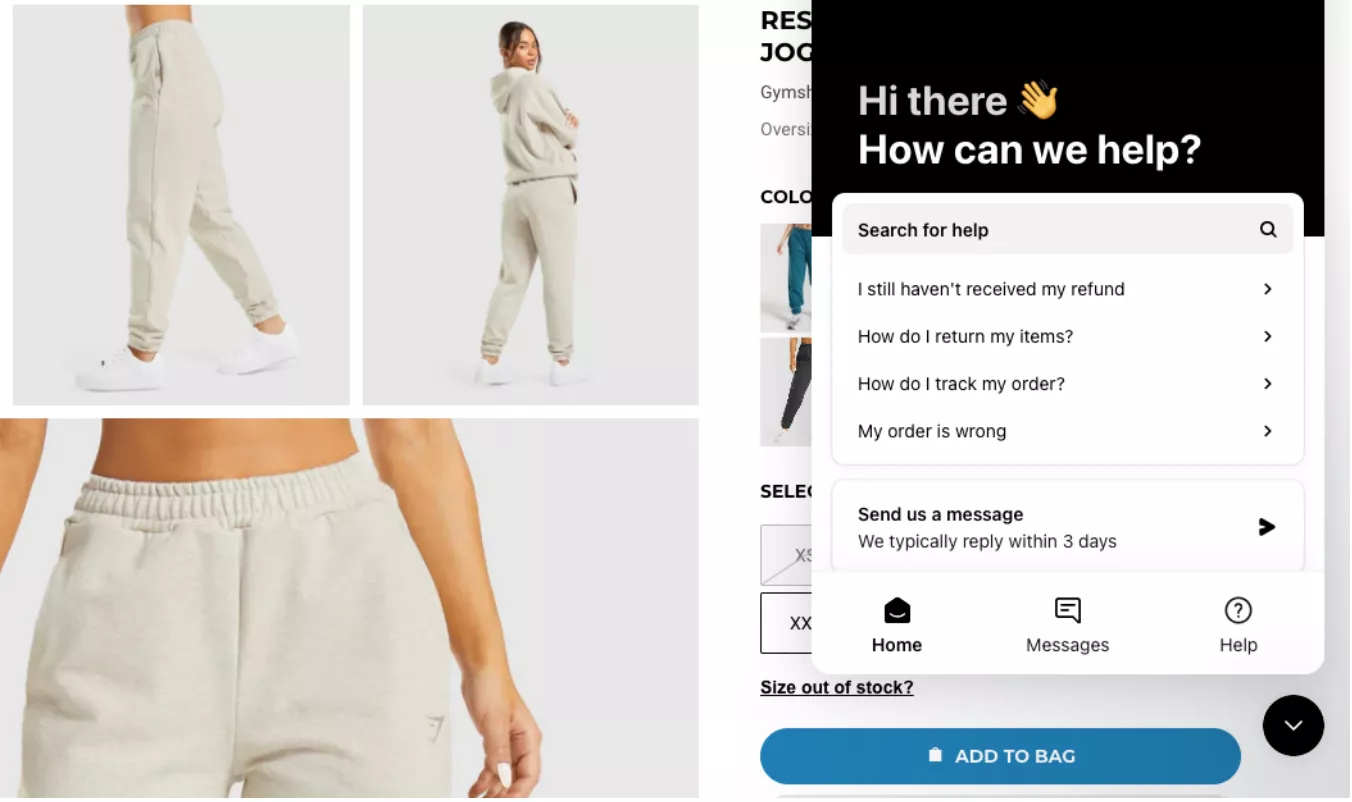
It’s a very simple tool.
Even if you can get it live only for a few hours, it’s fine.
I know a few companies that can run your chat for you, so please reply to the webinar email, and I’ll connect you to them.
25. Nudge them (FOMO marketing)
So this is, I think, something really simple again.
Social — there’s so much happening here.
Look at this product for a second:
- In stock
- 32 sold
- 31 viewing right now
- 1 left in stock
Then you have delivery and FAQs linked right there.
You will also get it in a day or two — I think depending on if we saw it yesterday or the day before — but you get it in two or three days if you order it in the next 12 hours.
So there’s a timer running there.
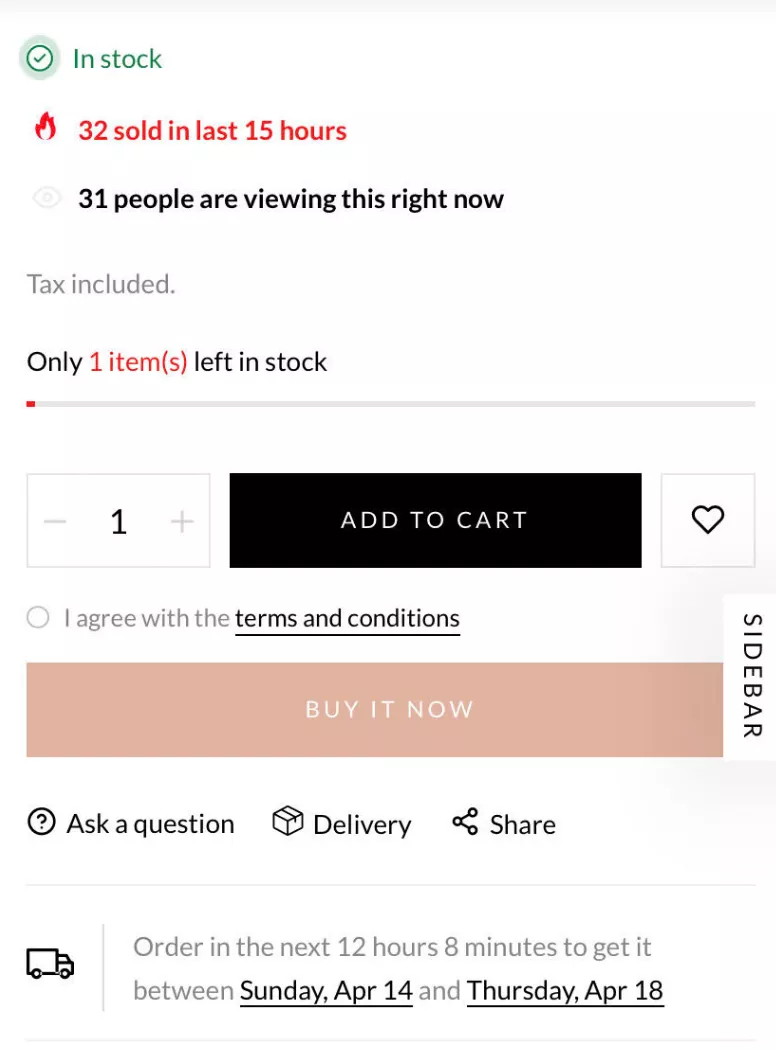
There’s so much happening here, and this helps.
Trust me, it does.
But what I want you to be careful about is AB testing all of this.
In our case, we experiment for our customers — we thoroughly AB test stuff like this because sometimes it can hurt you.
It can take trust away instead of giving you trust.
I remember recently there was a travel booking site in Southeast Asia that was hit with a massive fine because they were faking all of that —
“Only two rooms left,”
“Only one flight ticket remaining” — because they were just trying to rush people into booking.
26. Reduce perceived risk.
This is another very important one.
Look at this — I don’t want to sound shady in this idea to be honest, but in this case what you’re doing is:
100% risk-free money-back guarantee.
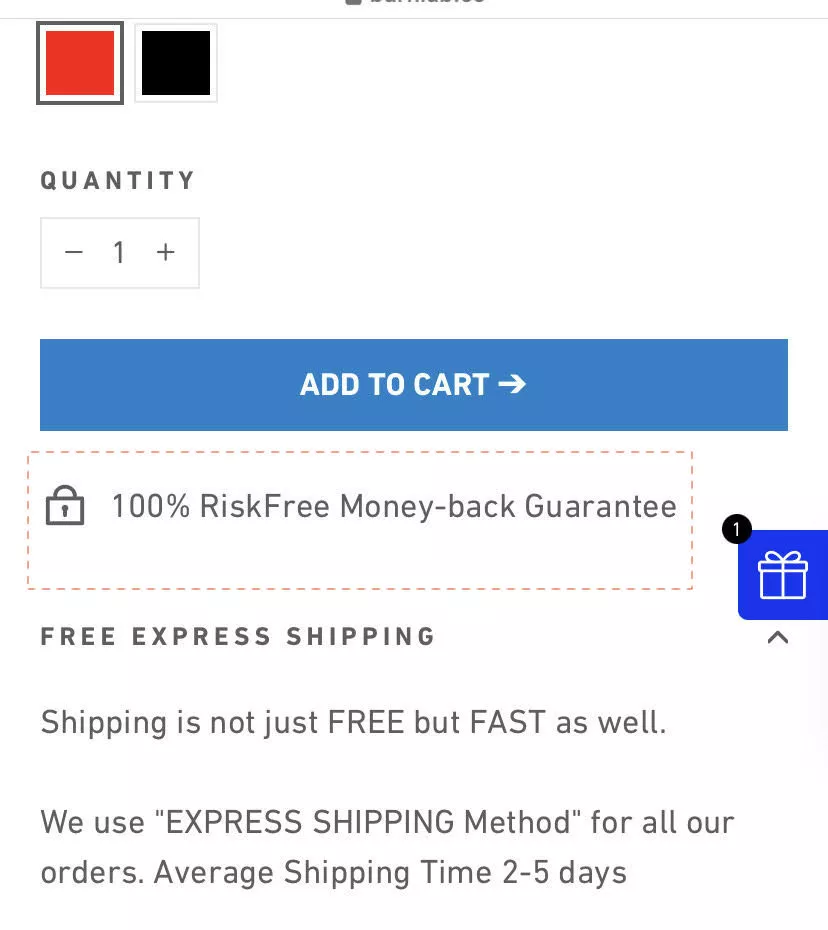
And then you can detail the guarantee out — that the guarantee stands for:
- quality of fabric
- it will not tear apart the moment you get it, etc.
So you are just standing behind the quality of your product — which I’m guessing you are happy with.
Point being: offering that upfront, straight away, is extremely important.
I recently bought this footwear from a business called Ares — I would want you to check it out if you don’t already.
I think they were on Shark Tank as well.
And I have something called plantar fasciitis, which is a condition where you need arch support, otherwise your back hurts — which is kind of weird.
But the interesting thing with them is: I bought it and they said:
“Hey, 60 days. If you don’t like it, you can give it back.”
And if you don’t like the color even, you can give it back and they’ll replace it for you.
Or they’ll change the size.
Or you can just take your cash back from them.
Which is fantastic.
So I just bought it immediately. It is 60 bucks, but it’s the best 60 bucks I spent because:
a) it solved my problem — it was a huge problem for me
b) it was a stress-free purchase
So I realized later that it’s 60 bucks, but it worked out. So that’s okay.
It’s better than Crocs — so let’s just put it at that.
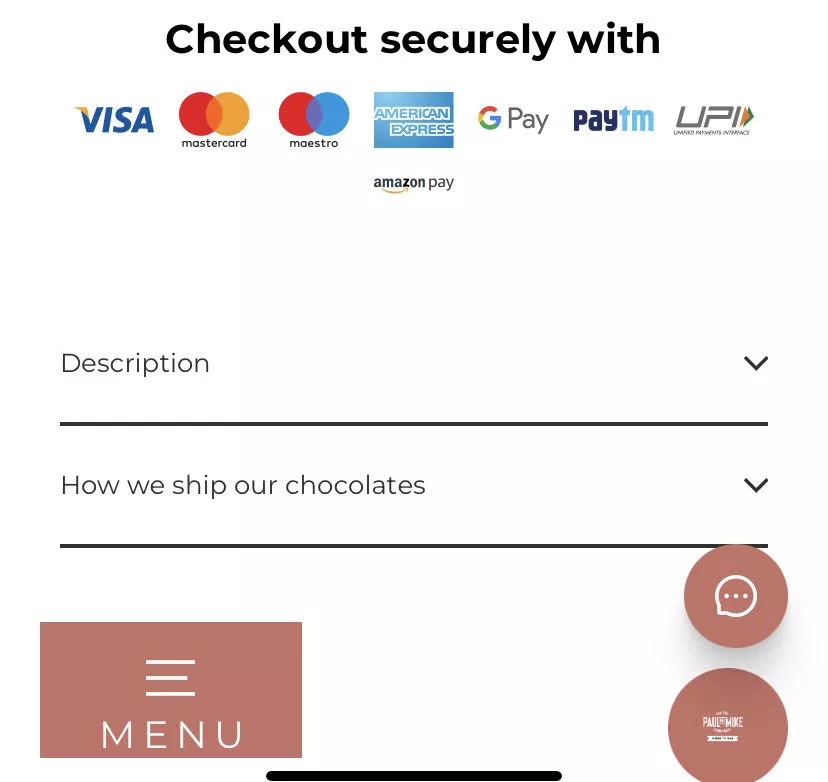
27. Display payment security early (Don’t wait until checkout)
Display payment security early.
I don’t know why we wait till checkout.
You can just borrow logos from so many of these businesses that are available — simple trust badges all across the board. These are things your eyes might not see, but ,b>your mind sees them. So be very, very, very clear about them.
28. Use exit-intent pop-ups (why aren’t we doing this?)
And then if they still choose to exit —
I don’t know why I don’t see an exit intent pop-up on every website in the world, by the way.
Please put your questions up there. We’ll make sure we address them in the next 10 minutes. I’m almost done here, but I just don’t know why we don’t do exit pop-ups a lot more.
In this case, it’s really simple, right?
“Not ready yet?
Let’s keep in touch.
Receive special offers by signing up to our newsletter.”
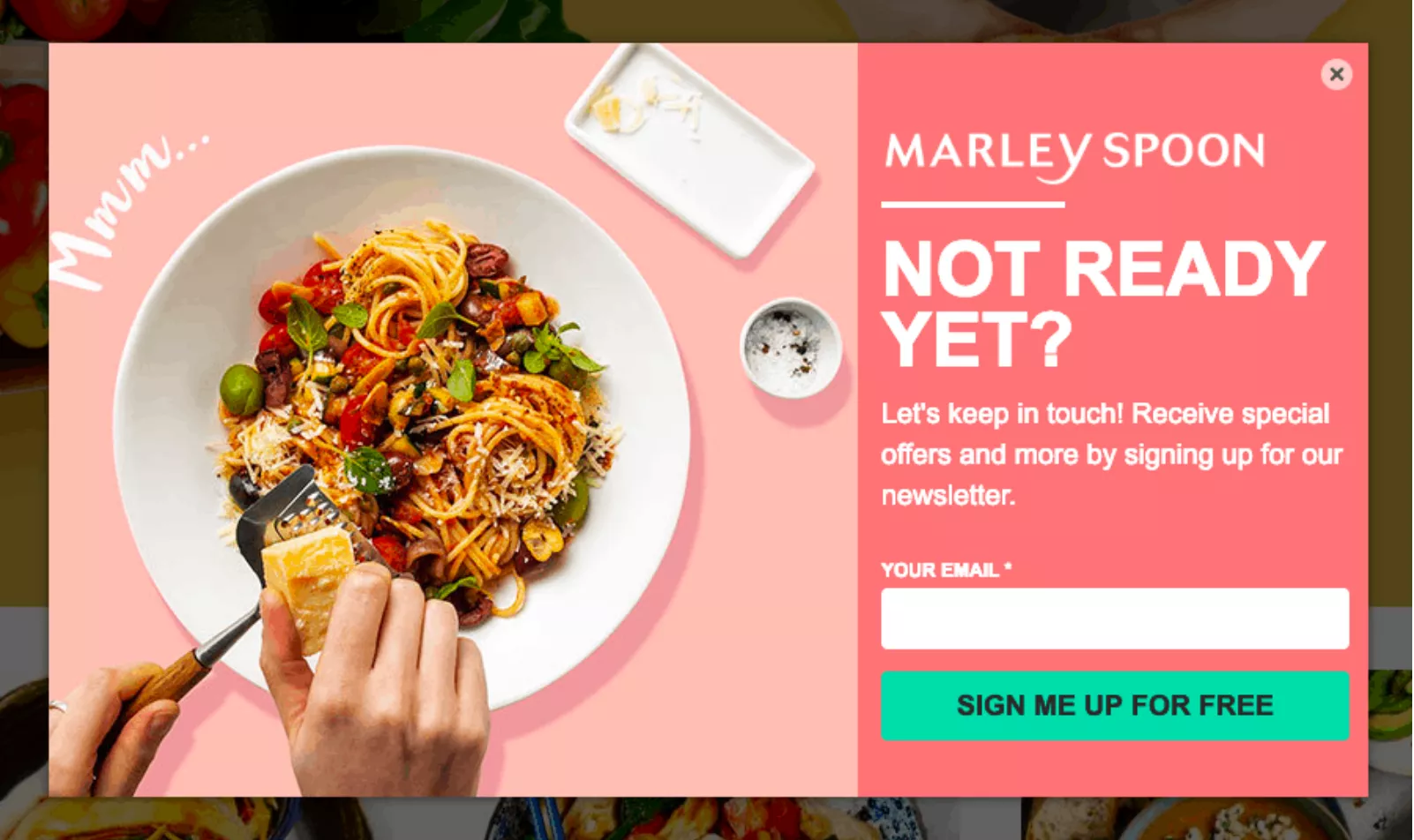
It’s a very subtle one.
There’s no real big demand here.
What they could also do is — in this case, what I feel they’ve done wrong is they have asked the customer to sign up for a newsletter for a meal delivery company.
I don’t know… are you excited to receive a meal newsletter from a meal delivery company?
I’m not.
What I would have rather done is:
“Get one recipe every week in your inbox.”
That’s what I would have liked.
That’s what I will give you my email all day for — something like that.
So just think through what things matter to your customers, right?
- Does a newsletter matter? Maybe not.
- But does good advice matter? Yes.
- Recipes? Yes.
- Fashion tips? Yes.
- Latest and greatest in sports — if you’re in any sporting product category? Yes.
But you’ll have to curate that content, so that effort has to go in.
But anyway, you’re writing a newsletter if you’re doing this, so might as well put the effort in the right place.
Wrapping up
Right, so we can take questions. That’s the advice that I had.
Just very quickly:
We do a very detailed and thorough email marketing and conversion rate optimization audits.
We run email marketing for more than 100 businesses and make sure that they drive more than 30% of their revenue from emails.
We’ve been able to triple, or in some cases quadruple, revenues that you drive from emails.
Plus, we also do conversion optimization. We have a platform for both. So we are the only technology company that doesn’t just give you a login and wish you luck — we’ll take ownership of what our technology does.
Thanks so much for spending time with us.
I’m going to get into answering questions.
Please feel free to articulate your questions and take your time with that. I’m going to stick around here for a second.
So René’s question is:
👉 “Is a discount the best lead magnet for a product-based business?”
Generally speaking, no.
Of course not.
I gave you one example just now — the recipes.
The intention is: Why should somebody give you their email?
So if you give them a 15% or 20% discount…
I often see out-of-stock also not being used well enough. And I think you’ve got to think about what matters to your customer and the frame of mind your customer is in.
If I can maybe take a look at your store — what industry you’re from — I can suggest more ways to do it. And I think I like your question also because that’s true. There’s just too much happening with discounts already in the world. Giving like a dollar for something is… I don’t think that’s the first thing that should come to mind.
If I was to run a B2C business — which I have in the past — but if I was running one today, I don’t think discounting would be the top of my mind, if that wasn’t what the business was built around.
Generally speaking, there are many ways to incentivize the user to give you their email ID:
- It could be information delivered to them.
- It could be recipes.
- It could be advice.
- If you’re a fashion store, it could be fashion-related guidance.
- If you’re in sports, it could be sports news.
I would want to dive into what your customer wants, and then give them something in exchange for their email. You have to give them something for sure.
👉 “Do you work with clients across the world?”
“We take clients from all over the world” — that’s my answer to your question.
Sort of yes, of course.
I’m in Bangalore right now, sitting in India myself — so why not?
But we… you know, conversion rate optimization is an extremely statistically driven business. You have to have volumes to statistically significantly optimize and make sure that you move the needle.
So that’s something we’ll have to make sure of.
Any further questions, folks? I’m happy to stick around for another minute or so.
👉 “And at what revenue level does it make sense to consider hiring an agency?”
We have never hired an agency, by the way — we did it on our own for the longest time possible, and then we had an in-house resource when it was possible for us.
Maybe also because we had the know-how and we knew how to do it.
I would consider not looking at agencies, but also individual consultants that can help you — people who you think have that.
And I also think — actually we should write a detailed blog about this. I know H is also on the webinar, so we should actually write a blog about how to pick an agency, what are the things you should ask them. We’ll work on that.
But generally speaking, I don’t think businesses put agencies through the scrutiny they should before they sign.
Because generally speaking, with agencies, it’s the founder that’s coming and pitching. So the charisma and the language is all there. But results are something you see — it’s a lagging metric. You see it two or three months later.
So it’s important you put them through the scrutiny, and maybe even ask them to put a document together of what they want to do and how they will do it. Even if they don’t want to share that document with you, at least present it to you, so that they have a plan before they actually onboard you.
So I think those things are important.
And actually, the other thing that I encourage business owners to do — and I do this myself as well — is take demos.
It’s completely fine to take a sales call.
I think being completely… avoiding talking to salespeople is never helpful.
Some of the best ideas sometimes come from salespeople trying to pitch you stuff and showing you their customers. And you might or might not buy from them — you can always say no — but at least you learn about what’s happening, what’s new, if there’s something you should probably take a look at.
⚠ Do Not Lock Yourself Into Long-Term Agency Contracts
The other thing is — for example, for Convertcart, for everything we offer, we do a month-to-month service and contract. So we don’t lock people in.
And I always advise that to businesses: don’t lock agencies in.
Don’t sign a 3-month, 6-month, or 12-month thing.
Do a month-to-month.
Watch closely what’s happening — what’s working and what’s not working — and make sure they have a plan before they get started.
Agencies often try to do this thing where they want to sign you up and then spend the first seven days on the plan. No. No go.
You have to put something together and show me what you’re going to do before I give you even a single dollar.
So, question:
👉 “You discussed product-based VR software — any recommendations?”
Gavin, I can take a look at your website again and maybe suggest.
But I think, you know, we are a software as well, and maybe we can kind of take a look at that.
👉 “At what traffic, revenue, ad spend levels does it make sense to use Convertcart?”
We have customers that range from anywhere between 20K in traffic going up to a few tens of millions.
But generally speaking, what also matters is transaction volume.
So we have the ones that are really small in traffic but have high transaction volume — you know, 300–400 transactions a month — because that gives us enough of a funnel to experiment effectively.
For emails, you need to have at least 20,000 emails in your list, or at least 50,000 in traffic, in which case we can help you build that list — the 20,000 list I’m talking about — over time.
And for conversion optimization, we have two different plans:
- a light plan — no A/B testing and experimentation,
- and another plan with A/B testing, very rigorous experimentation, and custom experimentation that we do for our customers.
So depending on your business — depending on your transactions, size of transaction, conversion rate, traffic — we can definitely tell you if this is a fit or not.
But yeah — that’s normally how this would work out.
I’m happy to take a look at your site, Gavin, and then maybe find a way to, you know, at least give you good advice.
“Ad spend levels” is not a criteria we normally look at.
Any other questions?
So I think — traffic. Generally speaking, think of all the channels that exist:
- you’ve got organic,
- paid,
- you’ve got socials,
- influencer,
- you’ve got that side of social paid — “paid social,” as I call it —
- and then you’ve got emails.
I would recommend you set some budget apart if you want a quick jump start to your business, and then find where your customers are — and then go there.
So if your customers, you feel, are on Google, searching for products like yours, I would invest there.
If you feel that’s not true, and your customers are regular people that are spending time on social media, then see if influencer is the way.
Influencer is actually really effective these days.
It gets the right kind of reach, and you’re more likely to get some kind of ownership on what has to be delivered there.
And generally, influencers — you know — you would be able to talk to agencies or at least test waters. Probably surf through Reddit and anywhere else to find the right influencers which actually move the needle.
So that’s another big channel that can give you a jump start.
Ads are obviously the best to kick things off because you can see where each spend is going. So if you spend like $1,000 on ads, you can then see what that yielded for you — what each $100 yielded for you in traffic and clicks, and then what that traffic and click is doing on your site, if you have a grasp on your GA.
But yeah — I mean, it’s a cold start problem.
There’s a book called The Cold Start Problem.
I would recommend you read that book. I think it’ll give you a lot of fundamental understanding of how to make it work.
It’s called The Cold Start Problem.
Yeah — I’ll probably drop the link.
I think that’s what it’s called. Let me just—
It’s not for e-commerce businesses, but it addresses how to start and scale a network-based business, generally speaking.
So yeah, it’s called The Cold Start Problem.
But trust me, all the answers lie in where your customer… all the answers are with your customers. They will tell you where they spend time, and that’s where your brand needs to be spending time. That’s the simple answer for your question.
Perfect. Thanks so much for your time, folks.
I know some of us have already hopped off, but thanks so much for taking the time to hear me out.
Get Fresh ideas to boost your conversion rate
(stuff that works for hundreds of stores)
Request a Free Site Audit"Convertcart’s Audit Report was deep and insightful. We never thought they would spend so much time in building and sharing such insightful content, free of cost."


Logan Christopher
Lost Empire Herbs