On-Demand
Improving 8 Most Important eCommerce Metrics (Immediately Actionable Strategies)
It is a common myth that tracking hundreds of ecommerce metrics is enough to achieve success.
The truth is, we should narrow down to the metrics with the most impact: average order value (AOV), customer lifetime value (CLV), customer retention rate, customer acquisition cost (CAC), you get the gist.
Why we’re doing this session: we’ve helped eComm stores for years, learned many lessons in the process - what works/does not work - and this session will be like a summary of our real-life learnings 🙂
We’ll talk about:
- Proven ways of improving your key metrics (stuff that is working for our customers as we talk)
- Some examples of stores doing really creative stuff to improve their key metrics


About the speaker

Shekhar Kapoor
VP, Marketing
Convertcart
Shekhar Kapoor (VP at Convertcart) has worked with 500+ online brands, including Squatty Potty, Prep Expert, and USA Hockey Assn., and helped them boost sales exponentially.
Shekhar Kapoor
VP, Marketing
Convertcart
SESSION REPLAY – IMPROVING MOST IMPORTANT ECOMMERCE METRICS
Okay perfect. We are expecting quite a crowd today. I'm just going to make sure people continue to settle in as I kick this off.
But once again, thanks so much for joining us. We wanted to do something different this time.
We did a teardown in the last webinar we had, and it was a hit.
I had so many questions immediately after the webinar that it immediately told me that it added value.
But also, some of those questions were generally speaking about numbers.
Those questions were: “Hey, what do you think my cart abandonment rate should be?” or “What do you think is a good conversion rate?”
And that led us to think that we need to start talking about something different.
We needed to start talking about — ideally start talking about — metrics that truly matter and metrics that are output metrics as opposed to input metrics. And I'm going to tell you what I mean when I say that.
Input vs Output Metrics
So yep, let's kind of jump right in.
Talking about metrics — there are input metrics, and there are output metrics, or you know, leading or lagging metrics.
For example, generally speaking, when a company is trying to grow, especially for an e-commerce company, conversion rate is a lagging metric because you're only able to track it after it has happened. Right?
So, for example, if your conversion rate is 2%, you can only say that after conversions have already happened.
So it's a lagging metric.
Fundamentally speaking, once it has happened, you cannot fix it. What you can, however, do is how it happens in the future — that is what you can fix.
Leading metrics, however, are how you, for example, drive traffic, how much it costs you to drive traffic — although cost also happens once you’ve incurred it — but those are things that can then affect your conversion rate.
So if you are driving traffic very effectively, if you're driving traffic from the right sources with the right intent and the right motivation, your conversion rate will automatically start to get better.
So, for every lagging metric, there is a leading metric.
So, for example, for cost of customer acquisition, there will be a different leading metric.
What we wanted to focus on today are these six because they make or break the success of an e-commerce business.
There are others as well, but we wanted to keep it simple. If this is something that is well-received in terms of ideas, we will do another set, which is probably a little bit more technical and slightly harder to track, so to say.
These are also easier to track, so we felt it was important that we cover just this for now.
Average order value, customer lifetime value, customer acquisition cost, customer retention, cart abandonment, and bounce rate.
Very simple stuff, very easy to calculate. We've written several times about this.
I'll also share formulas with you after the webinar on how to calculate some of this for you. I think some of it is really, really simple.
But generally speaking, these are the metrics that we'll focus on.
I want to start with this. I want to jump right in and then kind of take them up one by one.
1. Average Order Value
Let's begin with your average order value. Now, before I get into the first idea — it’s a really basic one — but I'll tell you why I think this is a very, very important metric.
Your average order value will make or break your acquisition strategy. I'll say that again: your average order value will make or break your acquisition strategy.
Why? Because if your average transaction size in your business is, say, 30 bucks and your gross margin on that is about eight bucks, that's the amount of money you have to play with — to essentially spend on acquisition, on customer acquisition, customer delight, and customer care.
Which means that eight dollars that you make on that, which you could say is your contribution margin — it's not the right formula, but let's just say your gross profit is more or less equal to your contribution margin — those are the dollars you have.
So, because it cost you $22 to make the product — your cost of goods sold — that’s the money you have to promote that product, to package it, to ship it, and to make sure that the customer loves it, and then to email the customer to come and buy again.
So if you can in any possible way increase that 30 to 40, or 30 to even 35, it gives you those precious few dollars extra to invest in advertising.
I very recently bought this pair of slippers — they're called Arches, I don't know if you know about it — and they're essentially arch support footwear.
So I saw it in a mall, I tried it out, I bought it, and then when I asked them how much it is, it's 60 bucks.
So it's $60 for a very simple slipper — slides essentially — for my feet.
And if I show you, I'm actually wearing them right now. I'm not going to bring it up in the webinar, but if I show you, they're actually really simple.
And then I started to think: why are they… why did they cost me $60?
And that's Australian, so $40 USD, you would say. And the answer is that the moment I bought them, I realized why they are so expensive.
And very simply put, it's four reasons.
Number one: they do a 60-day no-questions-asked return policy. So I can wear them for 45 days, 60 days, and give them back saying I don't like them.
So essentially, when I'm doing that, somebody else is paying for that return.
So they've marked their product up. They're selling the product at a significantly higher value.
The second reason is they have a size-related policy as well.
So if you're not happy with the size, you can get it changed in the first 15 days.
If you're gifting it to someone, you can change the color in the first 15 days.
So there are so many of these guarantees or assurances they're able to give their customer because they charge that premium.
Right, I think the product itself has no reason to be costing that much. It's a really simple slide which probably costs half of what it makes to you know manufacture a Crocs.
AOV Tactic #1: Tier Your Discounts
Getting into the actual things that you can do on your site — I hope these takeaways are things you can instantly implement. But let's quickly jump in, and I hope you understand why average order value is extremely, extremely important for your business.
The first is: tier your discounts.
Now, the number one reason we've mentioned this is because I feel a lot of businesses lose value by discounting too much. You give away too much too early, and that's one thing that I would recommend we stay away from.
So if you see what's happening here, it’s: only if the customer is spending 200 bucks is when they get 40 bucks off, which is about 20%. If they spend less, they get a lower percentage off.
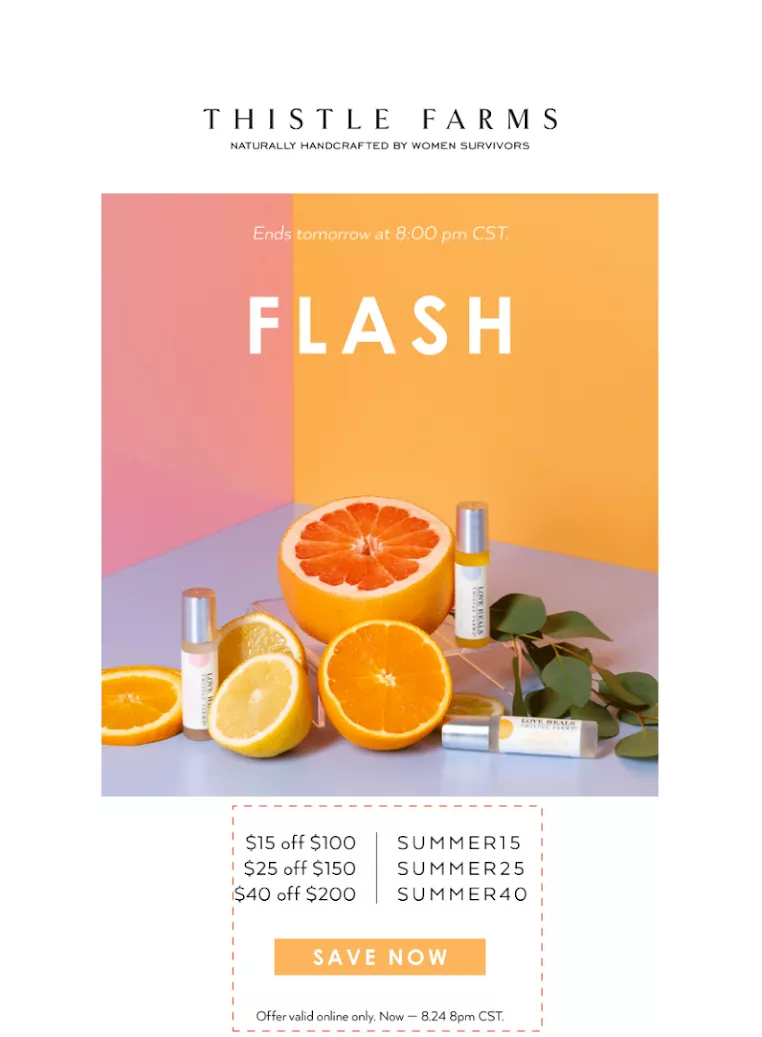
Don't run blanket discounts across your site. Don't just give a coupon away.
Think through discounting.
One of the things that we do for our customers, for example, is we get in, and we tell them which are the products that customers are converting at the same rate for — discounted price and full price.
And if the discounted price has not improved your conversion rate on those top 20 products or top 10 products you are selling… why discount?
It really doesn't serve any purpose.
The whole reason for running discounts is that people buy more.
But if that's not happening after running discounts, and you're not tracking that data of whether your conversion rate went up or not after running a discount, there's no real point to kind of run them.
AOV Tactic #2: Why Not Bundle
Really simple one again — why not bundle?
Can you create bundles of products and then try and pitch them to the customer?
In some cases, what I see is businesses are unable to do this because the product line is such that bundling might not make sense. In those cases, what I encourage businesses to do is create gifting bundles.
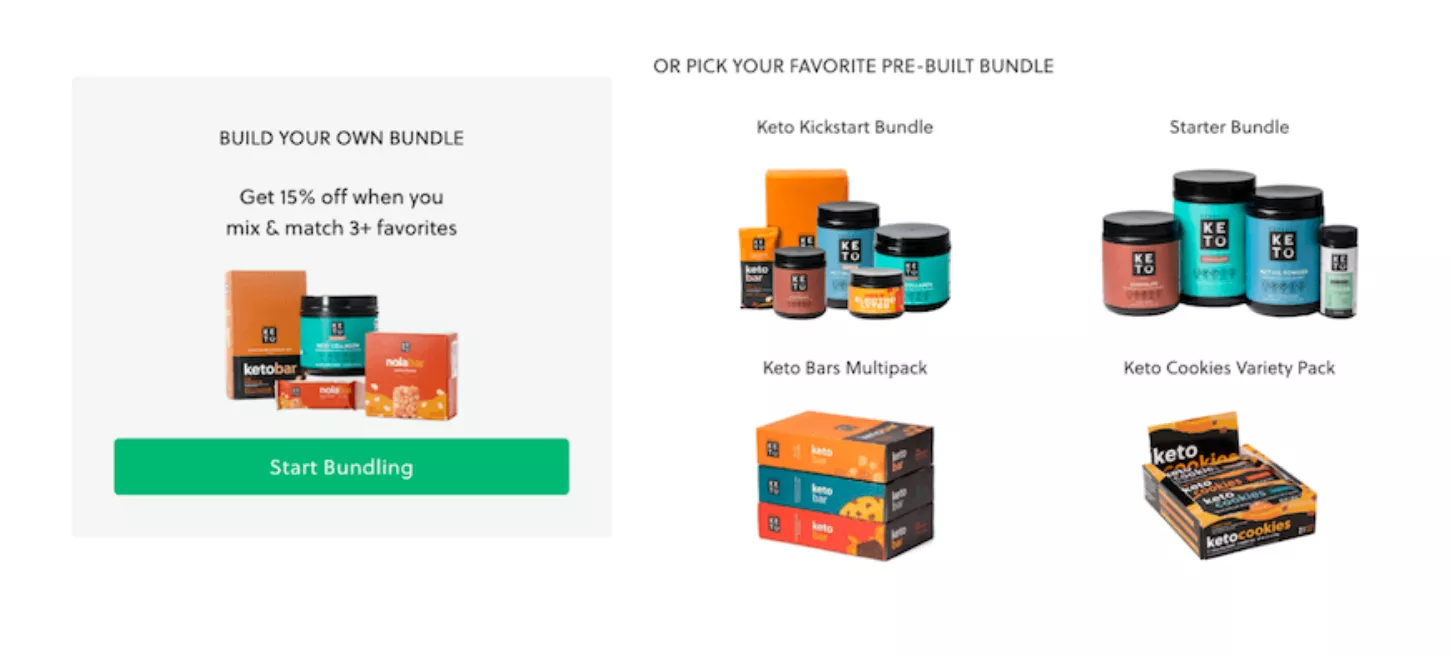
So for one customer to buy three products together might not make sense — but does it make sense for them to buy three together as a box and gift it to someone? Think about it. That's one way to do it.
But generally speaking, another way in which I see brands doing it is: adding products to their catalog purely to create bundles.
For example, if you are someone doing health supplements, why not add a bottle of some kind for a fitness beverage?
So think about things that can be added.
If the customer can take more value away from your business, it will pay you in the long run — even if the margins for those added products are not that high.
AOV Tactic #3: Give them multiple buying options
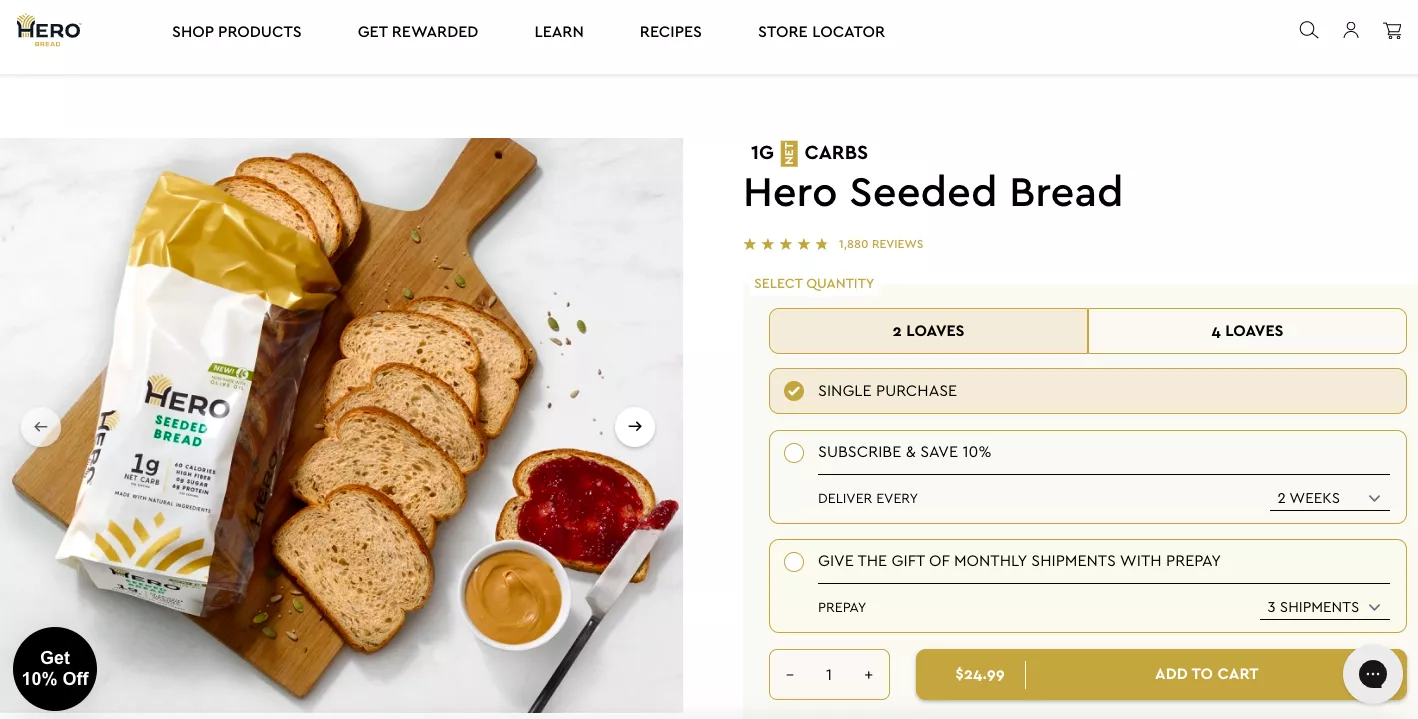
Then we have multiple buying options. Like in this case, buying more is generally equal to more discounts.
Again, the product has to be such that it supports this naturally, but I would recommend you still consider it and be innovative, irrespective of the product line you're in.
Like in this case, whether it’s a single purchase, a plus purchase, whether it's a subscription — I would want you to think through how you can encourage your customers to buy a larger quantity of whatever it is you're trying to sell to them.
AOV Tactic #4: Cataloging (Highly Underrated)
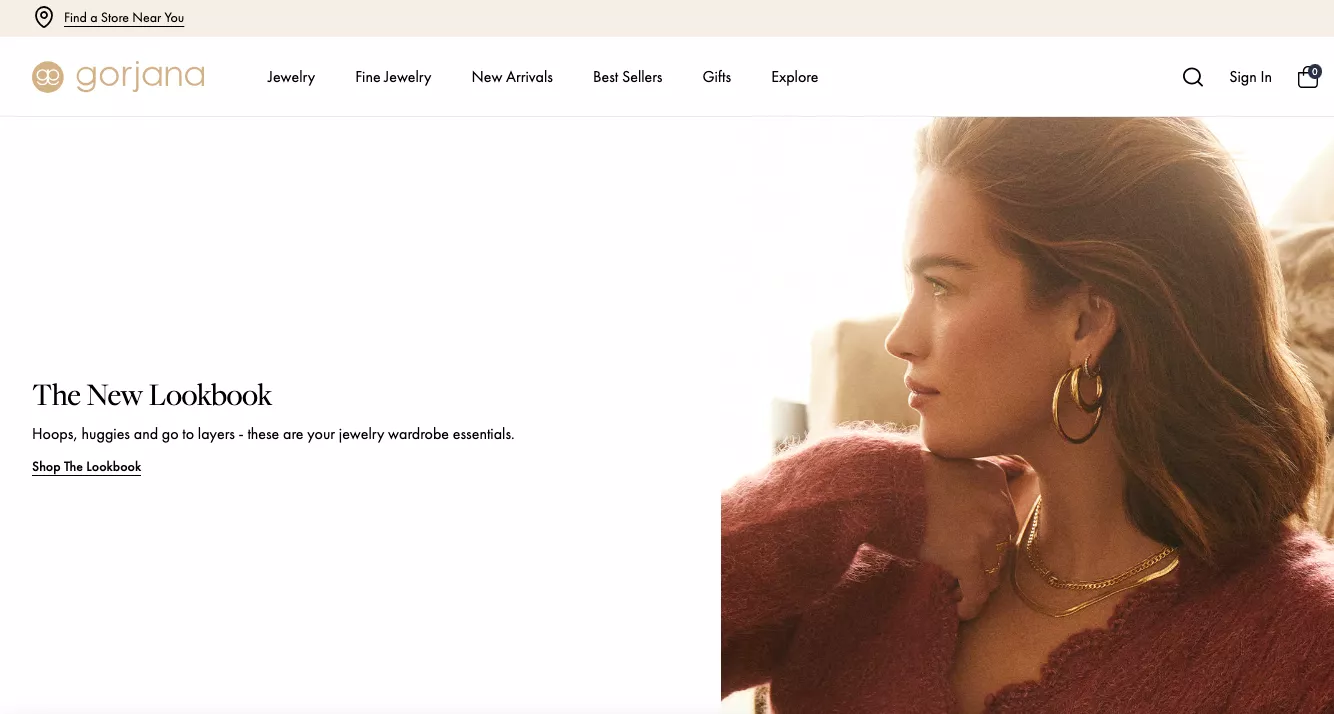
Cataloging is something that is highly underrated. And when I say this, this is also a conversion rate optimization tactic.
Sometimes, as brands, we don’t invest enough time, effort, and money in showing what our product feels and looks like when somebody is actually using it.
And I feel it would go a long, long way if we can put together the effort of showcasing what the product looks like and feels like.
In this case, it's done in the form of a lookbook.
Again, they're a jewelry brand, so a lookbook is what would make sense.
But in your case, show real people using products together, all in one place.
A brand that I can take example of is Peak Design — they do bags.
And for them, across their website, you can see different real people using their products: the side bag, the backpack, different types of products. And it adds a lot of value.
AOV Tactic #5: Add-Ons (Products or Services)
Add-ons are another very interesting way to increase your average order value. But the example I wanted to show here is how those add-ons are executed.
And I want to categorically state that add-ons don’t have to mean more products. They don’t have to mean more things that your customers buy from you.
They can actually mean more services.
The best business to be in is to be a bank or to sell insurance — I don’t know if you’ve heard this, but there’s a YouTube video about how money works.
I encourage all of you to watch it. I hope your worldview doesn’t change after you do. But generally speaking, add-ons can be anything.
So if you’re selling a product that’s even slightly valuable, I would recommend that you start offering add-ons on the lines of insurance or guarantees.
For example:
You would normally offer a guarantee for one year.
Why not extend that guarantee by six months by adding a $10 add-on saying,
“Hey, if anything happens in the first 18 months, we’ll take care of it.”
And essentially what you’re doing is getting those $5 or $15 or maybe $50 extra from your customers for that additional peace of mind.
And that $15 essentially costs you nothing. It costs you absolutely nothing in the short term.
In the long term, it depends on your product’s quality. But I'm giving you an example.
That’s one way in which you can give your customer more value. And in terms of value, you're not scamming them — you're giving them peace of mind.
Would you pay $5 extra if you knew that the company was willing to stand behind whatever product you're buying for an additional six months or an additional year?
It goes a long way if you can do that.
So I think additional services, additional add-ons, go a long way.
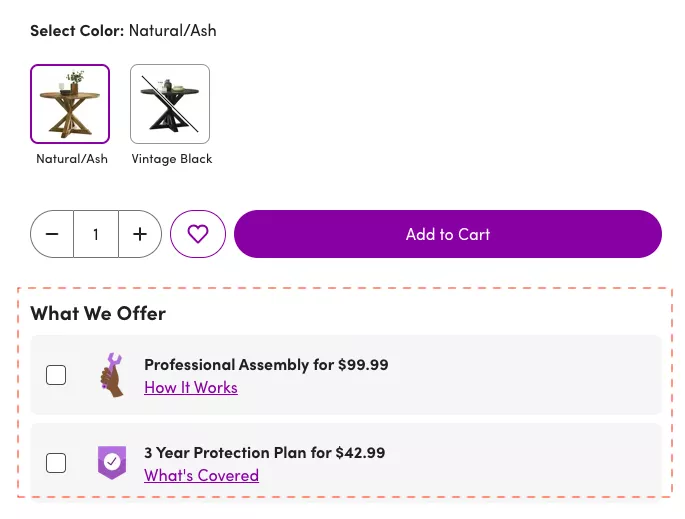
In this case, what's being sold is a three-year protection plan or a professional assembly.
And protection plans don’t have to cover wear and tear, don’t have to cover breakage, don’t have to cover everything.
AOV Tactic #5: Personalization (Ask Before You Sell)
Personalization is something I’ve brought up several times across webinars, and I keep bringing up new ways in which businesses implement personalization.
I would really strongly recommend focusing a lot on engagement. If your site — the moment I land on it — shows me the products that you are selling instead of the products that are relevant to me, then you've already started a losing battle.
The goal here is to start with the greatest sales pitch: start with questions.
I don’t know if you’ve seen this video of Piers Morgan sitting with Jordan Belfort — the Wolf of Wall Street guy — and he asks him to sell a pen. And that’s exactly what Jordan Belfort tells him. He says:
“Hey, you know what, Piers… this whole ‘sell a pen’ situation is actually just a waste of time, because the best pitches start with a question.
So. let me ask you — are you in the market for a pen right now?
And if you are, what kind of pens do you generally like?
And if the customer says they don’t want a pen, then I’m not going to sell to him.”
So in this case, you’re asking the customer: Who are they? What do they prefer?
And then you show them recommendations.
We’ve implemented things like these for our customers several times. We’ve A/B tested them several times. They work like a dream if executed well.
AOV Tactic #6: Product Comparisons (Let Them Compare Upward)
Product comparisons go a very, very, very long way if done right.
I don’t know if you’ve seen the tiered pricing that Apple deploys for their products.
For example, if you're actually in the market for an iPad — let’s say you're buying it for your kid — the base iPad is $329, and that’s 64 gigs. So you think, “Hey, let me see what more I can get in terms of storage if I buy more.”
What you see is the next model of the iPad: a better design, better colors, for roughly $420, $429.
So from $349 you go to $429 immediately — again, 64 gigs, Wi-Fi only.
If you spend $80 more — $5, $10, or $9 — you get Wi-Fi and cellular. But again, the storage stays at 64 gigs.
If you want to go 128 gigs, you pay $600, but you don’t get… you go to the next model, the iPad Air. You get 128 gigs of storage, but you don't get cellular.
So you spend another $60. So you start at $329, and after running your comparisons, suddenly you're looking at a $700 product.
So, just think through how you can implement this.
Let’s say you're selling leather bags and customers are looking at a $300 product. Allow them to compare it with other products that are on your site.
I would say don't go through the effort of getting a developer and implementing something too complex.
Just put together a simple creative on the product page itself on how this product compares to other products on your site — if, of course, they have to be comparable products for that — and let them make their own decision.
It also speaks to the depth at which you're operating — the kind of catalog you provide to your customers.
So average order value — again, about seven ideas.
I hope this was able to kind of open up some doors for you, make you think in a different way.
Please once again feel free to ask me questions as I go. And I hope everybody's happy with my speed. There are a couple of chats I'm getting, which are again directly to me, acknowledging those — thank you for that. But please select the “everyone” option when you're chatting so that everybody can see your questions. Otherwise, we’ll just get the same question a couple of times.
2. Customer Lifetime Value (CLV)
Getting back into the next metric, which is your customer’s lifetime value — how much a customer spends with you in the long run.
We will send you the formula for how this is calculated. There are a couple of ways in which you can do that. But there are two things we are addressing with something like this:
- Making sure your most loyal customers spend more over time, and
- Avoiding churn — which means a churn essentially is a customer that bought from you once and then never bought again.
Think of your customers and your company… think of your company as Netflix and your customers as Netflix customers.
Netflix essentially looks at their entire customer base as users, and then they work backwards from there. So if a user is generally sticking around for three or four months, they have mountains of data on:
- what the user watched,
- what the user preferences were,
- what led to the user discontinuing — was it the price,
- was it the collection of things that were shown to them, etc.
There are ways in which you can sign the customer up in a way that they don’t leave, or at least have lower chances of them dropping off after buying from you once.
But generally speaking, I'm going to show you some metrics as we keep going. The customers that buy from you the most are also your highest value in terms of the overall revenue your business makes. I'm going to show you some metrics for that in a bit.
But generally speaking, here are some tips you can use. There are about five here.
CLV Tactic #1: Hook the First Order With a Membership Discount
So the first one is hooking the first order with a membership discount. Tie them into a relationship with yourself.
So, in this case, for example — and in fact I saw an example of this just today morning at a Nike store.
Actually, that would be yesterday morning for… today morning for you, yesterday morning for me, yesterday afternoon for me rather.
So at the Nike store, at checkout, the lady asked me if I wanted to download the Nike app and sign up to get an additional 10% off on my order.
And I did that. I wanted to — of course I wanted to — I was trying to… my wife was trying to make me do so. I did that, and that purchase was logged in my Nike account.
And then I left the store. I had bought a shoe — a Nike Pegasus 39, and it’s a running shoe.
And of course, I got a welcome email with all kinds of running apparel in the email.
So, of course, Nike is Nike — impeccable use of my data, which I find intrusive, but again, I gave them permission to do that.
But why not add a membership to your business? Please consider it.
There are many apps, tools, methods in which executing a membership and managing it becomes very easy.
More often than not, I see businesses giving too much away to members. So please be careful of that. Please don’t lose half the revenue you get from your most loyal customers on the back of just delighting them. Right?
Loyalty does not have to mean that you also give something away all the time. Right?
Which is why it’s called customer loyalty — and the company has to be loyal to you, but only if the customer is also loyal to you.
So let the customer take that first step and sign up with your membership.
CLV Tactic #2: How-Tos as a Way to Foster Engagement
How-tos are, again, a really easy way of fostering engagement.
What we have seen is: generally, if products are sold and if products are to be used a certain way, manuals or how-tos — people coming back for those reasons — work out really well.
So if this applies to your business, invest an outsized amount of time in putting together highly interactive, high-quality how-tos so that people can come back to them and engage with you again, just to figure out how the product is used.
So in this case, for example, the product itself is separate, and then you've got recipes on the website, you've got various ways in which you can use the product, etc. And people keep coming back for that.
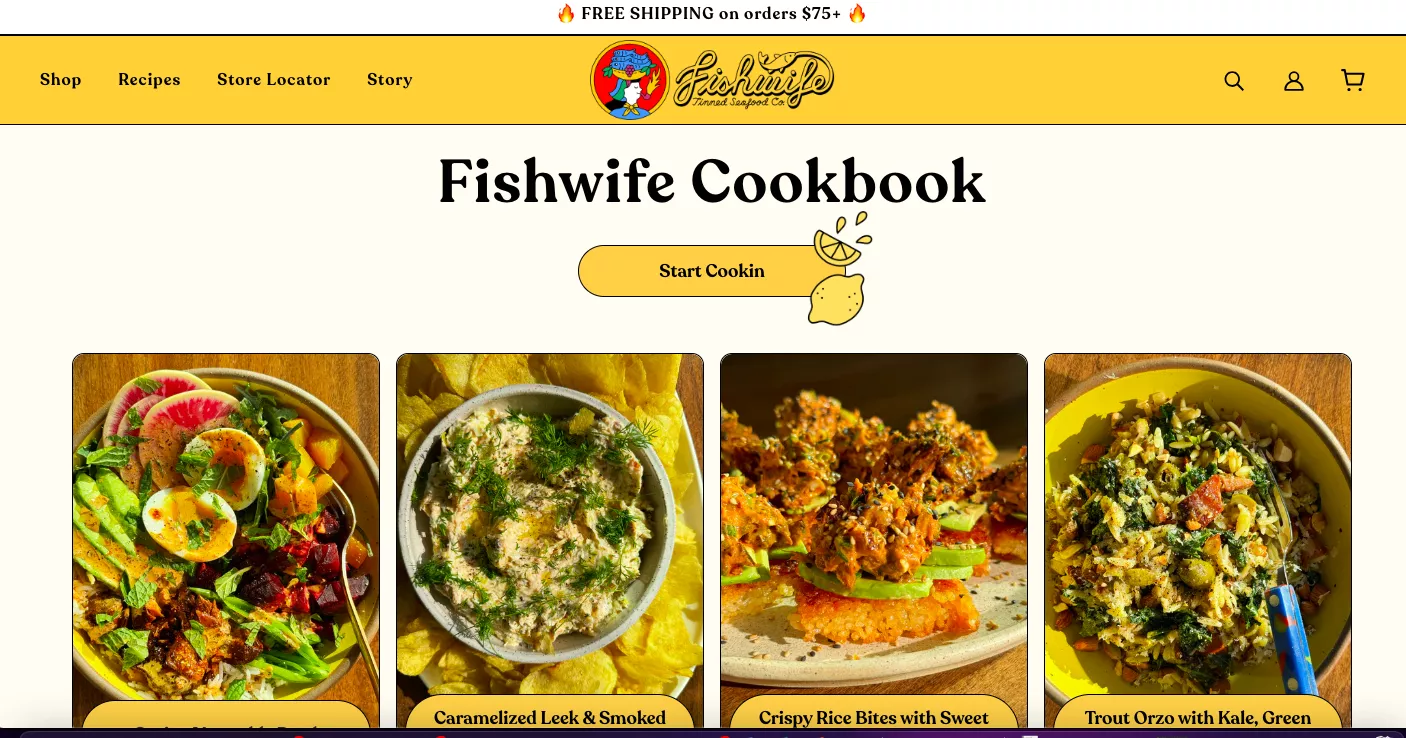
One of the other things that we generally see is: signing up for the how-to also gives you a large collection of emails.
CLV Tactic #3: Free Shipping as an Email Magnet (High-Intent Leads)
And coming to emails — here is another interesting idea, which is free shipping.
It's one of the biggest detractors in e-commerce still. So if I am somebody who is buying from you, look at it this way:
I am an Amazon Prime customer, as most people are — most people with the budget are. And on Amazon, my shipping options start with today. When I place an order, I can get my order as early as today itself.
And then I land up on your site, and I see that the order is going to get shipped tomorrow — it’s not going to get delivered — and then it's going to take three to five business days to reach me.
So naturally, matching up to Amazon’s experience is not straightforward. Bezos is Bezos — you can't beat him in a day.
But can you delight the customer by offering free shipping, and maybe — I don’t know — charging a couple of dollars extra on your product itself?
Needless to say, people who actually opt into a pop-up like this, which offers free shipping, are also going to be high-intent customers.
So essentially, people who will sign up for a free shipping popup are the ones who considered your product that much, the ones who went as far in that journey to actually know what shipping generally costs for you.
This is the highest-quality email you will collect, because if they abandon cart, if they abandon checkout, you’ve captured them even before they abandon.
So your cart abandonment list size will actually go up.
Let me explain this:
If you have 50 people that abandon your cart in a month — or in a day (a day is probably a better number) — if 50 people abandon your cart in a day, you might not have the emails for all 50.
You might only have it for five.
Something like this will make that five go to 15.
And you have three times the cart abandoners identified, which you can email and bring them back to the site. And we'll talk about cart abandonment as well in some time.
CLV Tactic #4: Differentiate Your Brand With Amazing Customer Support
Differentiate your brand with amazing customer support.
This example was something that we particularly liked.
In this case, the customer is trying to return dog food. The company has given the refund and asked them to donate the food to somebody on the street or at a dog food shelter.
They also had flowers delivered that said, “You know what, we’re sorry that you didn’t like it.”
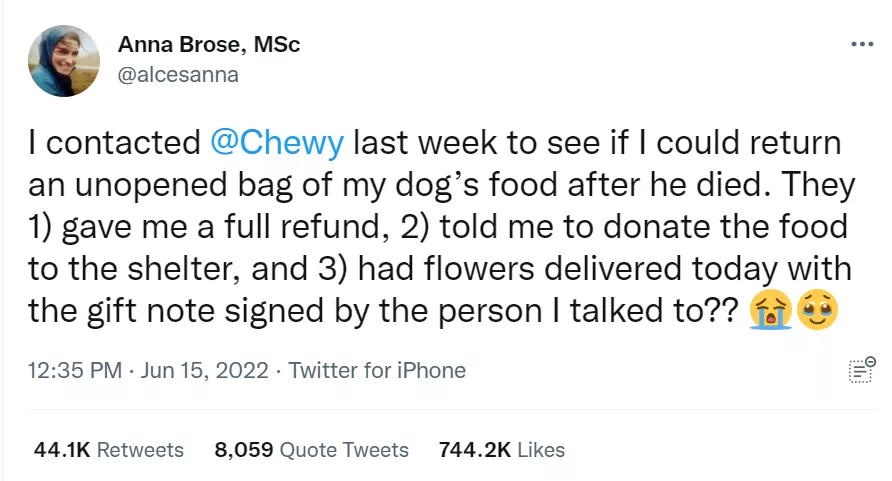
So I think there are endless examples of companies going above and beyond in doing this.
I would recommend hiring an intern or just somebody for the weekend, with some extra money, just to focus on delight — just finding those top 20 customers or the 15 from the week that are your loyal customers, and just pushing the customer delight even farther, as far as you can, so that people start to sneeze about you.
They start to talk about you.
And when I said “sneeze,” Seth Godin says this — that great brands, they spread like the flu.
Because the customers, they fall in love with brands, and they start sneezing about it, they start talking about it, and everybody catches the flu eventually.
CLV Tactic #5: You want people to be happy about shopping with you
In this case, this is an idea that I had actually shared in my last webinar as well: stand for a cause and make shoppers feel good.
Feelgood brands have so much higher retention.
We work with a brand called JBYoga — I don’t know if you’re into yoga, but the JBYoga mats are amazing, and I highly, highly recommend them.
But apart from the fact that their mats are amazing, for every yoga mat you buy from them, they plant a tree for you.
And that feelgood associated with every purchase from the brand is amazing.
So each time they launch a new product, their entire community of buyers comes back and buys from them. And that’s powerful. That’s amazing. I mean, of course, right? So if they launch a new product, they have about 100,000 buyers waiting to buy from them at the moment they launch it. That’s powerful.
Which also makes me think that generally speaking, only if you think long term is when you would do things like this.
If you’re just focused on your next week or next month’s goal too much, you would never invest in these long-term things that build your brand over time.
So I just generally feel businesses need to sometimes take a step back and think about these long-term metrics — lagging metrics like customer lifetime value.
3. Retention
Or overall customer retention — to solve for short-term goals like your next month’s revenue.
If your retention was 30% higher, your next month’s revenue would be that much more predictable because you would know that 80 repeat buyers buy from you each quarter, or every six months, and you're confident that you'll meet your next month’s target as well.
Otherwise, your revenue and traffic will continue to be erratic — if it is already.
This is what I was mentioning earlier in terms of data points:
11% who keep buying from you generally drive about 45% or more revenue for you.
This is something we've seen over and over again with our own customers as well. Convertcart helps solve conversion rates and does amazing lifecycle marketing or email marketing for our customers. We have a mountain of data we are able to analyze and help our customers with.
And this is a repeat theme — that people who buy from you a second time contribute to more than 25% of your revenue, and people who buy from you a third time contribute to even more because of how loyal they are.
And the other thing is — and that’s the reason we included customer retention as a key metric — is because if you can retain a customer… or let me just put it this way:
Retaining a customer is probably 20% the cost of acquiring a new one.
Think about it.
What is the cost to acquire a new customer?
$30? $100? Depending on what you're selling.
Versus what does it cost to retain a customer?
Nothing.
It actually costs nothing if you do it well.
Retention Tactic #1: Build a Simple, Valuable Rewards Program
So I'm going to jump into some of the tactics that might be useful, and then we can kind of go from there.
The first one is, of course, a simple rewards program. I want to give some really boring examples — like Starbucks. Starbucks has more than $1 billion in their wallet, which means they're bigger than a lot of banks that we know. I think it's more than that. But that’s the power of a rewards program. That’s the power of a repeat purchase program.
In this case, there’s a bunch of things happening. If you sign up, you have access to better customer support, faster shipping, you have vouchers that you can redeem — so there’s a bunch of things happening.
I think, generally speaking, craft something together that you can honor. Even if it is something as simple as faster customer support, it’s useful. So I think you don’t need to make it too complex, but at least consider this. You know, kind of have people sign up for something special.
Retention Tactic #2: Take rewards beyond purchases
And the other thing is to take rewards beyond purchases.
Reward your customers not only for buying.
Reward them for:
- leaving a review,
- sharing you on WhatsApp,
- referring a friend,
- adding a picture,
- mentioning you on Instagram.
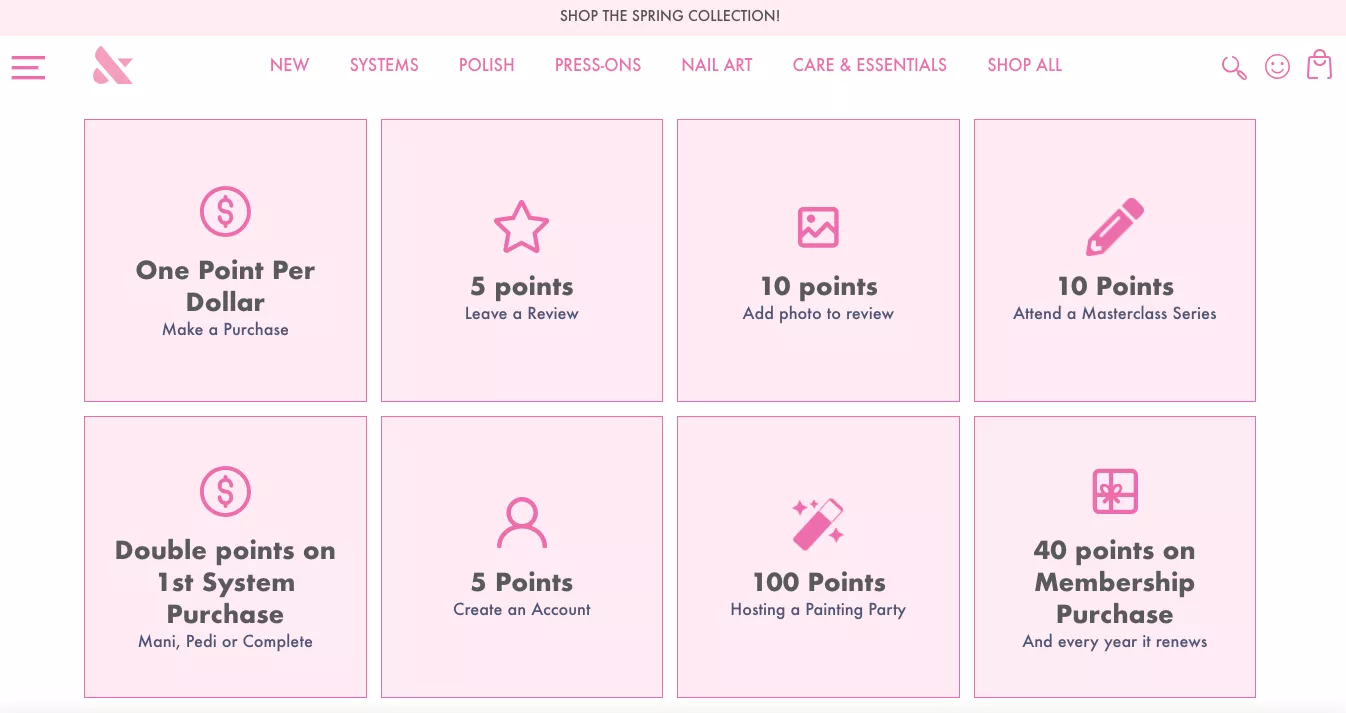
There are several reward programs that can help you execute something like this.
There are various apps that can help you execute this. I strongly recommend you take a good look at this.
But remember one important thing: once you've chosen a rewards app and your customers have started to sign up on that, you cannot switch from one app to another because your customers would already be signed up on one reward platform.
And that reward platform is constructed in a certain way — whether it's doing coins for your brand or it's doing some kind of points or something on those lines. So just kind of do a thorough analysis of whatever you're signing up with, and then go for it.
But don’t over-intellectualize it, because sometimes I see people spending too much time on “What product should I finally buy?” And then they’re just creating an Excel sheet comparing features.
Don’t worry about it. Keep it simple. Keep it easy. The simpler it is for you, the simpler it will be for your customers to understand it.
If you make it too complex, you've already lost the battle as far as rewards go.
Retention Tactic #3: Subscriptions (The Easiest Path to Retention)
Subscriptions go a very, very long way.
This means subscribing to your newsletter, subscribing to the product itself, and several other different things. So I think your business model has to allow it, but this is the easiest, most straightforward way of retaining a customer.
Now, of course, nobody subscribes to t-shirts.
But there are actually brands that let you subscribe to socks, for example.
So sock subscriptions — nobody had heard of it five years ago, I think. And now there's a small box at the door every two weeks with a new pair of socks.
It’s extremely wasteful — I think, that’s my opinion — but I know of companies that have more than 50,000 subscribers just subscribing to new socks.
So yeah, make of that what you will.
Retention Tactic #4: Make Returns Easy (Loudly and Clearly)
Making returns easy — another interesting one.
Look at any successful fashion shopping store in the world. You look at the Boohoo-sort of brands in the UK, you look at some of the largest shopping stores in China. You look at the largest ones, for example, in India — you've got Myntra and such.
In Australia, you've got several different platforms. Even if you look at Myer or Kmart in Australia, if you look at the US as well — the ones that make it the easiest to try a product are the ones that generally win in the long run.
So have a return policy focused on the customer.
Don’t take on too much cost from the return itself — but then be extremely loud about it.
Most of the cases, because the customer is buying direct from brand — D2C — there is more risk on the customer’s part.
They’ve probably heard about you for the first time. They’ve probably seen the product for the first time. They’re not too sure.
So give them the assurance that they can send the product back if they don’t like it. It’s going to go a long way.
Make it easy — and say it loudly.
Those are the two points.
Retention Tactic #5: Keep Your Email List Growing (And Make Every Click Worth It)
And with emails — retention sometimes fails, and unsubscribes happen. So I think this is another important thing about emails:
Your list size, your email subscriber list size, should 100% only grow.
If your email list size is smaller than what it was three months ago, you’re in trouble.
Which means that every time you're sending a campaign, you're losing subscribers, and you're not gaining subscribers at the pace at which you're losing them — and that is never a good thing.
So in this case, for example, what's really happening here is a very simple thank you email, talking about the brand and why the products are so great, and you would really love them. That’s it. There are no sales here, no promotions, there is no St. Patrick’s Day 50% off going on.
If you solicit a click from the customer, make it worth the click.
Otherwise, you can just communicate with your customers.
I know a lot of the people that are with us today on the webinar found out about it through the newsletter — which I write — and we put in a lot of effort in the newsletter. I cannot take the effort away from the team that writes it with me. But then again, the intention with the newsletter is to give as much away as possible.
So if you're not subscribed, please subscribe to our newsletter.
We give out similar interesting nuggets about e-commerce growth every few days.
Retention Tactic #6: Salesy Emails Can Still Be Fun (If They’re Human)
Salesy emails can be fun as well.
This was one that I really liked.
And to be honest with you, the best copy still comes from humans — our Head of Content made me say that, but I also agree with him.
Generally speaking, that is true. AI is amazing, but emotions are supposed to be raw, they're supposed to be real — you cannot fake it.
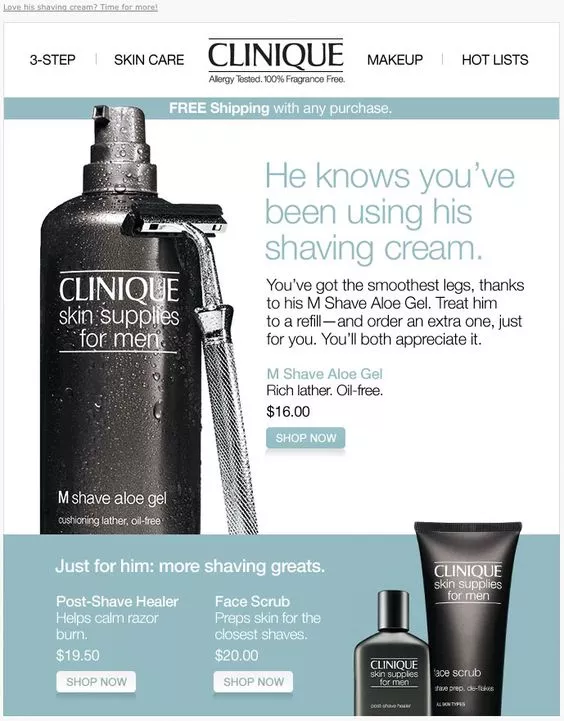
In this case, this is a really interesting one. He knows you're using his shaving cream, and you're essentially selling a refill to the wife. And I think that kind of goes a long way.
4. Customer Acquisition Cost (CAC)
I've already spoken about how your average order value will determine your gross margins or your contribution margins.
Let’s get into customer acquisition cost — the most effective way to influence it.
Now, normally when I see companies solving for customer acquisition cost, I see them obsessing over optimizing their ads. I've audited countless Google Ads and Meta Ads accounts — mostly because the proprietor or whoever is running ads has asked me to take a look at it and say,
“Hey, do you think I can do something better to get traffic at a lower cost?”
And that's the wrong motivation.
The best way to lower your customer acquisition cost is to acquire more. Right?
So your total ad cost — let's say it's $30,000 a month — divided by your total new customers acquired — let’s say it’s 1,000 customers — so it costs you $30 to acquire one customer.
That's how you calculate your customer acquisition cost.
But instead of trying to change the numerator — and figuring out a way to spend less, although that’s a good thing — why not focus on the denominator?
Why not convert 1,100 instead of just 1,000?
So that's what we look at here.
CAC Tactic #1: Address Objections the Moment They Land on Your Site
The moment people land on your site, try and have a conversation with them through your experience.
If you are a brand, invest the time, effort, and money in telling them your story. And then — speak. Your customers will have some very key objections, concerns about your products. Eliminate them straight away.
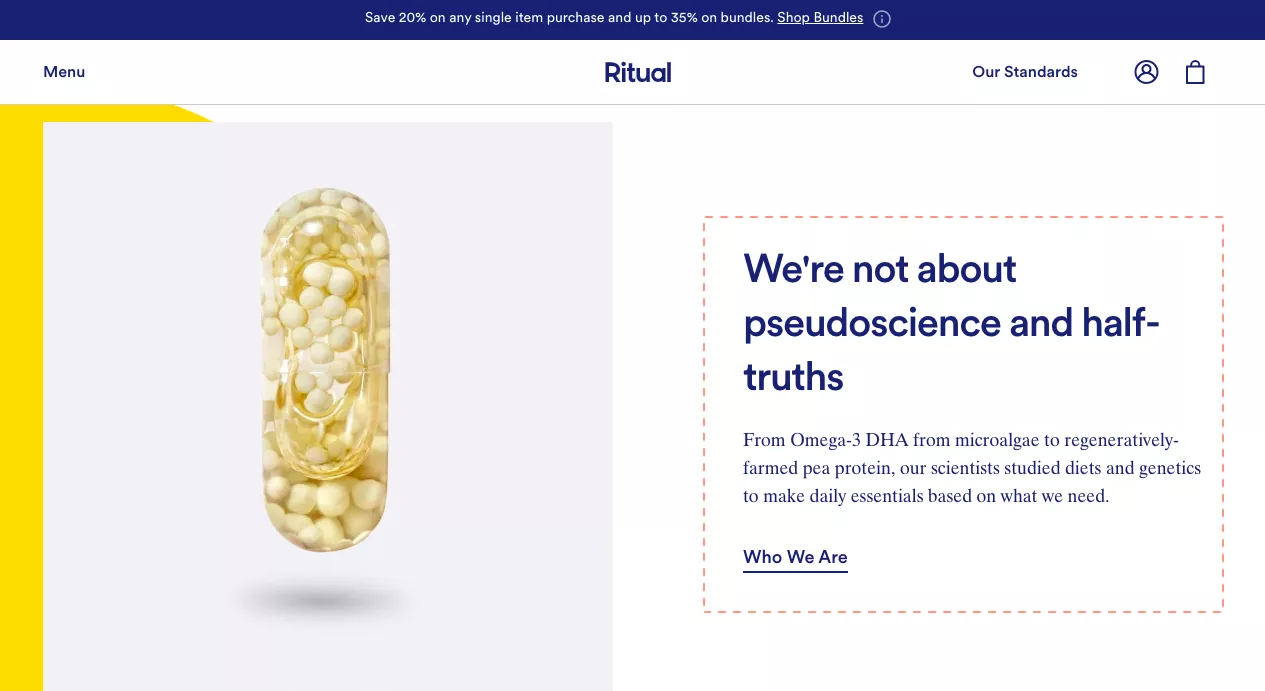
In this case, for example, this is a supplement, and you're going to talk about what goes into consuming something like this.
I was looking at an anti-aging product just a couple of days ago, and when I was going through their reviews, what I realized is that the customers are very, very educated — for lack of a better way to put it. People knew exactly how much lithium was there in the product.
And for some people who were sensitive to lithium in anti-aging goods — and this is also a note of caution that most anti-aging products out there have a lot of lithium in them — generally people who are very sensitive to it, they start losing hair the moment they start consuming anti-aging supplements.
So it has its anti-aging benefits with skin, etc., but you start losing your hair — and you know, clumps of hair. So that's one of the things that I saw in reviews.
But when you look at the website, actually there’s no way for me to know how much lithium is in the product if I don't really spend like six or seven minutes finding the right information about the product.
So a lot of customers are finding that out once the product reaches them, and that's disappointing.
So it’s important that you spend the time going through customer feedback and reviews, and then address some of those concerns even before the purchase is made.
CAC Tactic #2: Set the Right Expectations (Remove Misconceptions Early)
Or set the right expectations.
For example, when customers sign up with Convertcart, they often think we will double their conversion rate in a month or two months. And it's our responsibility to tell them that conversion rate optimization is not a silver bullet.
It is the most predictable long-term strategy you can use to improve your revenue. And generally speaking, our customers see anywhere between 30 to 100% improvement in their conversion rate in the first 9 months to 12 months.
So it takes time. There are quick wins often, but if I were to sign you up by saying I'm going to change your life in 45 days — it's a lie, right?
And that's why — that's something that we knew from our customers, and now we take the time to eliminate that as an issue straight away in the purchase journey.
The second piece — from a retention perspective — is to make sure that even for the customers that have already bought from you, and the traffic that’s coming to you again, you are being extremely loud about people that love you.
So make sure that — the previous point was about negative reviews and feedback and how you use them to your advantage — this one is about making sure you use the great reviews and great feedback you have to your advantage.
So ensure that we kind of do that as well.
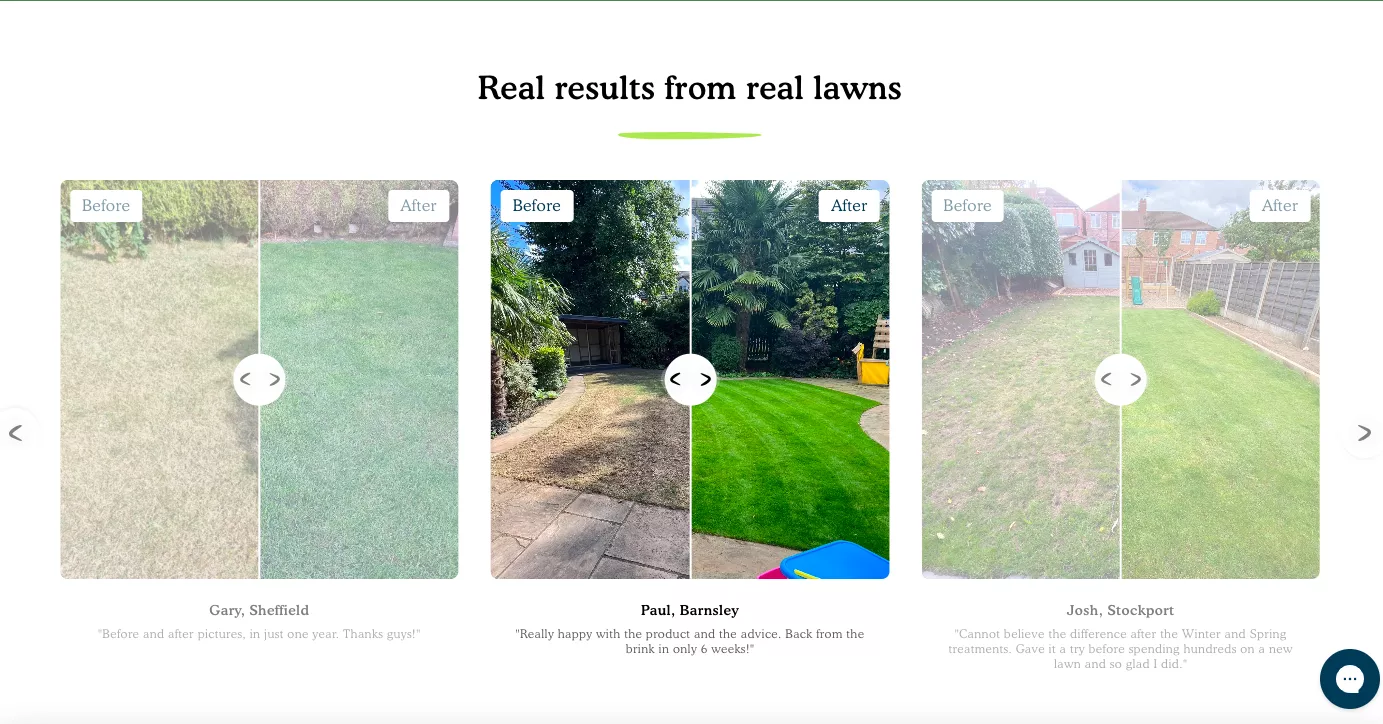
CAC Tactic #3: Use Real Images (Raw Beats Perfect)
Images should be as real as possible.
I encourage you to take a look at Instagram and TikTok and influencers.
Generally speaking, the most successful influencers — the largest ones — also garner more clicks and likes and traction on the most raw and original pictures taken from their own phones, compared to professionally shot pictures at an event.
So I would just strongly recommend using real images.
CAC Tactic #4: Use Original Content and a Real Brand Story
Using original content as opposed to doing things that are not that authentic.
I already spoke about brand story — and if you can, I strongly encourage standing behind the brand, letting the founder tell the story directly.
A lot of businesses stay away from doing this — I don’t know why — but it's important that as a brand owner, you come forward, tell the story of the brand, and stand behind it.
It makes you a lot more dependable.
Generally speaking, if you don't want to do that, still be sure to highlight ways or reasons for why your brand or product can be trusted.
Generally speaking, I see businesses approaching trust in a very template way — like installing a form of popup, adding reviews, that kind of simple messaging.
That's okay, there’s nothing wrong with that. But it's not differentiated enough, and that's something that might not work in the long run because it's very easy for your competitors to do that as well.
So that's something to think about.
CAC Tactic #5: Let Real Customer Stories Shine
Real customer stories — I'm going to repeat this point later on again — but let real customer stories shine.
In a lot of cases, we see some really solid testimonials, but there is no image in them, there’s no customer image, there are no real names, and they just don’t look that good.
So please execute them well.
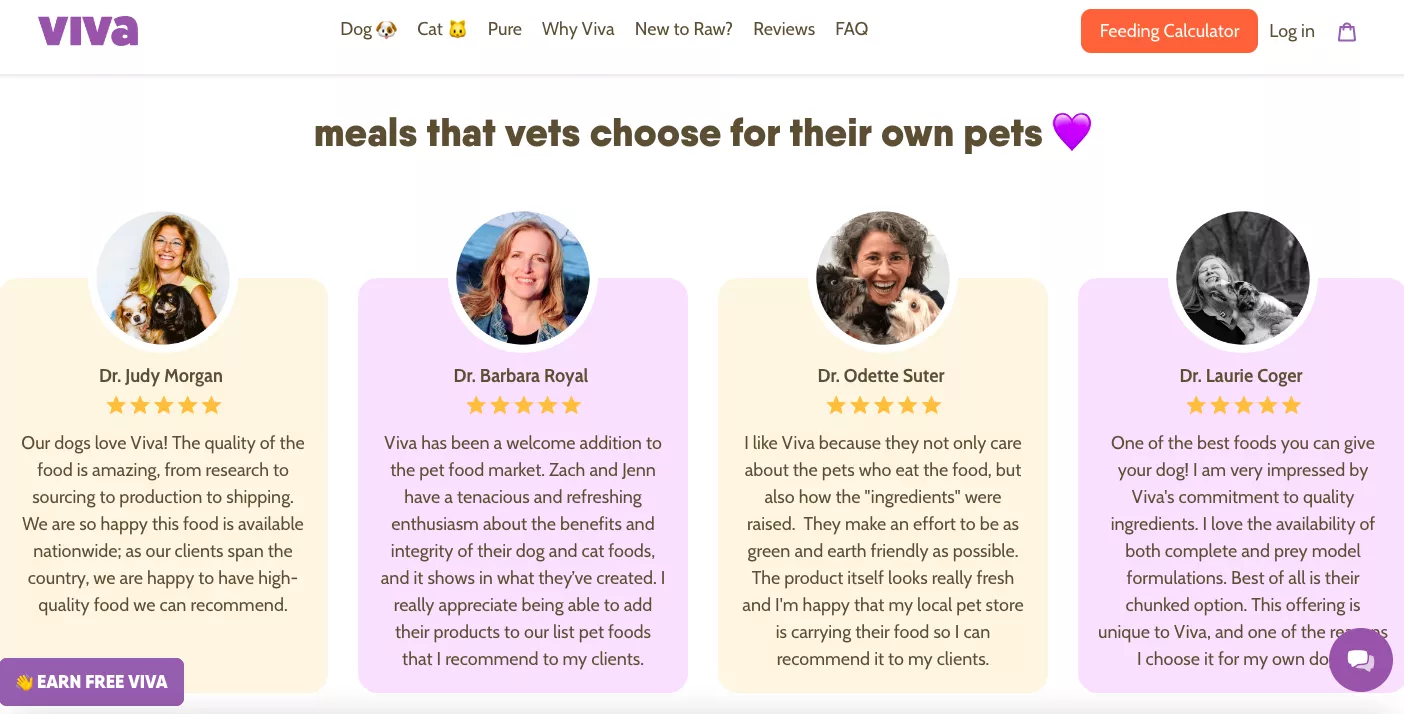
Even if there are only five or six good testimonials or reviews on your site — but they have the actual picture of the customer and their name — it looks that much more authentic.
Right? In this case, if you see all the four testimonials that we have here are vets — they're veterinarian doctors that own pets — and then are leaving a review for the product. Which is huge. Which is amazing.
So Ry, to answer your question: instead of doing an app, why wouldn’t you maybe do an image creative or maybe a custom deployment of just the top five or six testimonials?
Like in this case, this would be executed without an app.
This one would be a really simple static implementation from a reviews app.
Convertcart also does reviews, but you know — there is Yotpo, there is Smile, there's many other apps that you can use. But an execution, an implementation like this does not need an app. You can actually do that straight away. And that means no cost, no subscription.
The best way to do that, Rene, is to reach out to them — or maybe if they’ve given you good feedback on email, maybe get their Gmail profile picture, download it, get their content.
Your top 10 customers will be more than happy to give you that —
“Hey, you know what, we would love to feature you on our website. Can I use your picture from your social media profile?”
And they'd be more than happy to oblige.
We have a very big meat delivery business here, and they actually print their loyal customers' pictures on the packaging for a full month sometimes. So the customer testimonial and the customer's picture is on the packaging. So it’s going to thousands of houses with the customer picture on it.
So imagine the effect it could have on other customers — and the effect it would have on the customer whose picture is on the packaging.
Just something to think about.
I hope I’ve answered your question, J.
CAC Tactic #6: Explicitly Tell Shoppers Everything You Do
This is something that I feel businesses don’t go far with — which is to explicitly tell shoppers everything you do.
5. Prevent Cart Abandonment / Recover Abandoned Carts
I'm going to go into the next thing and come back to this, and connect the other execution we have as an example in this document.
I also want to speed up because we are nearing our time limit. We have a bunch more points — I think we don't have enough time to cover everything.
So I'm going to speed up, and please ask me to slow down or repeat anything that you would like for me to kind of jump into.
Cart Recovery Tactic #1: Offer Tiered Rewards
Offering tiered rewards — in this case, free gifts.
Can you add a simple free gift to every order?
There are a lot of free gifting apps that allow you to do this, to execute this very easily.
I really encourage you to do that. It's added delight and it goes a long way.
So see if you can do a free gift or free priority shipping above a certain order size.
That would ensure that you are solving for one of the biggest, most painful metrics that ever exist in e-commerce — cart abandonment.
Cart abandonment is — if you picture it in a physical way — it's like you walked into a Target or an Aldi or any other similar store in your neighborhood, you filled up your cart with stuff that you wanted, you walked up to the register, and then you left the cart, and you went away.
Imagine the amount of pain you've caused — I mean, first of all imagine the amount of pain you've gone through yourself of actually walking through aisles and aisles of products, and then picking what you wanted, and then abandoning the cart.
And then the pain you've caused to the store — to go back and rearrange everything.
An abandoned cart is just disappointing.
So I think it goes without saying — this is the most painful metric because you've gone so far into the journey. You've paid for the customer to see you as a brand on ads, they've clicked on the ad, they came to the site, they've given you a good shot, they've spent a few minutes with you — and then they left.
So we’ve got to arrest this.
In this case, for example, shipping, as I said, is painful.
If you can offer it for free, it goes a long way.
If you want something from the customer in return for offering free shipping, you could definitely do that.
Cart Recovery Tactic #2: Use Subtle (or Shameless) Nudges to Push Completion
You could also do some subtle nudges — like in this case, this is a more shameless one, I would say — where you're giving a discount away for completing the purchase in the next 9 minutes.
Another way in which I would do this is:
“If you order in the next 10 minutes, we will ship it the same day. We will ship it today itself.”
I think you can try and execute that.
For example, a bag store that I was shopping on here in Australia just yesterday was shipping out within an hour of the order if it was placed before 4:00 every day. So again — you're committing to shipping, you're not committing to delivery. There’s a big difference.
Cart Recovery Tactic #3: Use Popups Effectively (Even Hard Ones Pay Off)
Or better than that is — you know — use popups effectively.
In this case, the cart is sitting inside a popup. This is a hard one to execute.
I know this idea is not easy for you to do on your own, but this is something that we’ve also done before.
It's interesting to give the customer a reminder.
In this case, if you see, the 20% off that the customer is potentially getting is calculated, and they're being shown a final amount in the popup itself.
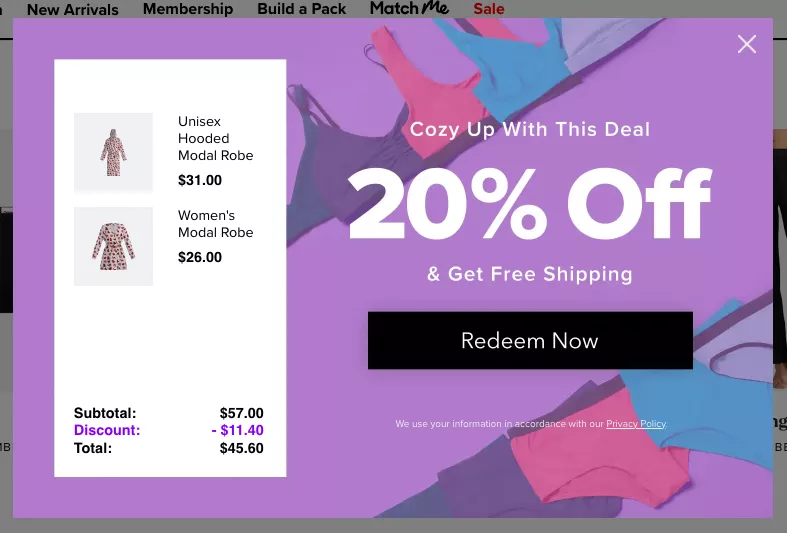
So it’s a hard execution — but it’s a really effective one.
Cart Recovery Tactic #4: Create Urgency in Your Cart Abandonment Emails
And then — you know — create urgency in your cart abandonment emails.
Birchbox is, you know, one of our customers as well. And in their case, their products used to actually sell out pretty fast. So the customer here was aware that we are not joking — the product can actually run out of stock, and there is a strong case for them to finish their purchase soon.
5. Bounce Rate
The next one is connected — it's about bounce rate.
So it kind of applies to all the pages of your site, including the cart. But I want to just quickly take the next five minutes on this.
Folks, if you have any questions, please put them in the chat. I generally leave the last 10 minutes for questions, but since we’re short on time, I'm going to continue to motor through these points so that you have this information, and I'll take questions as we go.
So please ask me any questions that you might have about:
- any other metrics that you feel you should be tracking, or
- any other metrics that you feel I can comment on, as far as your overall experience goes, or
- anything that you're evaluating using GA4, or anything on those lines.
Generally speaking — also a quick note — we are happy to go in and take a look at your GA4 for a select few businesses.
We can do that at no cost.
So the audit that we would run, we are happy to go in and analyze your Google Analytics itself, and then look at some of these metrics, and then come back to you with our findings if needed.
So that's our giveaway for the webinar.
Bounce Rate Tactic #1: Build Trust Really Fast
Build trust really fast.
So in this case, for example, there’s so much happening — world’s top performing diaper, verified safe, there is EWG verified, plastic neutral, organic cotton, totally chlorine free — so there’s so much happening here that it’s very hard for you to believe, right now when you look at the screen, that this product is not good quality.
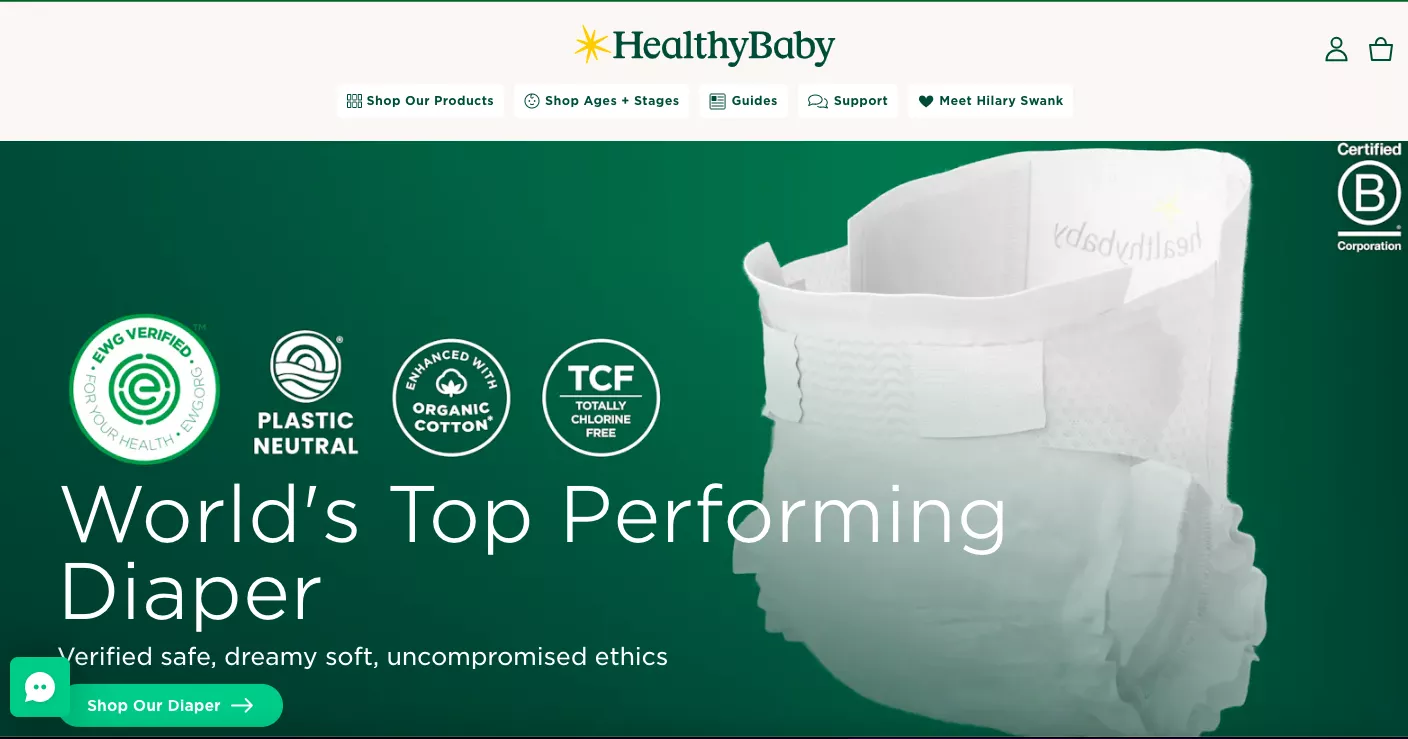
I mean, you would have to really convince yourself — or see some kind of customer testimonial — for you to believe that.
Bounce Rate Tactic #2: Showcase Benefits (Make the Value Instantly Obvious)
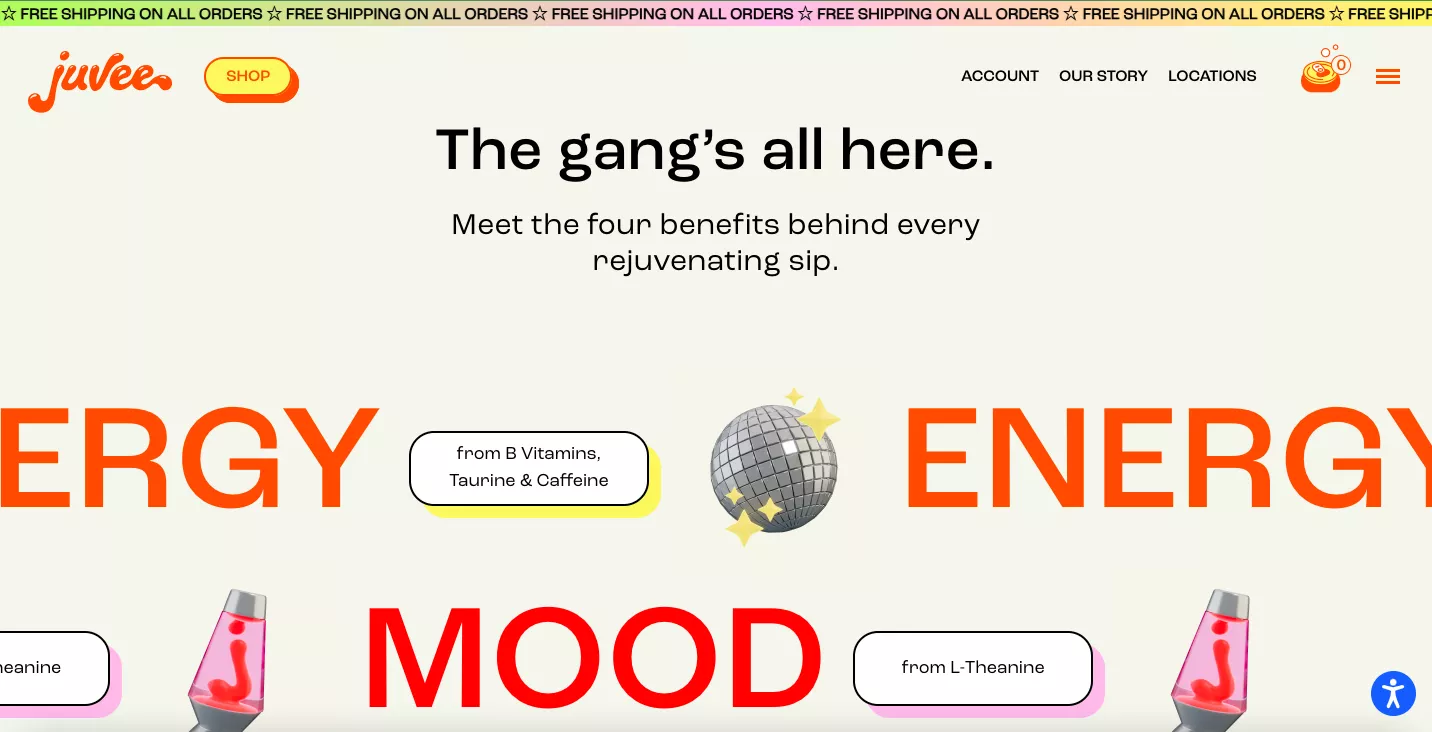
Showcasing benefits — in this case, for example, these lava lamps that you see are interesting.
They talk about what the product originates from. For example:
- energy comes from B vitamins, taurine, and caffeine,
- mood enhancement happens from the theanine that’s in the product.
A very interesting way to showcase the value prop without making it boring.
So in your case as well — I don’t know if you're doing this — but if you're selling something as simple as a t-shirt:
- can you talk about the material of the t-shirt in a slightly more confident way?
- can you talk about where it originates?
- can you talk about using sustainable packaging?
- can you talk about using sustainable ink?
- can you talk about the fact that it does not have any tags for someone to be irritated with?
There are so many things that we sometimes overlook that exist in our product, and we fail to emphasize those benefits.
So please think about those.
Bounce Rate Tactic #3: Highlight the Most Important Categories Immediately
Highlight the most important categories right away.
So now I want to connect this point to the earlier point — which is to tell shoppers what you can do for them.
In this case, you instantly walk them through the different problems you can solve for them, or the different things you can do for them the moment they land on the site.
So in this case, for example, the moment you land on Milk Bar, you instantly know that they do:
- cake
- cake truffles
- pies
- cookies
- gluten-free
bundles
whatever else might be there
So you know exactly what they do.
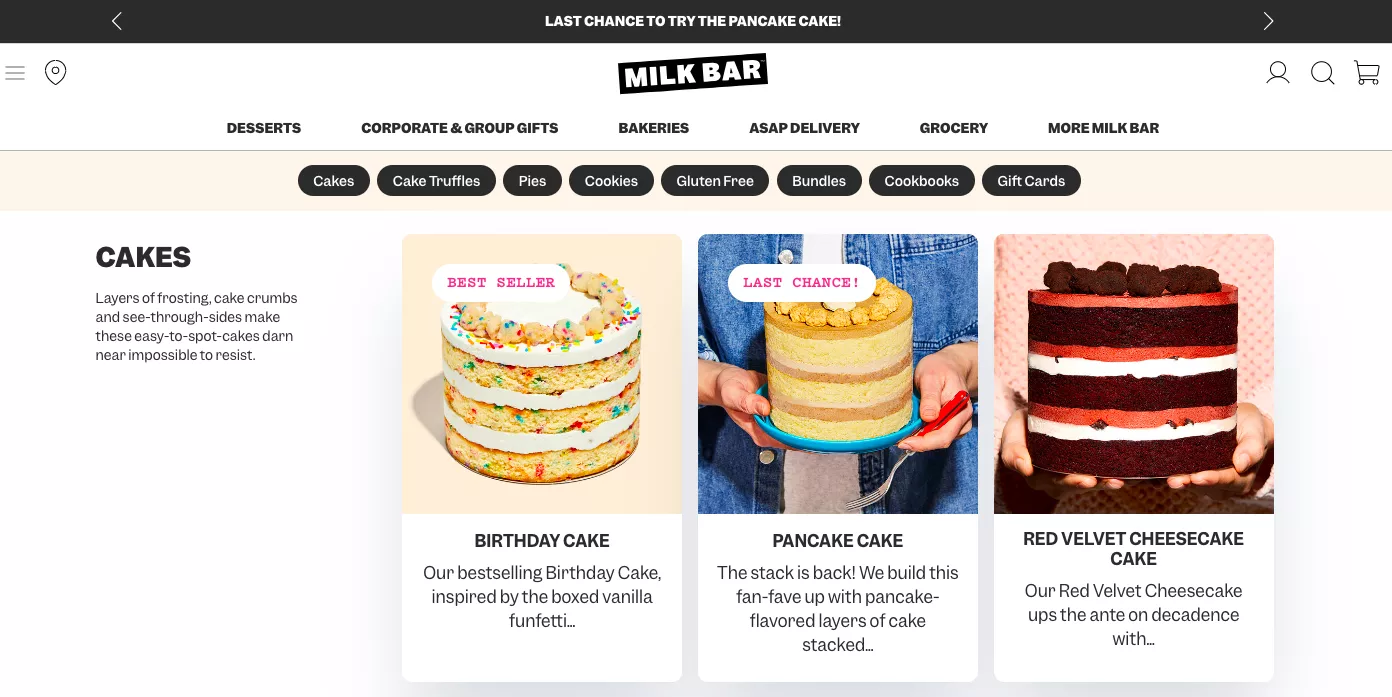
For some businesses, this takes time — and it's kind of surprising to me.
Like if I go on a dresses store that I was looking at just the other day — they do women’s dresses. But it takes very long for me to know that it’s actually bridesmaids’ dresses that they specialize in. That’s their specialty.
So I think if they just lay it out in terms of categories — bridesmaid dresses, summer dresses, I don’t know — all of the different things they could possibly do… just make it extremely easy for me to instantly realize everything you’re offering.
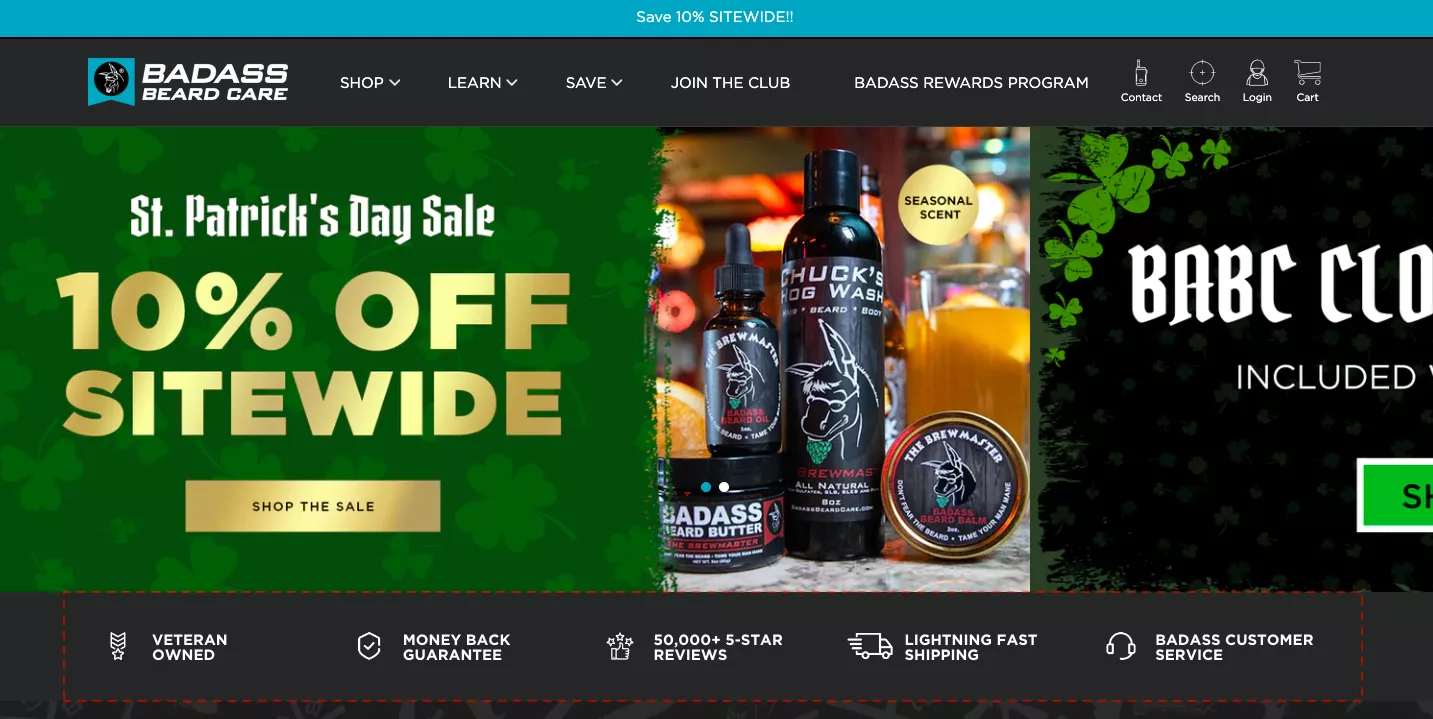
Bounce Rate Tactic #4: When You Run a Big Sale, Be Loud About It
When you're running a big sale, really be loud about it.
So I’ll just give the St Patrick’s Day sale example.
In some cases, I see businesses don’t announce it well enough. Your sale days should look very different from your non-sale days. That’s when your repeat traffic will actually respect the sales you're running.
Otherwise, you will be that store that is always on sale — because your sale days and your non-sale days have no difference.
Think about it.
Bounce Rate Tactic #5: Show the Love You Get From Your Customers
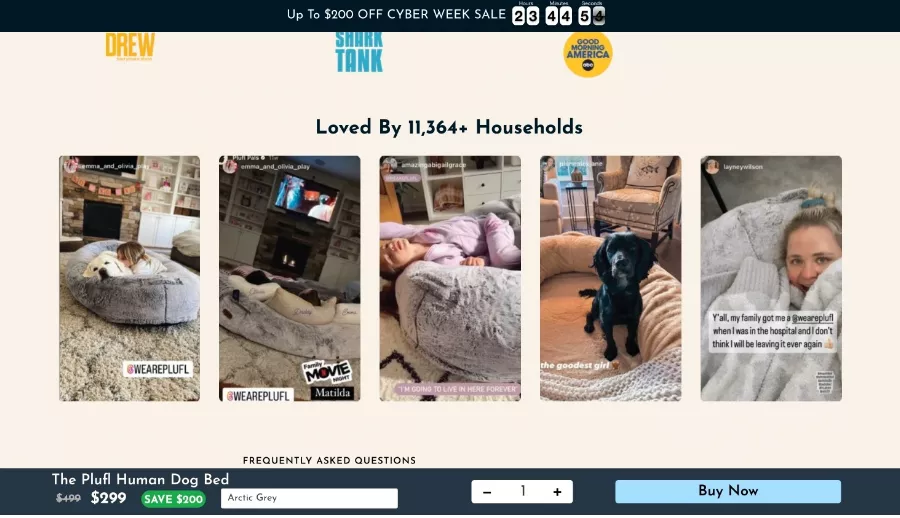
Show the love you get from your customers.
Real household pictures — in this case, customers that are posting about the product on Instagram with their pets are being given a free pillow, or something on those lines.
I know this for a fact because I tried it myself, and I would again strongly recommend something like this.
Bounce Rate Tactic #6: Pop An Exit Intent With Products Similar To What They Were Looking For
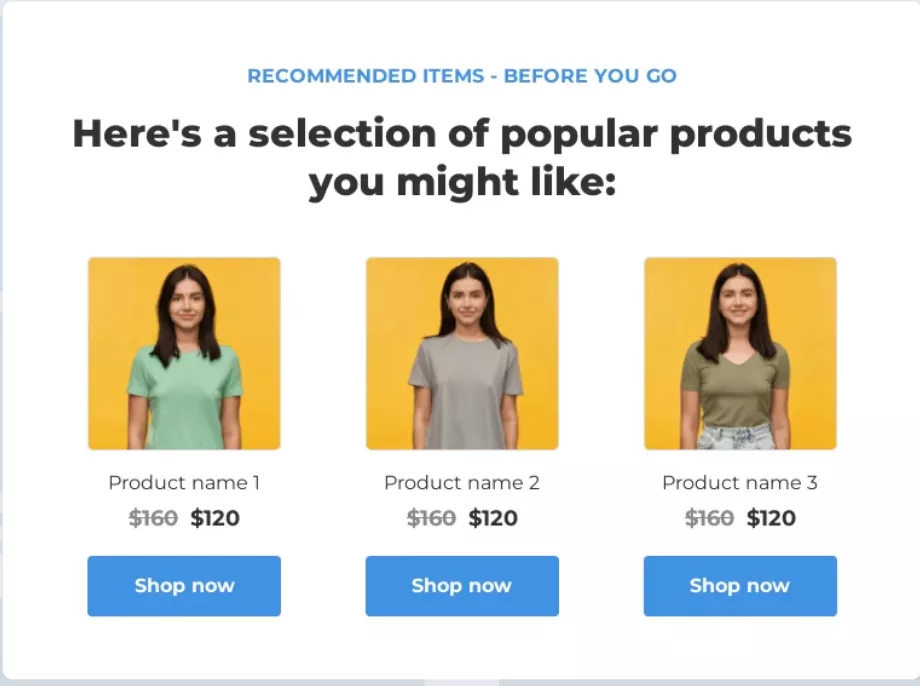
Exit intent is very, very effective — but it only applies to desktop.
I know your desktop traffic is probably 20–30% of your traffic, but it’s also your highest converting device. So I would strongly recommend using exit intent intuitively and implementing it in a way that is relevant to the journey of the customer.
In this case, you are showing them product recommendations in the popup.
Bounce Rate Tactic #7: Or, Give Them a Discount + Drive FOMO
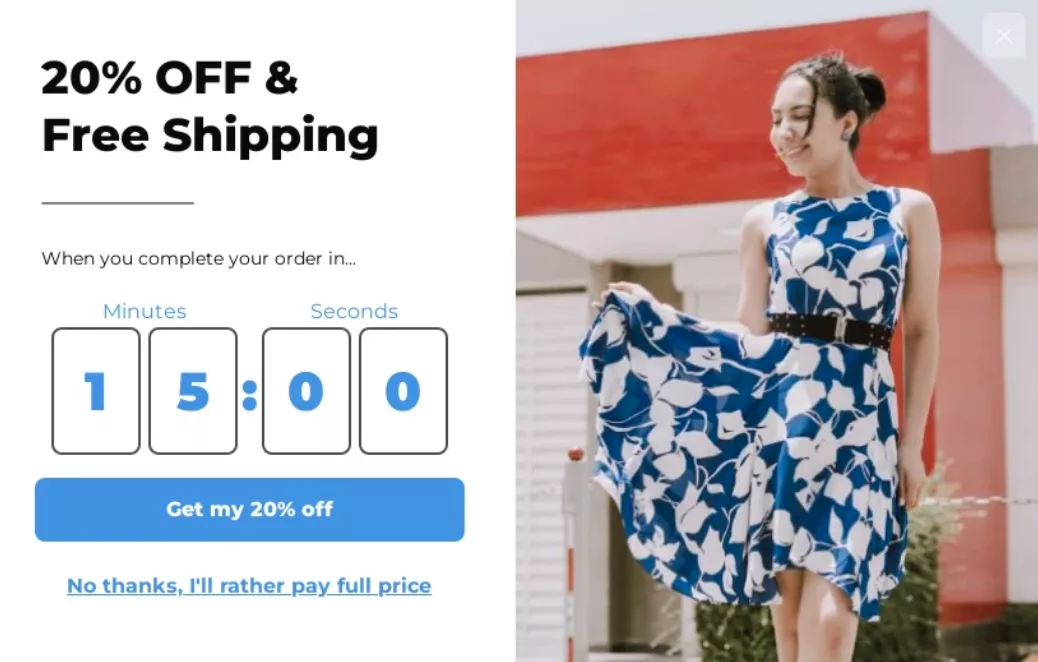
Moving further — a 20% off on shipping, for example. Again, it's time-bound. So there are many things happening here:
- there is a timer,
- there is a shipping offer, and
- to close the popup, you have to essentially say, “No, no — I’ll pay the full price.”
So you're essentially giving people a little bit of FOMO.
By doing this — another way in which I've seen companies implement this is by saying that “we only have 50 such coupons we give out every day.”
And you could just show them: “This is coupon 31 out of 50 today.”
I would recommend that you implement something on those lines.
That would make the customer feel that they… like, for example:
If you shop here — there's a mall called DFO — if you shop there, the parking is really expensive. It’s like 15 bucks for parking.
But if you shop, you get a parking coupon where you get like a 70% off on your parking when you're checking out.
It’s interesting — but every store has those parking coupons.
But generally, they run out.
So they have limited coupons.
So you understand what's happening. It's the best mall in the city — you would definitely want to go there because of the amazing collection of brands they have — but you would also be compelled to check out because they'll run out of the parking coupons, and you want to pick up one.
And you'll only pick up one when you check out somewhere.
So that’s interesting.
Bounce Rate Tactic #8: Don’t Ignore Chat — It’s Underrated and Underused
So I think in this case, for example, Lowe’s is doing a great job of maybe popping up a chat.
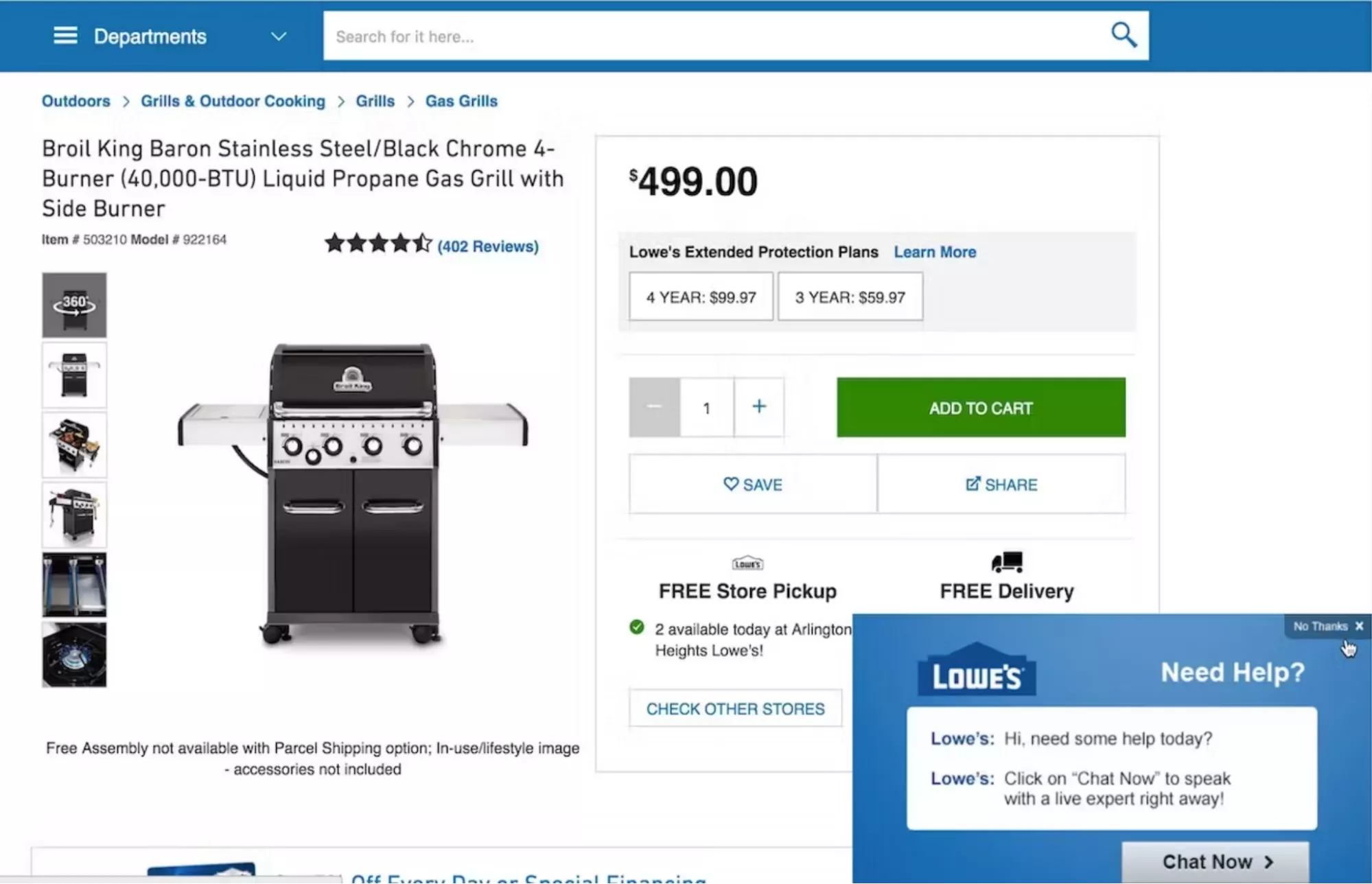
I wanted to show you this also because it's a very simple way of doing this.
But generally speaking, chat is often ignored, underrated.
You're probably sitting on it one or two hours a day — somebody in your office probably doing this as an add-on responsibility.
Consider taking it to the next level.
Especially if you're selling high-value products, your customers are very likely to have questions about them.
Bounce Rate Tactic #9: Make Key Categories Instantly Visible on Mobile
This is my earlier idea — which is highlighting the most important categories — implemented for mobile.
Your key categories should be instantly available on the phone as well.
Again, the phone has less screen real estate, so it takes time.
And then you've got showing the low-hanging fruits up top.
So in this case, in fact, I would go as far as recommending what you could do is — instead of showing just any deal — you could show just one deal.
One product that’s on sale, instead of four or five options.
That just brings more focus to whatever it is that you're selling, and it goes a long way.
So it's a very good A/B test I would definitely want to run.
Closing Remarks
Sorry, but I think in the last few minutes I’ve kind of run us through seven or eight different ideas.
Again, I'm glad that you were able to join me.
I think that brings us to the end of everything that I had today.
This is the most number of ideas we've ever given in a webinar, so I really hope for everyone here it has added value.
Again, I have a couple of questions in my DM which I have just answered while talking — really simple ones.
Okay, perfect.
Folks, thanks so much for joining us once again.
Get Fresh ideas to boost your conversion rate
(stuff that works for hundreds of stores)
Request a Free Site Audit"Convertcart’s Audit Report was deep and insightful. We never thought they would spend so much time in building and sharing such insightful content, free of cost."


Logan Christopher
Lost Empire Herbs