

Trusted by 500+ companies


Glossary
A repository of acronyms, jargon, and useful definitions perfect for eCommerce founders & marketers like yourself.
Here is a thought that should keep you up at night.
You spend a small fortune driving people to your website, and then roughly 97% of them leave without buying.
They browse, and they wander off. And you've paid for every single one of them. Conversion Rate Optimization is the discipline dedicated to fixing that.
It’s about persuading more of the visitors you already have to do something useful, like buying a product, signing up for an email list, or booking a call.
Think of it this way. If your website were a shop on the high street, SEO is what gets people in through the door. CRO is what stops them from wandering out empty-handed.
It is the art and science of making your website work harder, so you don't have to spend more.
At its core, CRO is a process. You look at how visitors actually behave on your site, where they click, where they hesitate, where they give up and go to a competitor, and then you make changes to remove whatever is getting in their way.
A "conversion" can mean different things depending on what you're after. Buying something is the obvious one. But signing up for a newsletter, adding a product to a wishlist, or clicking a demo button all count as conversions too. The small victories matter because they tend to lead to the big ones.
The maths is pleasingly simple:
So what's a good conversion rate? It depends entirely on who you are and what you're selling. But here's a rough guide to where different industries tend to land:
Here’s a word of caution about benchmarks: treat them as a rough compass, not a target to obsess over.
The only number that genuinely matters is whether yours is improving. Even nudging your rate from 2% to 3% on a site doing £500,000 a year adds £5,000 in revenue without spending an extra penny on advertising.
Here is the part that surprises most people: good CRO is not guesswork. It follows a loop, and that loop is what makes it compound.
The process goes like this. You start by researching how people are actually using your site.
Tools like heatmaps (which show where people click) and session recordings (which show exactly what they do before they give up) are extraordinarily revealing.
You'll discover that users are clicking things that aren't clickable, missing your best offers entirely, and abandoning checkout because they can't find the delivery cost.
Then you form a hypothesis: "If we move the delivery price to the product page, more people will add items to their cart."
From there, you run a test: typically showing version A to half your visitors and version B to the other half. You measure the results, declare a winner, make it permanent, and then start the whole cycle again with a new hypothesis.
That last part, starting again, is the bit people miss. CRO is not a one-off project. It's a habit.
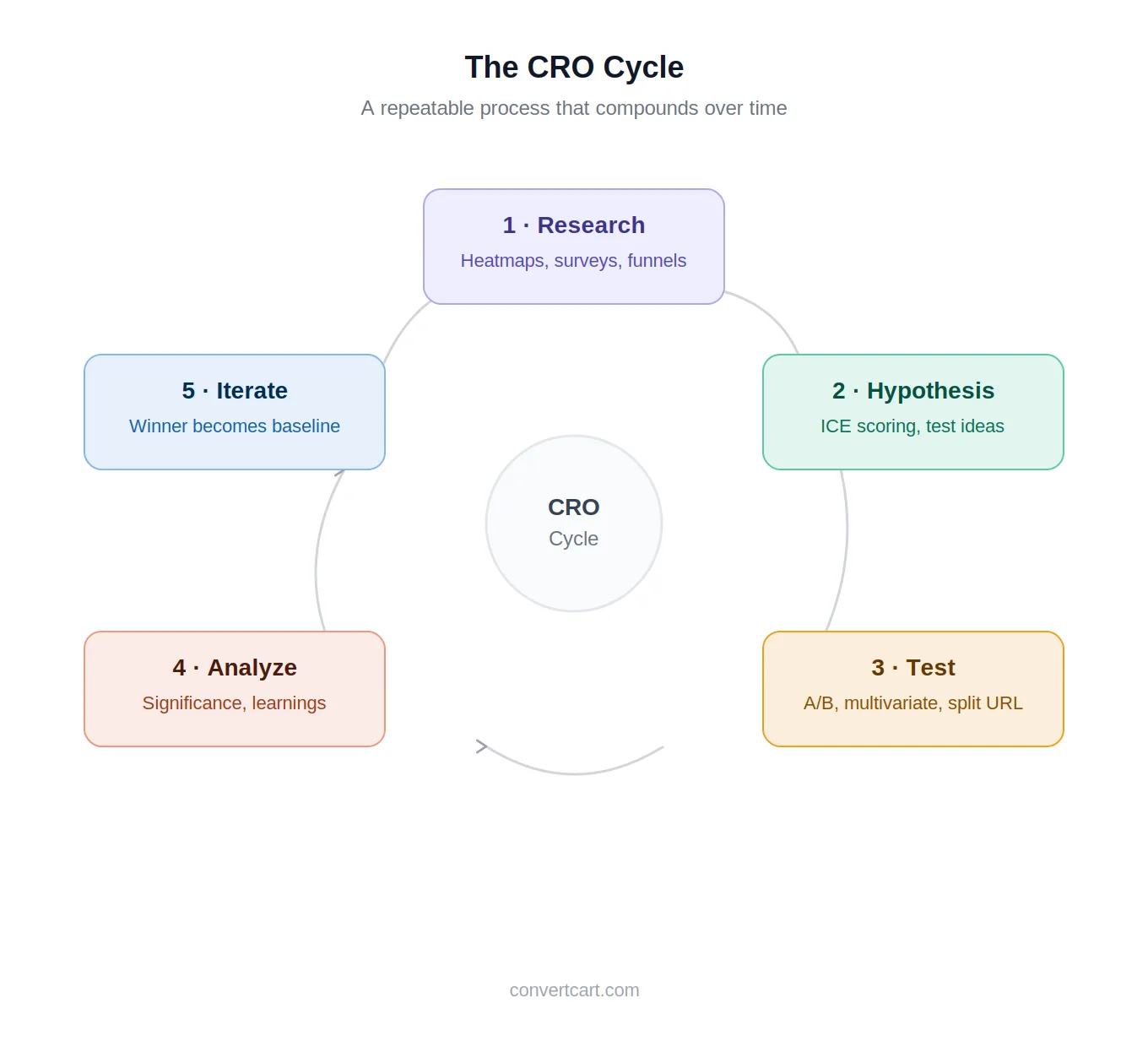
CRO has accumulated a fair amount of vocabulary. Here's what the important ones actually mean.
A/B Testing
A/B testing is the practice of showing two different versions of a page to different visitors at the same time, then measuring which one performs better.
It sounds simple, and it is, but the devil is in running tests long enough to trust the results.
Heatmaps
Heatmaps are visual overlays that show you, in warm colours, where visitors click, tap, and scroll. Cold colours show where they don't bother. They're often the fastest way to spot a problem.
Session Recordings
Session recordings let you watch anonymised replays of real user sessions. Watching someone spend three minutes hunting for your returns policy before quietly leaving is humbling, but useful.
Funnel Analysis
Funnel analysis maps the steps between landing on your site and completing a purchase, and shows you exactly where people drop off. Usually it's somewhere you'd never expect.
Statistical Significance
Statistical significance is the confidence level that tells you a test result is real, not just lucky noise.
Most practitioners aim for 95% before calling a winner. It means running tests longer than feels comfortable, but calling things early is how you make expensive mistakes.
ICE Scoring
ICE scoring (Impact, Confidence, Ease) is a simple framework for deciding which tests to run first when you have more ideas than time. You score each idea out of ten on all three dimensions, multiply them together, and the highest number wins.
One fills the funnel. The other stops it from leaking. You need both.
SEO is how you get people to your website in the first place. It's about keywords, backlinks, and convincing Google that your pages are worth showing to people. CRO takes over from where SEO leaves off: once those people arrive, it works to make sure they don't immediately leave.
SEO tends to take months to show results. CRO can show results in days, sometimes hours. SEO is upstream; CRO is downstream. The best-performing eCommerce businesses tend to invest in both simultaneously, because there's no point in filling a bucket that has holes in it.
The honest answer is that you need CRO if you have a website and a goal. But it earns its keep most visibly in a few specific places.
Checkout pages tend to produce the biggest wins, because they're where intent is highest, and friction is most costly. Product pages matter enormously.
The difference between a good product image and a mediocre one, or between a clear size guide and a vague one, can shift conversion rates meaningfully.
Landing pages live and die on CRO, because they're designed to do one job and one job only.
But CRO applies just as readily to SaaS businesses trying to get trial sign-ups, to media companies converting readers into subscribers, and to travel sites trying to stop people abandoning a five-step booking form halfway through.
Wherever someone has to take an action, CRO has something to offer.
Because it's the only way to grow revenue without simply spending more to acquire it.
The case for CRO tends to become very clear very quickly once you run the numbers. More revenue from the same traffic is the headline benefit, but the second-order effects matter too.
.avif)
.svg)


.svg)

.svg)
.svg)
2026 Convertcart, All Rights Reserved
33/1, Castle Street, Ashok Nagar, Bengaluru, India