If you think email marketing is old-school, think again.
2026 is redefining how brands connect with customers.
From AI-powered automation to interactive eCommerce emails, the latest email marketing trends are transforming the inbox into a personalized experience hub.
For eCommerce brands, especially, email marketing for eCommerce is no longer just about sending discounts or product drops; it’s about creating stories, experiences, and conversations that convert.
The new wave of eCommerce email marketing focuses on localization, real-time personalization, and ethical engagement that customers actually want to open.
In this guide, we’re breaking down the biggest email marketing trends for 2026 Q1, covering automation, design, and data strategies that are driving results right now.
Whether you’re refining your eCommerce email strategy or building your next big campaign, these insights will help you send emails that connect, convert, and stand out in every inbox.
1. AI-Powered Journey Orchestration: Timing Is Everything
In 2026, email marketing is getting smarter, not just faster.
The next generation of automation tools is evolving into full-fledged “journey orchestrators” that don’t just react to customer behavior but predict it.
Imagine your eCommerce email marketing system knowing when your customer is most likely to open their inbox, how local weather might influence their shopping mood, or what product they’re about to consider next.
AI now combines real-time data like time zones, weather conditions, browsing history, and purchase intent to send the right email at the right moment.
For eCommerce email campaigns, this means no more one-size-fits-all scheduling.
A customer in Miami might get a morning “Fresh Drop” alert during their commute, while someone in London receives it just before their evening stroll.
The result? Higher open rates, better engagement, and emails that actually feel intuitive.
For example:
No more “blast on Tuesday at 10 AM.”
Instead:
A shopper in Miami gets a sunny-day push right before their morning commute.
Someone in London gets the same drop at dusk, when they typically browse on their walk home.
Same campaign. Two totally different delivery moments.
The result? Emails that feel natural, not scheduled.
Higher opens, smoother conversions, zero friction.
2. Real-Time Analytics and Adaptive Campaigns: The End of “Set It and Forget It”
In 2026, email marketing isn’t something you schedule and pray for anymore; it’s something that thinks, reacts, and evolves the moment you hit send.
With AI-powered dashboards and instant engagement tracking, marketers can now watch a campaign perform in real time.
Picture this: your eCommerce email goes out to thousands, and within minutes, your system knows:
Which subject line is pulling the crowd
Which CTA is doing the heavy lifting
When engagement starts to dip
Which segment is responding differently than expected
No more waiting for end-of-day reports. No more post-mortems.
Your system now tweaks the running campaign mid-send, from timing to layout to copy tone.
It’s like your email campaign has a built-in editor sitting in the control room, making micro-adjustments to maximize results.
Things to remember when setting up an adaptive campaign
Give your system options to play with. Don’t send one version; give it multiple subject lines, CTAs, and designs so it has something to optimize.
Keep an eye on the first few minutes. Even with smart automation, those early signals help you spot anything weird.
Check the learnings afterward. Real-time optimization is great, but the insights you gather help you plan the next big win.
3. Advanced Behavioral Segmentation: Predicting What Shoppers Want Next
Gone are the days when email segmentation meant grouping customers by gender or purchase history.
In 2026, email marketing is all about understanding intent, not just identity.
With the rise of predictive algorithms and AI analytics, brands can now create ultra-detailed segments based on micro-actions, such as how long someone hovers over a product, how far they scroll, or how often they revisit a sale page.
These behavioral cues give marketers real-time insight into what customers almost bought and what might push them to finally convert.
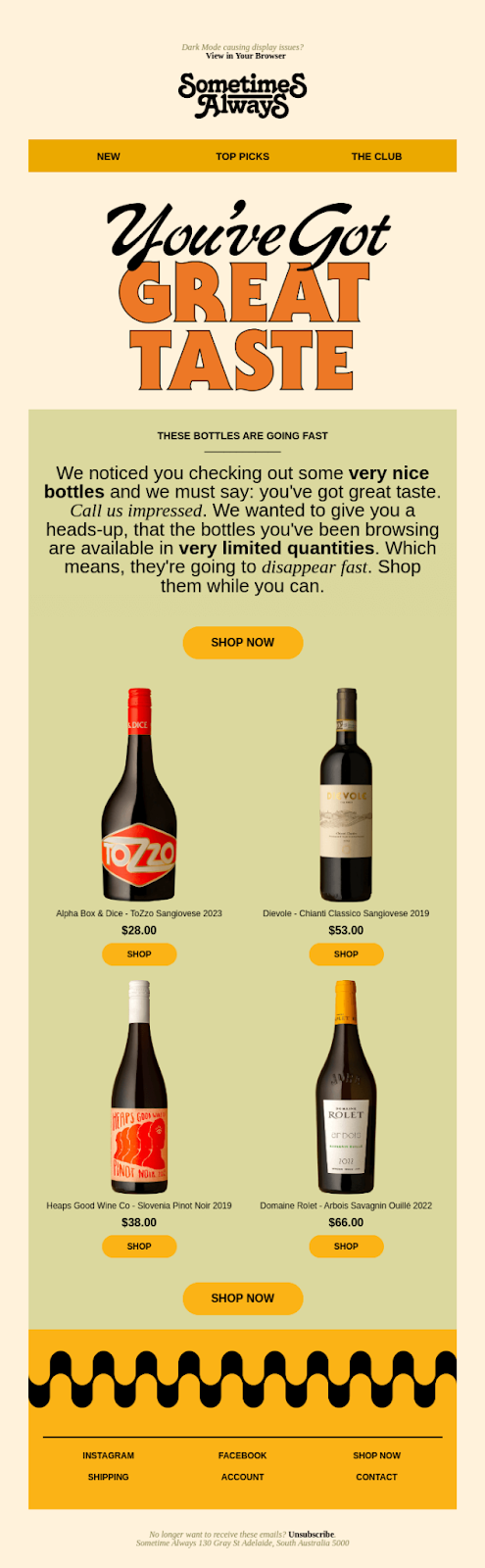
For eCommerce email marketing, this means your campaigns can now respond instantly to shopper behavior.
Imagine sending a gentle reminder email just as a customer leaves a product page, or offering a personalized discount based on their browsing pattern.
This kind of advanced behavioral segmentation turns every eCommerce email into a smart, adaptive message, boosting engagement and conversion rates across the board.
In short, the future of email marketing for eCommerce isn’t just about who your customers are; it’s about what they do next.
4. A/B Testing: Crafting Emails That Evolve With Your Audience
In 2026, email marketing has moved way past the old “test two subject lines and pray” routine.
Today’s tools run continuous A/B testing; basically, your campaign keeps adjusting itself while it’s live.
The big question readers always have is:
“Okay, but what does that even look like in real time?”
Here’s the picture:
Your email goes out in multiple versions, maybe a few subject lines, two banner designs, different CTAs, and slightly different send times.
As customers start interacting with them, AI watches every micro-signal:
Which subject line gets opened fastest
Which hero image makes people scroll
Which CTA gets clicked on mobile vs desktop
Which sends time hits when people are actually active
Which tone sounds more natural for that region or segment
And instead of waiting days for results, the system starts shifting traffic immediately.
If Subject Line C is outperforming A and B, Boom, it becomes the dominant version.
Is the blue CTA beating the red one by lunchtime? The system rolls out blue for the rest of the audience.
If evening send times outperform morning for a segment? The next wave adjusts automatically.
It’s not magic, it’s just tons of tiny experiments, all happening at once, and all updating live.
This is what makes continuous testing one of the biggest eCommerce email marketing trends of 2026: Your emails get smarter with every open, click, swipe, and skim.
For brands, that means less guesswork, fewer flops, and emails that feel strangely “just right” for each person who receives them.
Your audience changes daily, their mood, their device, and their attention span, and now your emails can change right along with them.
5. Localization and Globalization: Speaking Every Customer’s Language
By 2026, eCommerce brands won’t just personalize emails for individuals; they’ll adapt entire campaigns for cultures, regions, and markets.
Cross-border eCommerce is exploding, and customers now expect brands to understand their culture, buying norms, seasonal cues, humor, and even regional sensitivities.
This goes beyond translation.
It’s about:
Cultural tone-matching: Different humor styles, formality levels, idioms, and emotional triggers per region.
Local shopping context: Currency, taxes, delivery expectations, payment methods, and return norms customized for each market.
Market-specific visuals: Colors, imagery, and design conventions that align with local culture (e.g., white = purity in the West, mourning in some Asian regions).
Seasonal + weather-specific content: Not just global holidays—local festivals, weather patterns, sporting events, payday cycles.
Regulatory localization: Adapting emails to comply with each region’s privacy and marketing laws.
Modern tools don’t just translate; they use AI cultural modeling to recreate the same message as if it were written from inside that country.
This is where globalization meets neighborhood-level familiarity:
A Swedish customer sees midsummer references,
A Brazilian customer sees Carnival delivery delays,
A Singaporean customer sees heatwave-related product picks.
When done right, global brands stop feeling foreign—and start feeling like local favorites.
6. Multi-Screen Email Marketing: Designing Beyond the Inbox
In 2026, email marketing isn’t just happening on phones and laptops; it’s following your customers everywhere.
From smartwatches and voice assistants to car dashboards and smart TVs, the inbox is expanding into new, everyday spaces.
This shift means eCommerce email marketing has to evolve, too.
Shoppers might now glance at your eCommerce email notification on their smartwatch, hear a product teaser read aloud while driving, or tap through an interactive offer from their TV screen.
Designing emails that adapt seamlessly to these new touchpoints is quickly becoming one of the biggest email marketing trends of the year.
For brands, this means prioritizing clarity, brevity, and responsive design.
The subject line has to catch attention in three words, visuals need to scale to any screen, and CTAs must be voice-friendly and tap-friendly.
The goal? Deliver a smooth, engaging experience across every device, not just mobile and desktop.
As email marketing for eCommerce continues to blur the lines between digital and physical spaces, brands that master multi-screen design will turn every notification, glance, or swipe into an opportunity to connect.
7. Sensory Language: Making Emails Feel Alive
The next big wave in email marketing isn’t just about personalization, it’s about emotional immersion. In 2026, brands are using sensory language to create emails that don’t just inform, but feel.
Instead of generic product descriptions, eCommerce email marketing is shifting toward words that evoke touch, taste, sound, and emotion.
Think: “buttery-soft fabric that hugs you back” or “the crunch of your first morning bite.”
Paired with data on audience mood and browsing behavior, these sensory cues help brands send messages that match how customers are feeling in that moment.
This subtle emotional targeting is becoming one of the most effective email marketing trends, especially for eCommerce email campaigns.
Imagine sending warm, cozy copy during a rainy week, or high-energy product launches when customers are in a weekend-shopping mindset.
When you blend creative storytelling with emotional intelligence, email marketing for eCommerce is evolving beyond visuals and discounts; it’s becoming an experience readers can almost touch.
8. Accessibility-First Design: Inclusivity Is the New Standard
In 2026, great email marketing isn’t just beautiful, it’s accessible.
As digital communication evolves, brands are realizing that accessibility isn’t optional anymore; it’s a core part of user experience and brand integrity.
Accessibility-first design goes far beyond color contrast.
The latest email marketing trends highlight innovations like AI-powered alt-text generation, smarter screen-reader optimization, and adaptive fonts that automatically adjust for readability across devices and user needs.
For eCommerce email marketing, this means every message can be understood, seen, or heard, regardless of how someone interacts with it.
Inclusivity is also expanding to embrace neurodiverse audiences, a key focus for email marketing for eCommerce in 2026.
Subtle changes like cleaner layouts, reduced animation overload, calmer color palettes, and consistent CTA patterns help create an experience that feels welcoming and intuitive to everyone.
The most forward-thinking eCommerce email campaigns are already setting a new standard: accessible by design, empathetic by intent.
As eCommerce email marketing becomes more human-centered, accessibility isn’t just compliance; it’s connection.
9. Zero-Party Data Expansion: The Era of Willing Personalization
Privacy isn’t killing email marketing, it’s redefining it.
As third-party cookies disappear and consumers become more data-conscious, 2026 is ushering in the age of zero-party data, information that customers choose to share directly.
In modern eCommerce email marketing, this means collecting insights through micro-surveys, polls, and gamified quizzes right inside the inbox.
Instead of tracking users in the background, brands are simply asking: “What do you love?” or “Which color suits your mood today?” and customers are happily responding.
This shift marks one of the biggest email marketing trends of 2026.
Zero-party data allows marketers to craft truly personalized eCommerce emails that reflect customer intent, not assumptions. It also builds trust, a priceless currency in the digital age.
For brands focused on email marketing for eCommerce, it’s a win-win: customers feel seen and heard, while marketers gain accurate, consent-based insights to power segmentation, recommendations, and future campaigns.
In short, eCommerce email marketing in 2026 isn’t about guessing who your customers are; it’s about inviting them to tell you and rewarding them for it.
FAQs - eCommerce Email Marketing Trends
1. Is email marketing still effective in 2026?
Absolutely, maybe more than ever. Despite the rise of social media and AI chat interfaces, email remains one of the highest ROI channels for eCommerce. The difference is how it’s done.
Email marketing and eCommerce strategies are now more creative, data-driven, and user-centric.
Brands that focus on quality over quantity, sending the right email at the right time, are seeing stronger engagement, higher conversions, and deeper loyalty.
In short, email isn’t going anywhere. It’s just getting smarter, faster, and more personal.
2. How can eCommerce brands make their emails stand out in 2026?
Standing out in the inbox takes more than great visuals; it takes strategy. The best email marketing for eCommerce combines three things:
Emotion – Writing that connects (think sensory language and storytelling).
Timing – AI-driven delivery based on real-time behavior.
Trust – Transparent data practices and user-first personalization.
The winning formula for 2026 is simple: don’t chase clicks, build connections. When your emails feel intuitive and human, they naturally perform better.
3. What role does personalization play in 2026 email marketing?
Personalization is no longer a “nice-to-have” — it’s the backbone of email marketing in 2026. But here’s the key difference: it’s not just about using someone’s first name anymore.
This year, personalization is powered by AI, emotion mapping, and real-time data. Your eCommerce email marketing platform can now track how customers interact across channels, predict what they might buy next, and automatically tailor content to their intent and timing.
Picture this: you browse a summer collection at 8 p.m., and by 8:05, you receive an eCommerce email showing your size in stock — styled with your past purchase preferences. That’s not magic — that’s modern personalization.
It’s what separates generic messages from meaningful moments. And it’s why personalization remains one of the most profitable email marketing trends in 2026.
4. What metrics will matter most in 2026 email marketing?
Forget open rates — the real power lies in engagement depth.
In 2026, marketers are focusing on metrics like scroll depth, dwell time, click intent, emotional tone response, and post-email conversion behavior.
AI dashboards are giving brands richer insights into how users interact, not just if they do. For eCommerce email marketing, these behavioral insights will help refine personalization, predict churn, and build more loyal customer journeys.
It’s the difference between sending emails and sending experiences.
5. How often should eCommerce brands send emails in 2026?
Quality over quantity is the mantra of 2026. With inboxes more crowded than ever, email marketing eCommerce strategies are shifting toward intent-based sending.
That means emails are triggered by behavior, not by calendar. If a customer interacts with your brand multiple times in a week, they’ll receive timely follow-ups. If they go quiet, your next message might be a re-engagement story instead of a sales pitch.
The sweet spot? Two to four meaningful emails a month — tailored, valuable, and emotionally intelligent.
6. What’s one mistake brands should avoid in 2026 email marketing?
The biggest mistake? Treating email as a broadcast channel.
Email marketing for eCommerce in 2026 is a conversation, not a campaign. Over-sending, ignoring personalization, or skipping accessibility alienates users fast.
Instead, focus on creating value with every send. Make your readers feel seen, understood, and appreciated. When your emails respect attention, they earn it.
Upgrade your online store conversions
98% of visitors who visit an eCommerce site drop off without buying anything.
Even when you feature the best eCommerce promotions.
Why: user experience issues that cause friction for visitors.
And this is the problem Convertcart solves.
We've helped 500+ eCommerce stores (in the US) improve user experience and 2X their conversions.
How we can help you:
Our conversion experts can audit your site - identify UX issues, and suggest changes to improve conversions.
Subscribe for more articles like this!
Thank you - we'll see you in your inbox soon!
Oops! Something went wrong while submitting the form.
Read by 5000+ ecommerce store owners
Subscribe for more articles like this!
Thank you - we'll see you in your inbox soon!
Oops! Something went wrong while submitting the form.







.avif)
.svg)


.svg)

.svg)
.svg)
