Email Marketing
What is the Best Time to Send eCommerce Emails?
July 8, 2026

Insights in this post come from our CRO team's decade of experience working with eCommerce brands. Written by Sumedha Gurav and Abhishek Talreja. Reviewed by Harsh Vardhan.


Insights in this post come from our CRO team's decade of experience working with eCommerce brands. Written by Sumedha Gurav and Abhishek Talreja. Reviewed by Harsh Vardhan.

You scheduled it for Wednesday morning. Best day, everyone says.
You hit send, watched a few opens trickle in over coffee, then got pulled into your day.
By the time you looked again, it was basically over: a handful of opens, fewer clicks, and that quiet was it the offer, or just the wrong moment?
Rewind your last sales email and try to place the exact moment it lost people.
The hour it landed? The morning open that never became an afternoon click? The Sunday send that felt safe and slipped past everyone?
Most store owners can't point to the moment, which is exactly why "best time to send" stays so slippery, whether it's a promo, a Wednesday campaign, or a full sales push.
A few patterns do hold almost everywhere, and each one points to a section below:
Data Sources:
⚠️ Note: Apple's Mail Privacy Policy automatically reports emails as opened, irrespective of whether the email has actually been opened – meaning, actual opens may be lower than what you would expect.
You're feeling this if your open rates swing wildly from send to send, same list, same kind of offer.
A great email that lands in a dead inbox never gets the chance to be great.
That's all timing does: it buys your subject line, your offer, and your brand the moment they need to actually be seen.
It won't rescue a weak offer, and it won't paper over a subject line nobody opens. But it's the one variable you can fix this week without rewriting a single word.
Here's why the "right time" isn't the same for your store as the one in the chart. Run these against your own list:
That last one is the quiet problem. You can nail the hour and still get ignored if you've trained your list to tune you out. Timing gets you the open. What you do with the rest is the next few sections.
You're reading this section if you've been sending on the same day out of habit and never tested whether it's the right one.
Before we start: none of this applies to your triggered emails. Cart abandonment, welcome flows, back-in-stock, those fire off subscriber behavior, not a clock, so leave them out of this entirely. What follows is only for the campaigns you choose to schedule.
The days don't line up in a neat Monday-to-Sunday ranking.
They cluster by what people are doing when your email lands, and once you see the three groups, the timing stops feeling random.
You're seeing this pattern if your emails get opened, but the clicks come in weirdly late, or not at all.
These are work days, and that single fact drives everything.
People open on their phones early, often mid-commute, then vanish into their day.
The open happens in the morning; the action happens later. Send too late, and you miss the open window entirely; treat the morning open as the finish line, and you miss the buy.
Two of these four days are quietly your best of the entire week, and it's not the two most people pick. One is the strongest open day there is, which is why "just send Tuesday" is advice you'll hear everywhere.
The other is a mid-week day most owners write off as a dead zone, and they're leaving its evening slot completely unused. The morning-versus-evening split is different for each of the four, and getting it wrong is why a "good day" send still underperforms.
The specific windows, day by day:


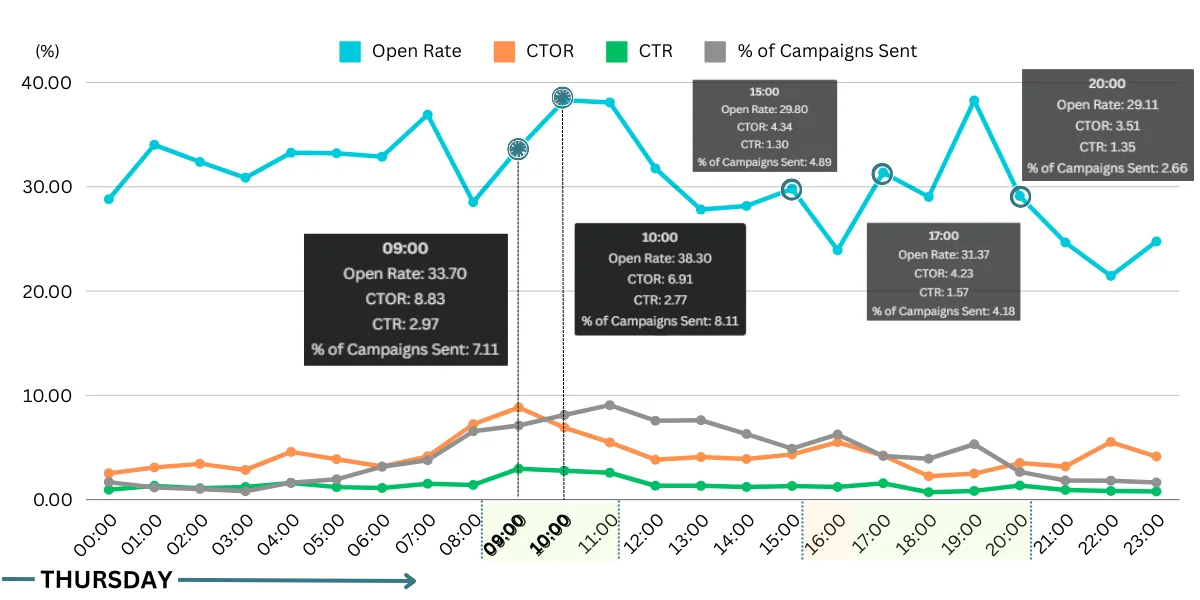
Notice the shape already: the chart's flat "8 AM is best" collapses the moment you look at a real week.
You're seeing this if your weekend sends feel like a coin flip; sometimes they land, sometimes they're gone by the time you check.
This is when people plan and actually spend, and it rewards a completely different rhythm than the heads-down days.
One of these two generates more revenue per email than any other day of the week, and it has a hard cutoff you can watch happen in your own numbers: cross it and opens fall off a cliff. The other is a stock-up morning with the shortest usable window of the week, and a small, risky evening slot most people never test.
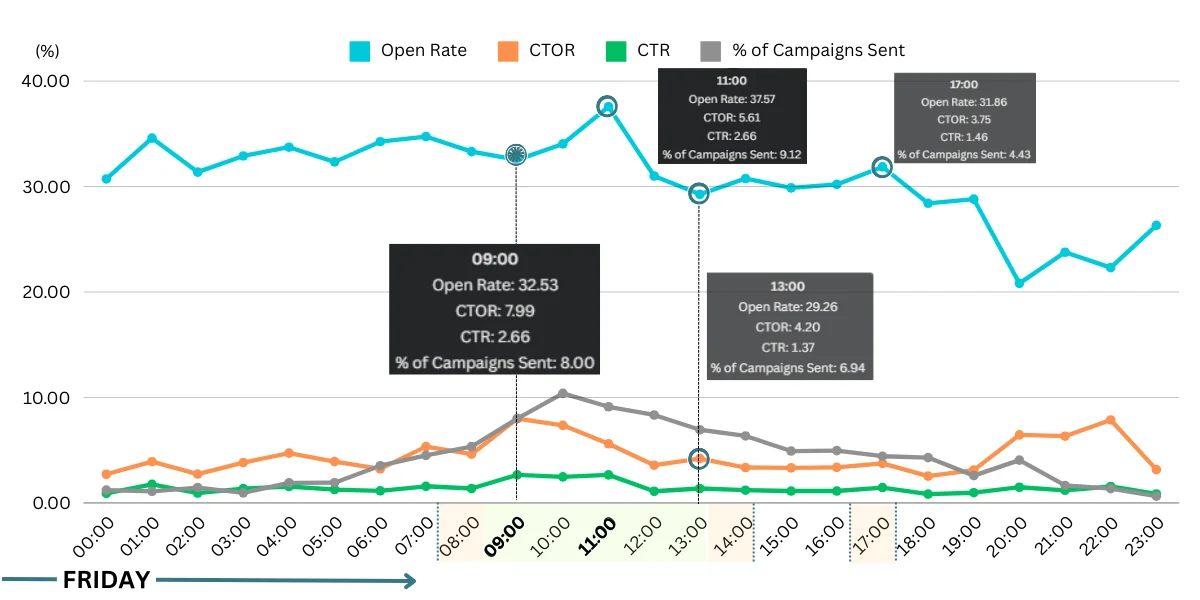
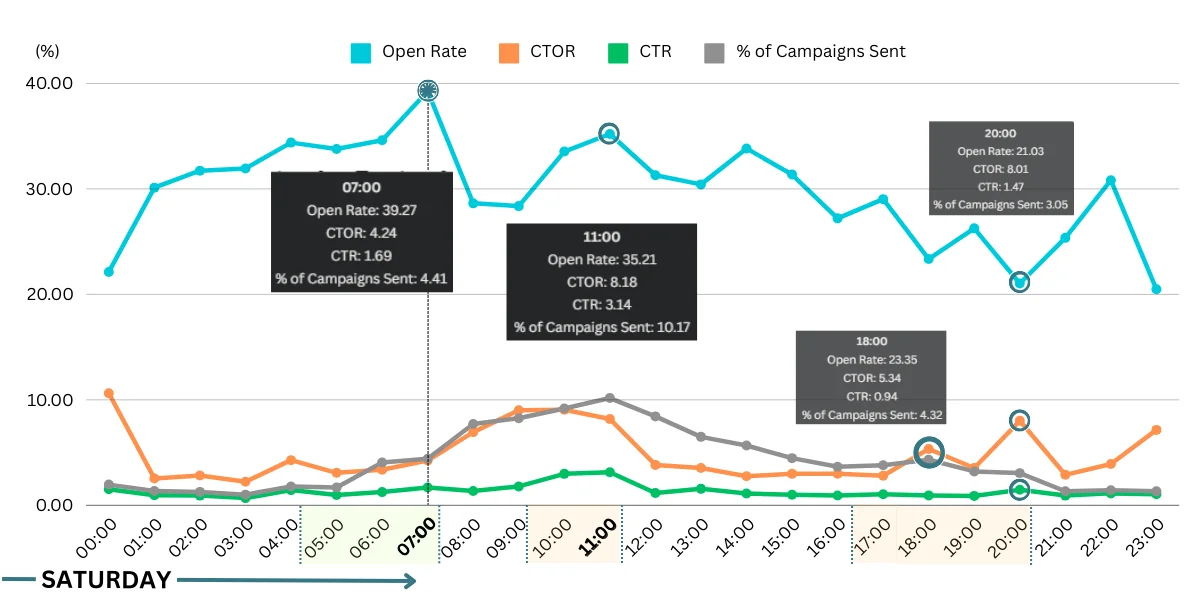
You're seeing this if your Sunday newsletter does better than you expected and you've never known why.
Sunday is its own animal: people are in chill mode, stocking up for the week and quietly prepping for Monday.
There's one moment on Sunday when opens, clicks, and click-to-open all peak together, the only time that happens all week, and if you're sending Sunday without hitting it, you're spending your best window on nothing.

Zoom out, and the pattern is human, not technical: people have almost no room for your email during focused work hours, so the sends that win are the ones already waiting when attention loosens, at lunch, in the evening, on a slow weekend morning.
Opens cluster around 9 to 10 AM on weekdays and 7 to 8 AM on weekends; conversions concentrate around 7 PM on weekdays and 6 to 8 PM on weekends.
But notice what just happened. You now have a published map, and it's better than the one-line "send at 8 AM" version. It's still not yours.
Every window above is an average waiting to be corrected by your own open data, and one more thing worth holding onto: around 44% of people unsubscribe when a brand emails too often, so the right time only works at the right frequency. Which day is your day, and how you'd find it, is where we're headed next.
Here's what breaks during the holidays: the rules above assume a normal inbox, and the holiday inbox is anything but.
A typical subscriber already gets well over a hundred emails a day, and that number spikes hard across the BFCM weekend.
Your perfectly-timed 8 AM Tuesday send is now buried under fifty others sent at the same "optimal" time. The best practice the rest of the year becomes the crowded lane during the holidays.
So you do the opposite of what the chart says, and you send into the gaps:
The through-line for the whole season: when inboxes are loudest, the borrowed schedule everyone's using is worth the least, and your own testing is worth the most.
Greentoe had a subscriber base of 130,000+ that was sitting largely unused, with no structured plan for the moments that matter most.
HTML code so the three images of the emails are shown beside each other with scroll
Convertcart built them a campaign calendar organized around exactly these high-volume windows, which are Thanksgiving, Black Friday, Cyber Monday, and their own promotional events, and timed the re-engagement deliberately instead of blasting the whole list at once.
Those promotional campaigns went on to drive 46% of the store's total assisted revenue through the platform, at a revenue-per-recipient of $20.19.
The takeaway isn't the size of the list. It's that a deliberate, well-timed cadence turned a dormant audience into nearly half the assisted revenue.
You can read the full case study on how Greentoe improved their email conversrate rates.
Here’s what the final report will contain:

“The report was deep and super insightful. Can’t believe it’s free.”
Logan Christopher CEO, Empire Herbs
Everything above was the borrowed map. This is where you draw your own, and it's the reason a store your size can outperform brands ten times bigger on email: they're sending to an average, and you're about to send to your people, at the hours they've already shown you they open.
The method doesn't care about your campaign type, list size, or goal, because it reads all of that from your own history instead of a chart. Here's how it works, start to finish.
If you're a newer sender, you don't have a pattern yet, so begin with the published times from the sections above and just send. After at least three campaigns, you'll have enough open history to stop guessing and start reading. Everything below depends on those first few sends existing.
Nearly every ESP lets you group subscribers by when they open. Build these five from the opens on your last three emails:
Now the count in each segment tells you the truth about your list that no chart can: this is when your subscribers actually show up. If your list is small or you send fewer than three or four times a month, build the segments from the last two opens instead. And if you captured location at signup, you can refine these further by timezone, which matters more than most owners think.
Some campaigns run on a fixed clock no matter what: an event email follows the event, a referral email wants work hours later in the day, around 1 to 5 PM when people can actually act. But anything that needs real attention, a newsletter above all, should be built around your segments rather than blasted at one time.
Here's the pattern for a Sunday newsletter, split into four sends:
That fourth send is the one people forget. You always need a version for the new, the erratic, and the not-yet-sorted, or you quietly drop a chunk of your list from every campaign.
This is the guardrail from the very top of the article, restated because it's where owners over-optimize.
Cart abandonment, welcome, thank-you, and order-update emails run on the subscriber's action, not your clock, and they already earn the highest open rates precisely because they're relevant in the moment. Send them immediately (cart and browse sends within 1 to 3 hours).
The exception: behavior-driven drips, like a post-first-purchase nudge or a milestone email, can use send times, so those you optimize.
When a flow has a second email, don't fire it on a blind delay.
Send the first email on its trigger, wait a day or two, then check which timing segment the subscriber belongs to and send the follow-up into their window: 8 AM for a Morning Opener, 7 PM for an Evening Opener, a sensible mid-morning default for everyone else. A 2 AM purchase gets an instant confirmation, sure, but the next touch waits for a human hour.
About 21% of opens happen in the first hour, and roughly 80% within 24 hours, so if an email hasn't been opened a day later, the timing or the subject line let it down, not the offer. Don't let it sit. After a 24-hour delay, resend the same email with a fresh subject line into the subscriber's open window. It's the cheapest re-engagement move there is, and most stores never build it.
Your audience may not behave like anyone's benchmark; a younger list can flip the whole pattern toward evenings. Once you have a baseline, test the real variables: day versus night, weekday versus weekend, one segment window versus another.
Two cautions that decide whether the test means anything: a weak subject line will sink any send regardless of timing, so fix that first, and schedule at odd-numbered minutes, 3:57 rather than 4:00, to sidestep the pile-up of mass emails all scheduled on the hour.
That's the whole method. The published times got you a starting line; your open segments are the finish. From here, "best time to send" stops being a question you look up and becomes something your own list answers for you, every campaign.
Subscribe for more articles like this!


.avif)
Read by 5000+ ecommerce store owners
.svg)


.svg)

.svg)
.svg)
2026 Convertcart, All Rights Reserved
33/1, Castle Street, Ashok Nagar, Bengaluru, India



