Most eCommerce pricing decisions fail because they're driven by competitors instead of business goals.
Start by deciding what you're trying to achieve—higher conversions, better margins, more repeat purchases, or faster inventory movement—and choose a pricing strategy that supports that outcome.
Then let customer behavior, not gut instinct, tell you whether it's working by tracking metrics like conversion rate, average order value, profit margin, and customer lifetime value.
The best-performing brands don't set prices and forget them—they continuously test, learn, and refine their pricing as the market and their customers evolve.
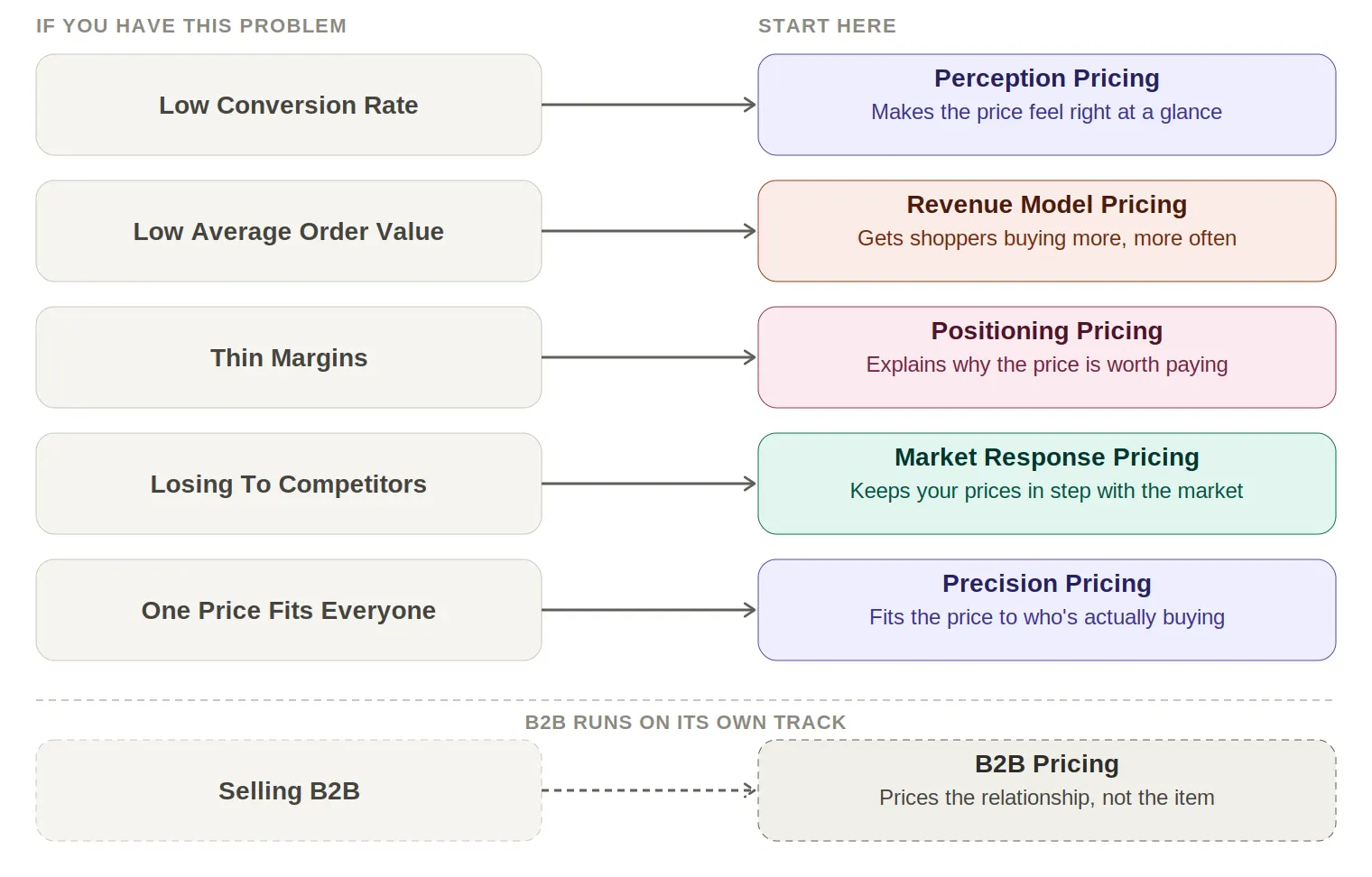
At Convertcart, we’ve audited numerous eCommerce stores and their pricing strategies, and that helped us create the Cents & Sense Framework: five categories that help you solve specific problems facing your store.
The Cents & Sense Framework: An eCommerce Pricing Strategy Model
Conversion rate stuck? Perception Pricing puts the price itself to work, shaping how it feels before a shopper even reads the description.
Rivals keep undercutting you. Market Response Pricing keeps your prices moving with the market instead of standing still.
Revenue Model Pricing is the fix for a low average order value, since it decides whether one sale is the end of the relationship or the start of one.
Margins too thin? Charge more, but earn it. Positioning Pricing explains why the price is worth paying instead of apologizing for it.
Not every shopper wants the same deal, and Precision Pricing makes sure they don’t get one.
Here's how it looks:
Pick the challange that matches your situation, then jump straight to that section below.
1. Perception Pricing: Makes the Price Feel Right at a Glance
Nobody buys a product for exactly what it costs to make. They buy it for what the price seems to say about the product.
That gap, between the number on the tag and the story it tells, is where perception pricing lives.
The Ninety-Nine-Cent Trick: Psychological Pricing
Drop a price from $10 to $9.99 and something strange happens in a shopper’s head. The number reads as meaningfully cheaper, even though the saving wouldn’t cover a stick of gum.
Chubbies, the vintage-shorts brand, layers this old trick with quantity pricing.
Buy two pairs of full-price shorts and the brand knocks $10 off, so the basket grows while each individual price tag stays untouched.
Part of why it works is that the brand already earned elsewhere.
Its partnership with Foundation 43, supporting mental health care and suicide prevention, shows up across high-intent pages, so the discount reads as generous rather than gimmicky.
Try this yourself and keep your endings consistent. A page mixing $9.99 with $10.00 and $24 looks careless, and shoppers notice sloppiness faster than they notice any single price.
Higher Price, Better Deal: Anchor Pricing
Boohoo has a trick up its sleeve, and it works because of how shoppers treat a crossed-out number. Put a higher price next to the real one, and the real one starts to look like a gift.
The company owns Dorothy Perkins, Coast, Oasis, and Warehouse, and it sells near-identical items across all four at different prices.
A shopper comparing Coast to Dorothy Perkins sees the cheaper label as the obvious deal, even though both dresses came off the same rack.
Boohoo leans on deep markdowns against inflated original prices too, which keeps the urgency dial turned up.
Here’s the catch though. Anchor pricing collapses the moment a shopper suspects you invented the original price, so keep the anchor believable, or the whole tactic backfires.
Charge More and Explain Why: Premium Pricing
Tiffany & Co. barely discounts, and it doesn’t need to. The brand charges more and dares the shopper to question it, betting that scarcity and craftsmanship justify the number.
What makes the bet pay off is everything wrapped around the price.
Free virtual and in-store appointments, the instantly recognizable Blue Box packaging, and a browsing experience considerate enough to greet returning shoppers with tailored recommendations all make the price feel earned rather than extracted.
Cut corners on any of that, and the same number starts looking like an overcharge instead of a promise.
⚠️
Find out what's stopping your store visitors from buying
Product discovery – barriers that prevent shoppers from finding items
Category/collection pages – improvements that drive deeper product exploration
Product page – what to optimize to convert 2–3x more buyers
Cart – ways to ease hesitation and speed up purchase decisions
“The report was deep and super insightful. Can’t believe it’s free.”
Logan Christopher CEO, Empire Herbs
2. Market Response Pricing: Keeps Your Prices in Step With the Market
Some prices need to move because the world outside your store keeps moving. This bucket covers strategies that flex with competitors, demand, discount cycles, and geography.
Keeping Up With the Rivals: Competitive Pricing
Organic groceries usually run at least 7.5% above conventional prices, which puts Thrive Market in a tough spot. Its answer is a price guarantee.
Find the same product cheaper elsewhere, whether at list price or through Autoship, and Thrive Market refunds the difference as store credit.
The brand even dedicates a support page to walking shoppers through exactly how the guarantee works, and that transparency probably does more for trust than the guarantee itself.
Prices That Move With the Moment: Dynamic Pricing
Nordstrom mostly plays a premium game. Twice a year it doesn’t.
During anniversary sales and defined clearance windows, the retailer leans into dynamic pricing hard, using steep temporary discounts to compete with rivals who charge similar prices but carry none of Nordstrom’s brand equity.
Same Product, Different Currency: Geographic Pricing
Swiff, an odor-control spray brand, sells the same bottle in two currencies without missing a beat.
A shopper in the US sees dollars with a buy-now-pay-later option built in, while a shopper in New Zealand sees the identical product priced and discounted in New Zealand dollars.
It’s a small piece of friction removed, and multiplied across thousands of visitors, small frictions add up fast.
The Art of the Markdown: Discount Pricing
Best Buy plays the percentage game harder than most electronics retailers.
It typically prices products 10 to 15 percent below competitors as a baseline, then stacks app-exclusive Best Buy Drops and loyalty-only deals for Plus members on top.
The stacking is the whole point. A single discount fades into the background, but a discount plus an exclusive plus a loyalty perk gives shoppers three separate reasons to buy right now.
3. Revenue Model Pricing: Gets Shoppers Buying More Often
These strategies aren’t really about a single price tag. They’re about the shape of the transaction itself: one-time, recurring, bundled, or deliberately unprofitable in the short term.
Pay Monthly, Stay Longer: Subscription Pricing
Scentbird bets that shoppers would rather sample five fragrances than commit to one full bottle, and it prices accordingly, charging a monthly fee well below what any of those bottles would cost outright.
The part that seems counterintuitive is how easy the brand makes it to leave.
Subscribers can skip a month or cancel any time without penalty. Removing the fear of getting trapped, it turns out, makes people far more willing to sign up in the first place.
Better Together and Cheaper Too: Bundle Pricing
Love Wellness built its early audience on tightly targeted Facebook ads, then gave that traffic a reason to buy on the spot.
Its Healthy Vagina Bundle pairs bundle pricing with subscription savings for roughly 50% more discount than buying the same items separately at one-time prices, so visitors convert on the first visit instead of drifting off to compare elsewhere.
Losing Money on Purpose: Loss Leader Pricing
Gillette had decades of brand loyalty behind it. Dollar Shave Club had a five-dollar razor and not much else, so it undercut the giant directly and let the loss do the work of acquiring customers.
Two things keep the math from breaking. A free shipping threshold protects margin on smaller orders, while first-time customers get free shipping specifically to keep acquisition costs low.
A subscription layer sits underneath all of it too, so a cheap razor becomes the on-ramp to a much longer, more valuable relationship.
Cheap Now, Pricier Later: Penetration Pricing
Launch low, grab share fast, raise the price once the product proves itself. That’s the entire idea behind penetration pricing.
Barnes & Noble runs it well on pre-orders, discounting exclusive editions to pull in early buyers and build hype ahead of a release.
It’s also how the chain competes with Amazon’s scale: aggressive pre-launch pricing that locks in sales before a book even ships.
4. Positioning Pricing: Explains Why the Price Is Worth Paying
Positioning pricing sacrifices short-term margin for long-term trust.
It rarely produces the single biggest sale of the day, but done consistently, it produces the most loyal shoppers of the year.
Pricing Without the Guilt Trip: Fair Pricing
Dossier launched its perfumes at $29 across the board and has since lowered that starting price to $19.
The brand built itself explicitly around cutting the markups that come from retailer margins, celebrity endorsements, and licensing fees, and it says so, loudly, on its own homepage.
In our experience auditing stores like this, transparent positioning tends to raise basket size rather than shrink margins overall.
Once the price stops feeling like an obstacle, Dossier shoppers routinely buy two or three fragrances in a single session.
Selling the Feeling, Not the Object: Value-Based Pricing
Away is technically a luggage company, though it would rather sell you the journey than the suitcase.
That story gets backing from thoughtful product details and a personalization option on its Bigger Carry-On Flex, so the premium doesn’t rest on durability alone.
Shoppers paying extra for a suitcase want a reason beyond how well it survives baggage handlers, and Away gives them one.
5. Precision Pricing: Fits the Price to Who’s Actually Buying
The last bucket doesn’t reshape a whole pricing model so much as adjust it at the edges: by variant, by size, by segment, or by moment.
Same Product, Different Price Tag: Product Variant Pricing
Charge differently across colors, materials, or editions of the same core product.
Just make sure a “Limited Edition” or “Organic” label earns its markup visibly, through material, story, or scarcity, or shoppers will default to the cheapest variant every single time.
Bigger Isn’t Always Cheaper: Product Size Pricing
Grocery and consumables brands charge differently by size or quantity all the time, and the trick to keeping it honest is showing the unit price alongside the sticker price.
Cost per ounce or per milliliter lets shoppers verify for themselves that the bigger size really is the better deal, rather than taking your word for it.
Back in Stock, Slightly Pricier: Restock Pricing
A sold-out item comes back, and the price doesn’t have to come back the same.
A modest 5 to 10 percent increase, clearly flagged, reflects real demand rather than punishing shoppers who happened to be patient.
Pair the restock with fresh photography or new reviews, and you reignite interest instead of just reopening a stale listing.
Not Everyone Pays the Same: Customer-Segmentation Pricing
Students, first-time visitors, and VIPs don’t have to see the same number, as long as the segmentation stays invisible to everyone outside it.
Nobody wants to discover their neighbor paid less for the identical item, and that discovery is the only real risk here
Double It and Call It a Day: Keystone Pricing
Double the wholesale cost, call it the retail price, done.
It’s the oldest trick in the shop, still common among physical product sellers, and it works best as a starting point you nudge up or down once you actually understand what your market will bear.
What About B2B Pricing?
Almost none of the eighteen strategies above apply cleanly once you’re selling to other businesses. A consumer buying one hoodie wants to see a price and click “add to cart.”
A business buying 500 units wants a quote, a negotiated rate, or a tier that recognizes it isn’t a first-time customer.
Three models dominate here. Tiered pricing drops the per-unit price as order volume climbs, so a 100-unit order might earn 10% off while a 500-unit order earns 20%.
Contract pricing locks in negotiated rates for a specific account or customer group over a set period.
Quote-based pricing skips a fixed number entirely, hiding behind a “request a quote” button for orders too complex to price on a page.
NAPA Auto Parts runs a version of this at serious scale, syncing contract, wholesale, and retail prices across roughly 10,000 locations, a logistics problem as much as a pricing one.
Most B2B sellers will never operate at that scale, but the principle underneath holds regardless of size: a B2B buyer expects the price to reflect the relationship, not just the item.
⚠️
Find out what's stopping your store visitors from buying
Product discovery – barriers that prevent shoppers from finding items
Category/collection pages – improvements that drive deeper product exploration
Product page – what to optimize to convert 2–3x more buyers
Cart – ways to ease hesitation and speed up purchase decisions
“The report was deep and super insightful. Can’t believe it’s free.”
Logan Christopher CEO, Empire Herbs
The Pricing Models Underneath the Strategies
A few terms get thrown around loosely in pricing conversations, so three are worth pinning down.
Cost-plus pricing takes your production cost and adds a fixed markup, simple to calculate but blind to what competitors charge or what customers value.
Price skimming does the opposite, launching high and lowering gradually over time, common in tech, where early adopters happily pay a premium for being first.
Economy pricing keeps both price and margin thin and bets on volume instead, which only survives if your overhead is low enough to carry it.
Strip away the branding and most of the eighteen strategies above are really just cost-plus, skimming, or competitive pricing wearing a costume that fits a particular brand.
Pricing Mistakes We Repeatedly Find During CRO Audits
We audit eCommerce pricing pages for a living, and the same handful of mistakes turn up again and again, regardless of category or price point.
A discount percentage with no dollar amount next to it, so shoppers have to do the math themselves.
Shipping costs that stay hidden until checkout.
A price rendered smaller than the star rating sitting beside it.
Subscription pricing that’s technically cheaper but visually easy to miss next to the one-time price.
Variant prices that jump around by color or size with no explanation for the gap.
Savings that only ever show up in the cart, never earlier in the browsing journey.
A price hierarchy so flat the number doesn’t stand out from the paragraph around it.
An anchor price that reads as invented rather than real.
You won’t find any of these in a competitor teardown. You’ll find them by sitting behind a real shopper and watching where they hesitate.
The Pricing Decision Framework
Reading about eighteen strategies is one thing. Deciding which two to actually run is another, so here’s the shortcut we walk clients through.
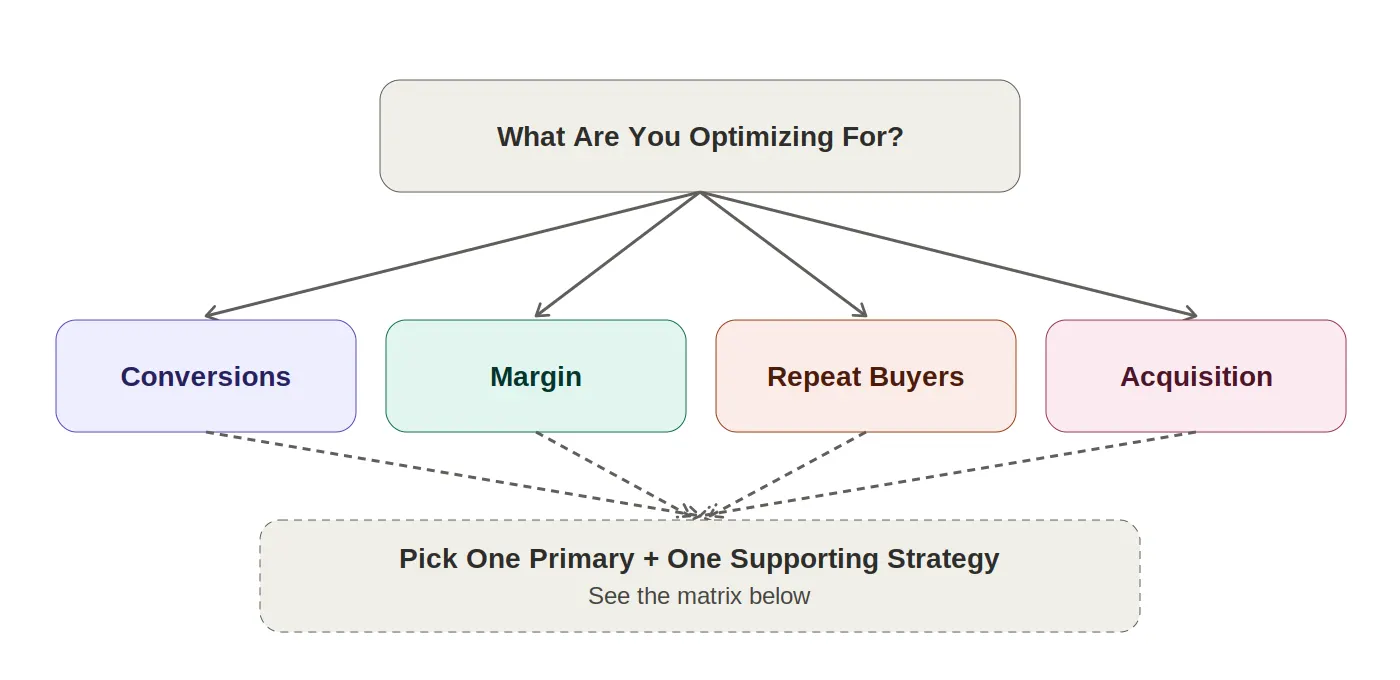
First, name what you’re actually optimizing for: conversions, margin, repeat purchases, or acquisition. Chasing all four at once is how pricing ends up contradicting itself.
Next, match that goal to a bucket, either using the table near the top of this piece or trusting your instinct about where the pain actually lives.
Then pick one primary strategy from within that bucket. Not three, just one, since shoppers can only recognize and trust a single clear pricing story at a time.
Finally, layer in exactly one supporting strategy from a different bucket, chosen because it reinforces the primary one instead of competing with it.
Pricing strategy decision tree: what are you optimizing for branches into conversions, margin, repeat buyers, and acquisition, all converging into picking one primary and one supporting strategy.
Tiffany runs this exact sequence: premium pricing as the primary, positioning pricing as the support.
Dollar Shave Club runs it from the other direction, loss leader pricing as the primary, a subscription model as the support.
Neither brand runs six strategies at once. They picked two that agree with each other. Match your goal to a starting pair below.
Match your business goal to a primary and supporting pricing strategy
Goal
Primary Strategy
Supporting Strategy
Conversions
Psychological pricing
Anchor pricing
Margin
Premium pricing
Fair pricing
Repeat purchases
Subscription pricing
Bundle pricing
Acquisition
Loss leader pricing
Penetration pricing
Mixed signals kill conversion faster than an imperfect price ever will.
Where You Put the Price Matters as Much as the Number
A well-chosen price buried on a cluttered page still loses the sale.
Show starting prices on homepage banners so shoppers don’t have to click through just to learn whether they can afford you.
Keep prices visible in navigation dropdowns and hover previews so browsing doesn’t require repeated clicks.
And put the price near the product title in a bold, easy-to-scan size, since that’s the first thing a shopper’s eye looks for right after the product name itself.
Show an itemized breakdown, highlight savings in a color that actually stands out, and reconfirm any discount right before the payment button.
Confusion at that final step kills more sales than a high price ever does.
The Last Word
Pricing only works as hard as the page it sits on.
We’ve audited plenty of stores with smart pricing where conversion still lagged, because the price never got a fair shot against a clunky cart or a confusing checkout.
Nail the Cents & Sense Framework above first. Then let someone check whether your store actually shows that pricing where it counts.
Our conversion team runs a free audit, and we’ll tell you plainly where you’re losing shoppers.
FAQs
What Is the Best eCommerce Pricing Strategy?
There isn’t a single best one. The right choice depends on your margins, your category, and your goal.
Value-based pricing tends to work well because it lets you charge for what customers believe a product is worth. Competitive pricing suits price-sensitive categories with several direct rivals.
Dynamic pricing fits brands with demand that genuinely fluctuates, and penetration pricing suits new launches trying to build volume fast.
What Are the Benefits of Two-Sided Pricing on Marketplaces?
Marketplaces that show pricing from multiple sellers give shoppers a wider set of comparable options and more transparency for comparing features and prices side by side.
That competitive pressure tends to push customer service and overall experience upward across every seller on the platform, not just the cheapest one.
What Is the Difference Between Price Anchoring and Price Skimming?
Price anchoring shows a higher reference price next to the real one so the real price looks like a deal.
Price skimming launches a product at a genuinely high price, then lowers it gradually as demand from early adopters cools and more price-sensitive shoppers enter the market.
One is a display tactic for a single moment. The other plays out over months
Subscribe for more articles like this!
Thank you - we'll see you in your inbox soon!
Oops! Something went wrong while submitting the form.
Read by 5000+ ecommerce store owners
Subscribe for more articles like this!
Thank you - we'll see you in your inbox soon!
Oops! Something went wrong while submitting the form.


.webp)
.png)
.webp)

.webp)
%20.webp)
.png)
.webp)
.png)
.png)
.webp)
.webp)
.webp)


.avif)
.svg)


.svg)

.svg)
.svg)
