QUICK NOTE - This article also contains a super practical Return Policy Friction Audit right at the end.
...
At Convertart, we look at the return policy as checkout in reverse. Here is exactly what a high-converting return policy is supposed to do—and what most brands are getting wrong:
What Is A Good Return Policy Supposed To Do
What Most Brands Get Wrong
Remove the fear of making a wrong purchase
Hides the policy in the footer like fine print
Turn disappointed buyers into repeat customers
Makes customers hunt for labels and chase support
Discourage abuse without punishing honest shoppers
Goes too strict or too generous, with nothing in between
Keep policies clear as countries and channels grow
Runs one generic policy for every country
Across hundreds of audits, we rarely see great return policies by accident. The strongest ones consistently share the same characteristics.
answer the question a shopper is silently asking before they ask support
remove effort during the return instead of after frustration begins
build confidence without exposing the business to unnecessary abuse
Here's how four real brands put the 3 qualities above to work, and what each one teaches about a different piece of the puzzle.
How Everlane's Return Policy Reduces Buying Anxiety
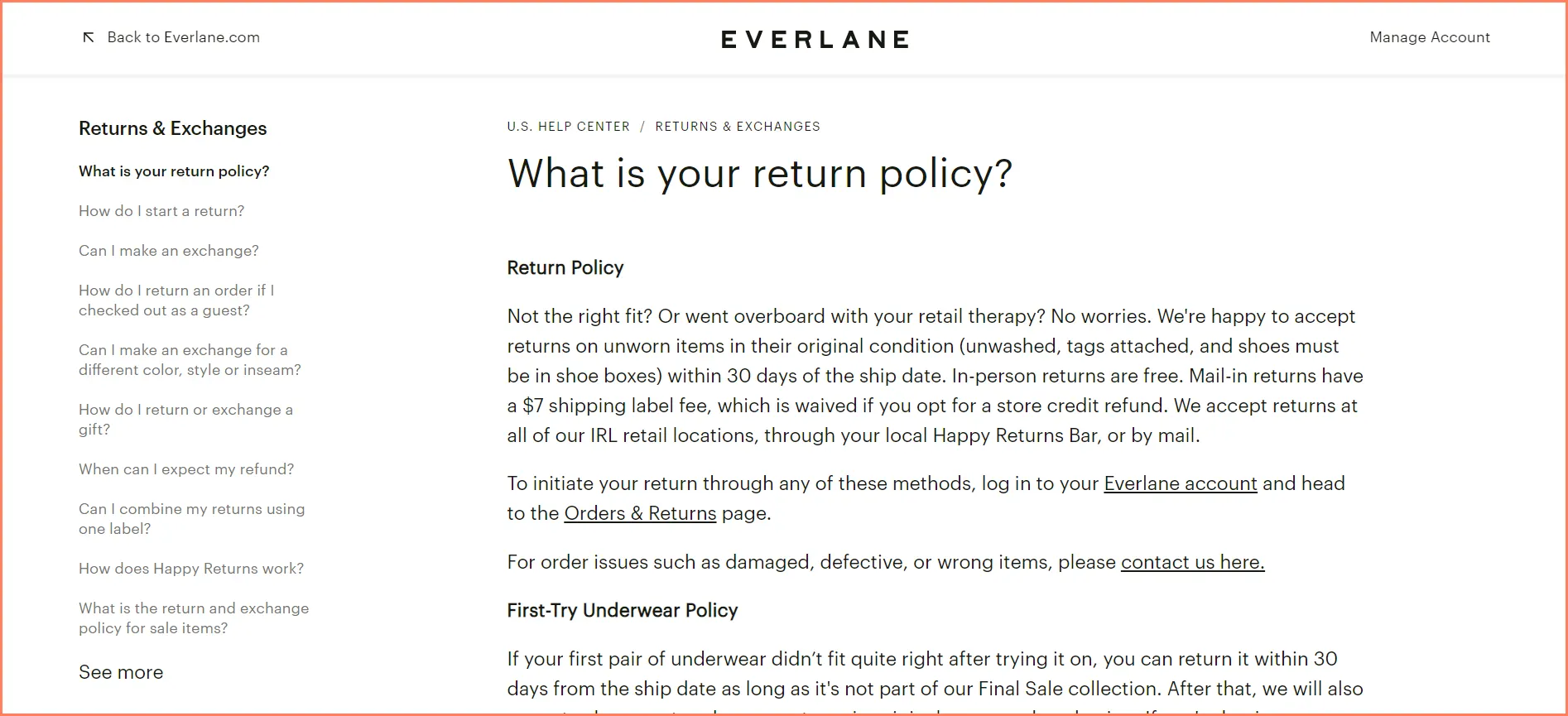
Everlane writes its policy the way you would explain something to a friend, not the way a photocopier explains itself to a fax machine.
Returns are accepted within 30 days; the page says so plainly, and the policy even covers underwear, provided it still meets the return conditions.
Most brands will not touch that category with a ten-foot pole, so the willingness to do it says more than any tagline could.
Near the bottom of the page, Everlane shows how many readers found the policy helpful. That is not decoration. It is a trust signal, placed exactly where a hesitant shopper's thumb happens to be hovering.
This kind of clarity is not just nice manners. According to Triple Whale's 2025 ecommerce benchmarks report, trust signals such as visible reviews and clearly stated return policies can cut cart abandonment by up to 28%, which is the sort of number that makes a marketing director sit up straight.
On BigCommerce specifically, you can surface this without any app using native Banners — see our BigCommerce conversion guide for the setup.
How Fairway & Greene Makes Returns Effortless
Here is a fact that should be tattooed on the wall of every operations team: a smooth return turns a disappointed customer into a repeat one.
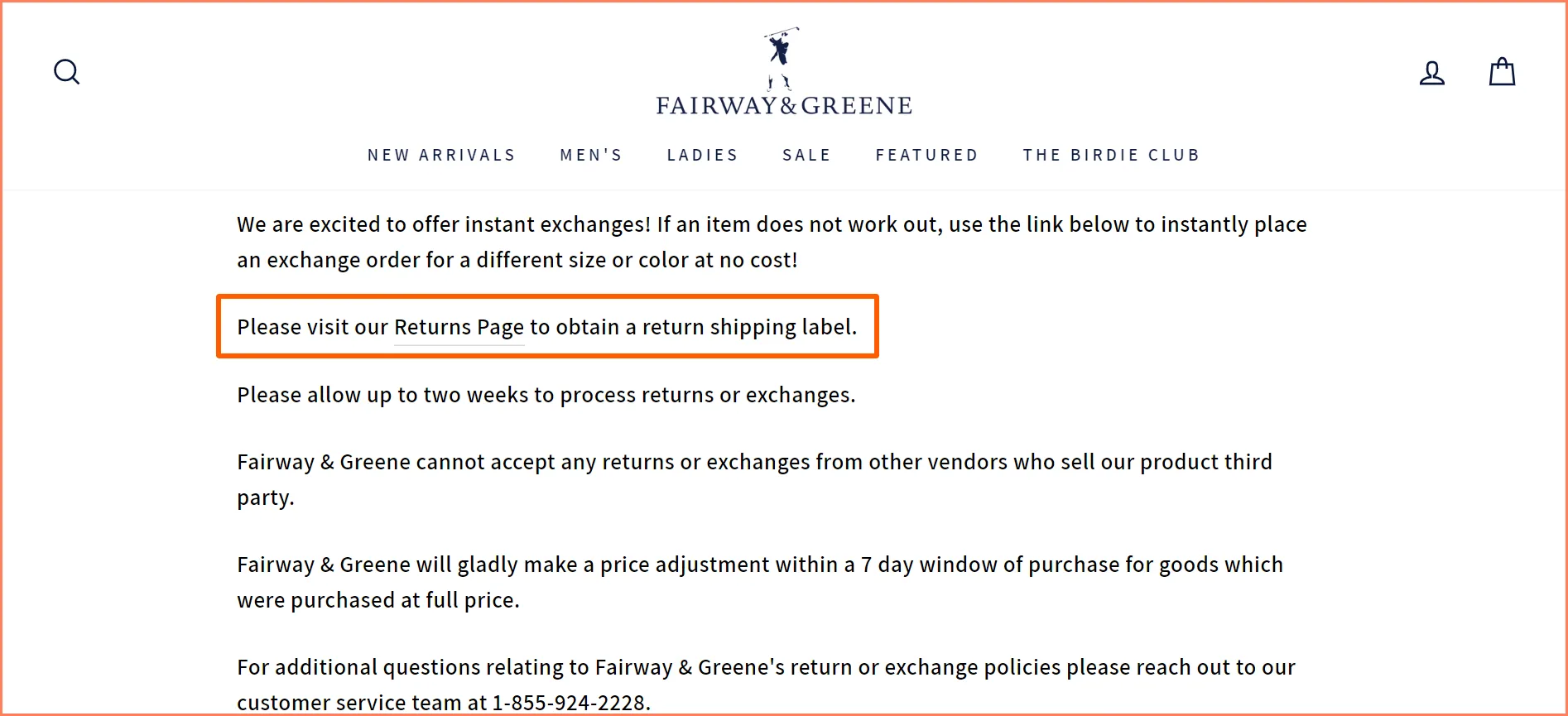
Fairway & Greene seems to know this instinctively. Its policy hands the customer a direct link to print a return shipping label, with no digging through menus and no email purgatory.The timeline is stated outright too.
Two weeks, start to finish, which means the customer never has to wonder and the support team never has to field the inevitable “where is my refund” email.
Fairway & Greene also promises a full refund within seven days of purchase, a small detail that does a surprising amount of trust-building on its own.
The same logic holds upstream too. Brands that spend months tightening checkout friction often forget that the return process is just checkout in reverse, and customers notice the inconsistency.
How Built Athletics Protects Profit Without Scaring Off Buyers
Return fraud is the uninvited guest at every eCommerce party, and according to the National Retail Federation's 2025 Retail Returns Landscape report, roughly 9% of all returns in the US are fraudulent in some way.
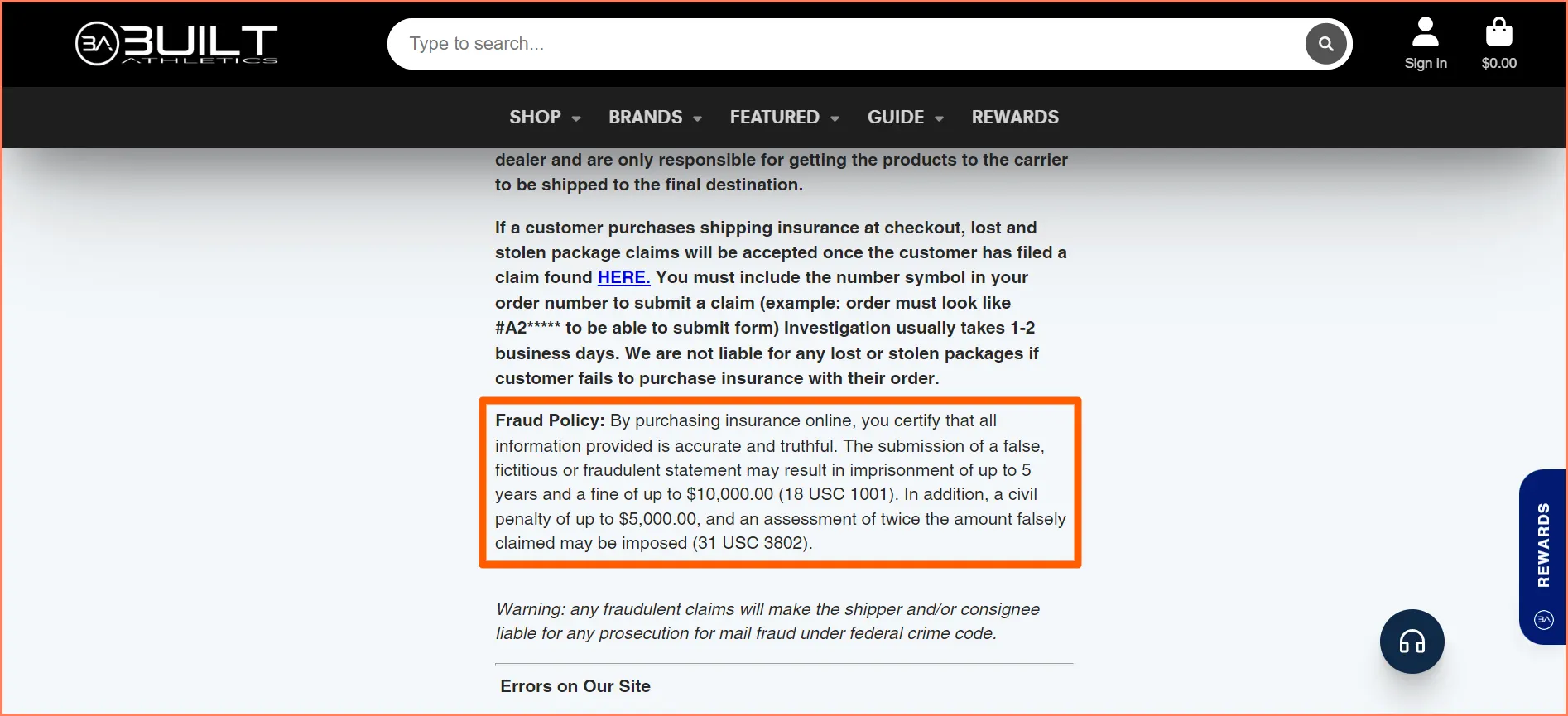
Built Athletics deals with this the way a sensible adult deals with an uninvited guest: by naming the problem out loud rather than pretending it is not happening.
Its policy cites the actual federal statutes that govern fraudulent claims. Genuine shoppers will never notice this clause, because it changes nothing about their experience.
Anyone weighing a fraudulent return, on the other hand, gets a very clear signal that someone is paying attention.
The lost-and-stolen-package clause works the same way. Claims only go through if the customer bought shipping insurance, which shifts the risk without punishing the honest majority who simply forgot to tick a box.
Related: brands that run discount-driven traffic without a clear plan often see clearance sales erode margin rather than protect it, which is the same profitability math at play here.
How Gymshark Scales Its Return Policy Across Countries
Sell in one country, and a return policy is a support page. Sell in fifteen and it becomes something closer to an air traffic control system. Gymshark handles that transition with a clarity that is rare even among brands twice its size.
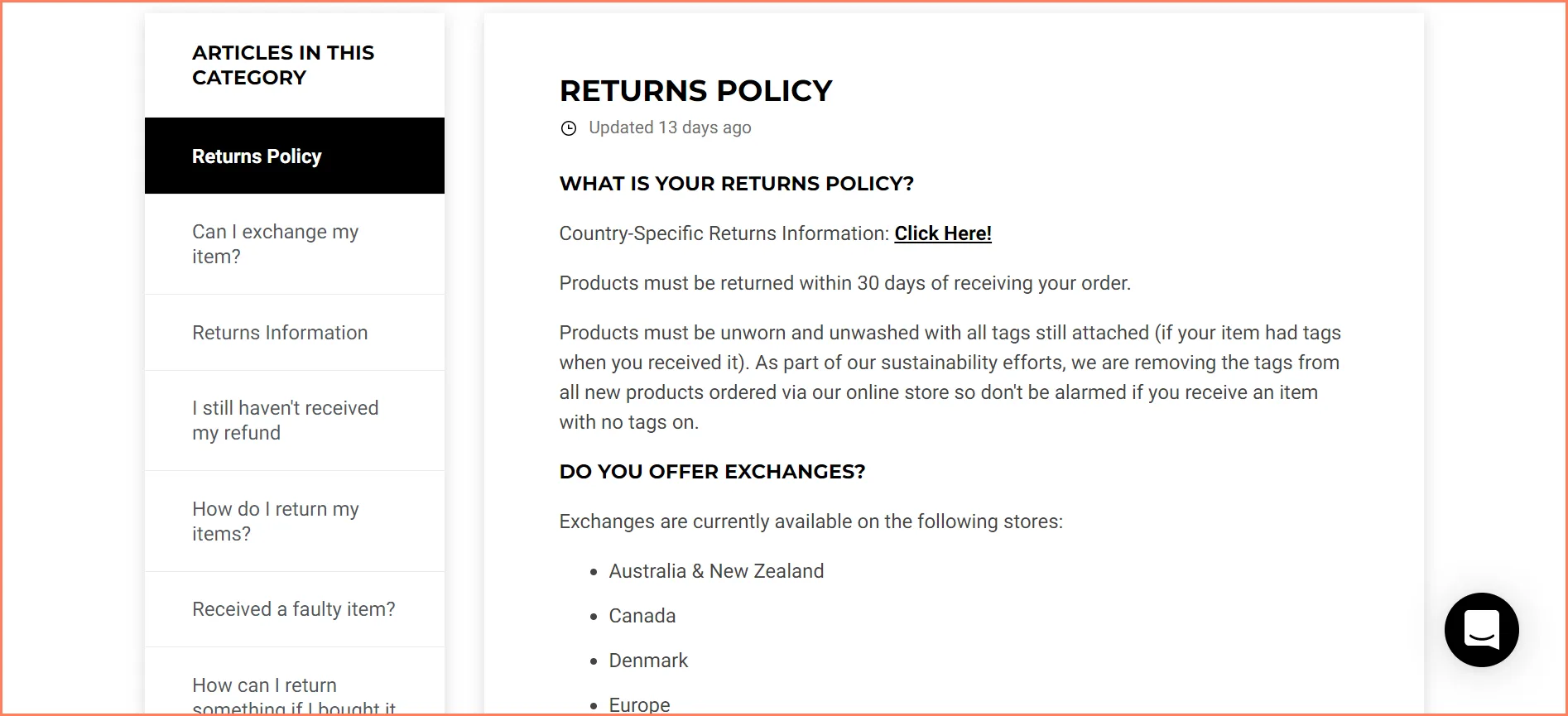
The policy splits out rules by country, so a shopper in Berlin and a shopper in Brisbane each see only what actually applies to them.
There is no scrolling through someone else's customs rules to find your own.
The page also displays when it was last updated, a small touch that quietly tells the customer this is a living document, not a PDF someone uploaded years ago and forgot about.
With US retail returns alone reaching an estimated $849.9 billion in 2025 according to the same NRF report, a policy that scales cleanly across borders is not a nice-to-have.
It is the difference between an operation that holds together and one that quietly leaks money in fifteen different currencies.
The Return Policy Friction Audit
Use this to find out whether your return policy is closing sales or quietly chasing customers away. It pairs well with a broader UX audit checklist if you want to look past returns alone.
Score yourself on the following (And count how many times you say Yes):
Before the purchase: Does a short version of your policy show up on the product page, near the Add to Cart button?
Have you cut the legal jargon down to something a normal human would say out loud?
Do you call out “Free Returns” or “No Questions Asked” anywhere a shopper might see it?
During the return itself: Can a customer print a label or scan a QR code without contacting anyone?
Can they start the whole process through a self-serve portal?
Does the policy say exactly when the refund will land, rather than a vague “processing time may vary”?
Behind the scenes: Have you flagged your final-sale or perishable categories with explicit exceptions?
Do you require original tags or packaging to discourage wardrobing?
If you sell internationally, do you have country-specific rules or buy-now-pay-later return logic in place?
How to Score Your Return Policy Friction Audit
Score
Verdict
What It Means
8 to 9 checks
Revenue driver
Your policy actively lowers the barrier to purchase and builds long-term loyalty.
5 to 7 checks
Standard utility
Your policy works, but it is not doing any conversion heavy lifting. Hesitant shoppers are probably still leaving.
Below 5 checks
Conversion liability
Your policy signals risk instead of confidence, and customers have to work to trust you.
Return Policy Questions People Actually Ask
What Should a Return Policy Actually Cover?
Think of it as a short contract written in plain English.
It needs to say which items qualify for a return, which only qualify for an exchange, how long the customer has to decide, who pays for shipping, and what happens if someone tries to game the system.
Leave any of those out, and you have not written a policy. You have written an invitation for confused emails.
Does an Online Store Have to Accept Returns?
Mostly, yes, at least for anything defective or damaged. That much is a baseline consumer protection in most places, not a courtesy.
Beyond that, a retailer gets to set its own terms. Whether you offer 14 days or 60, whether you charge for shipping or eat the cost yourself, that is your call, within whatever your local consumer law allows.
Where Should the Policy Actually Live on the Site?
Not buried in the footer, despite that being where roughly every brand still puts it. A short summary belongs on the product page itself, right near the Add to Cart button, with a link through to the full version.
That is the moment a shopper is weighing the risk of being stuck with something that does not fit, and that is exactly when reassurance does the most good.
Who Pays for Return Shipping?
Usually the customer, unless the item showed up broken or wrong, in which case the brand should be picking up that tab without an argument.
Some brands offer free returns across the board anyway, treating it less as a cost and more as an investment in not losing the customer entirely.
Do Free Returns Actually Increase Sales?
The honest answer is yes, often by more than people expect, and the pattern shows up consistently across broader conversion rate optimization statistics too.
Removing the cost of being wrong removes a lot of the hesitation that keeps a cursor hovering over the buy button.
The catch is obvious. Someone has to pay for all that reverse shipping eventually, which is why most brands reserve free returns for their higher-margin lines or their loyalty tiers, rather than handing it out to everyone on every order.
How Long Should a Return Window Be?
Thirty days is the industry default for a reason. It is long enough that customers do not feel rushed, and short enough that you are not still processing returns from three seasons ago.
Brands selling considered, higher-price items sometimes stretch this to 60 or 90 days, on the logic that a slower decision cycle deserves a longer runway.
There is no universal right answer here, only the one that matches how your customers actually shop.
Should a Return Policy Mention Fraud at all?
It should, and more brands are starting to realize this. A plainly worded fraud clause does nothing to a genuine customer’s experience, since they will likely never read it closely enough to notice.
For anyone weighing a dishonest return, though, seeing that the brand has thought this through tends to be enough of a deterrent on its own.
The trick is keeping the tone matter-of-fact rather than suspicious, so the 99% of customers who are entirely honest never feel like they are being treated as suspects.
Does a Return Policy Need to be Different for International Customers?
Once you are shipping to more than a couple of countries, yes. Customs rules, duties, and shipping timelines vary enough that a single generic policy stops being helpful and starts being misleading.
A customer in one country reading rules meant for another is not reassured.
They are confused, and a confused customer is one step away from abandoning the cart altogether.
Can a Return Policy be Too Generous?
It can, and this is the trap that swallows a surprising number of well-meaning brands.
A policy with no time limit, no condition requirements, and no exceptions for final sale items sounds wonderfully customer-friendly right up until the margins start bleeding out. Generosity without structure is not a policy.
It is an open invitation, and someone will always take you up on it.
The brands that get this right are generous on the things customers actually care about, like speed and ease, and firm on the things that protect the business, like fraud and final sale exceptions.
How Often Should a Return Policy be Updated?
More often than most brands bother to. Shipping carriers change, fulfillment partners change, and a policy written two years ago can quietly fall out of step with how the warehouse actually operates. A visible “last updated” date does double duty here.
It keeps the policy honest internally, since someone has to actually check it periodically, and it tells the customer externally that this is a page someone still looks after.
Most return policies are written by people trying to avoid a lawsuit. The good ones are written by people trying to win a customer. It turns out those are very different documents, and only one of them is worth reading.





.avif)
.svg)


.svg)

.svg)
.svg)
