


Category pages have always targeted a specific kind of shopper: someone who knows roughly what they want but hasn't picked a specific product yet. “Waterproof hiking boots.” “Affordable dining tables.” “Wireless noise-canceling headphones.”
Our own research on category page optimization covers how to win that shopper on Google and convert them once they land.
AI shopping assistants get asked the same kind of question, just conversationally.
A shopper types "best waterproof hiking boots" into ChatGPT instead of Google, or asks Perplexity where to find an affordable dining table.
That's a category-shaped question, not a product-shaped one.
Here's the part that should concern you. An AI assistant can answer that question by citing specific products directly, scraped from wherever it found them, or by surfacing a competitor's better-structured category page, without ever sending a shopper to yours.
It can do this even if your category page ranks fine on Google and converts well once a human actually lands on it.
Ranking and converting were never really about whether a machine can parse the page.
They just happened to correlate with it often enough that nobody had to separate the two problems until now.
This post is about separating them. Everything the original category page research covers, keyword targeting, layout, mobile UX, still matters.
This post covers the layer on top: whether an AI system treats your category page as a legitimate destination in the first place.
We built a diagnostic for category and listing pages, the same way our AI Pick Score™ diagnostic works for individual products. The two aren't competing metrics; they're sequential steps in the same journey.
Think of it this way. The Listing Score decides whether an AI assistant routes a shopper to your category page at all.
The Pick Score, from our product-page research, decides what happens to a specific product once a shopper is actually standing in front of it.
One is the front door. The other is what happens after someone walks through it.
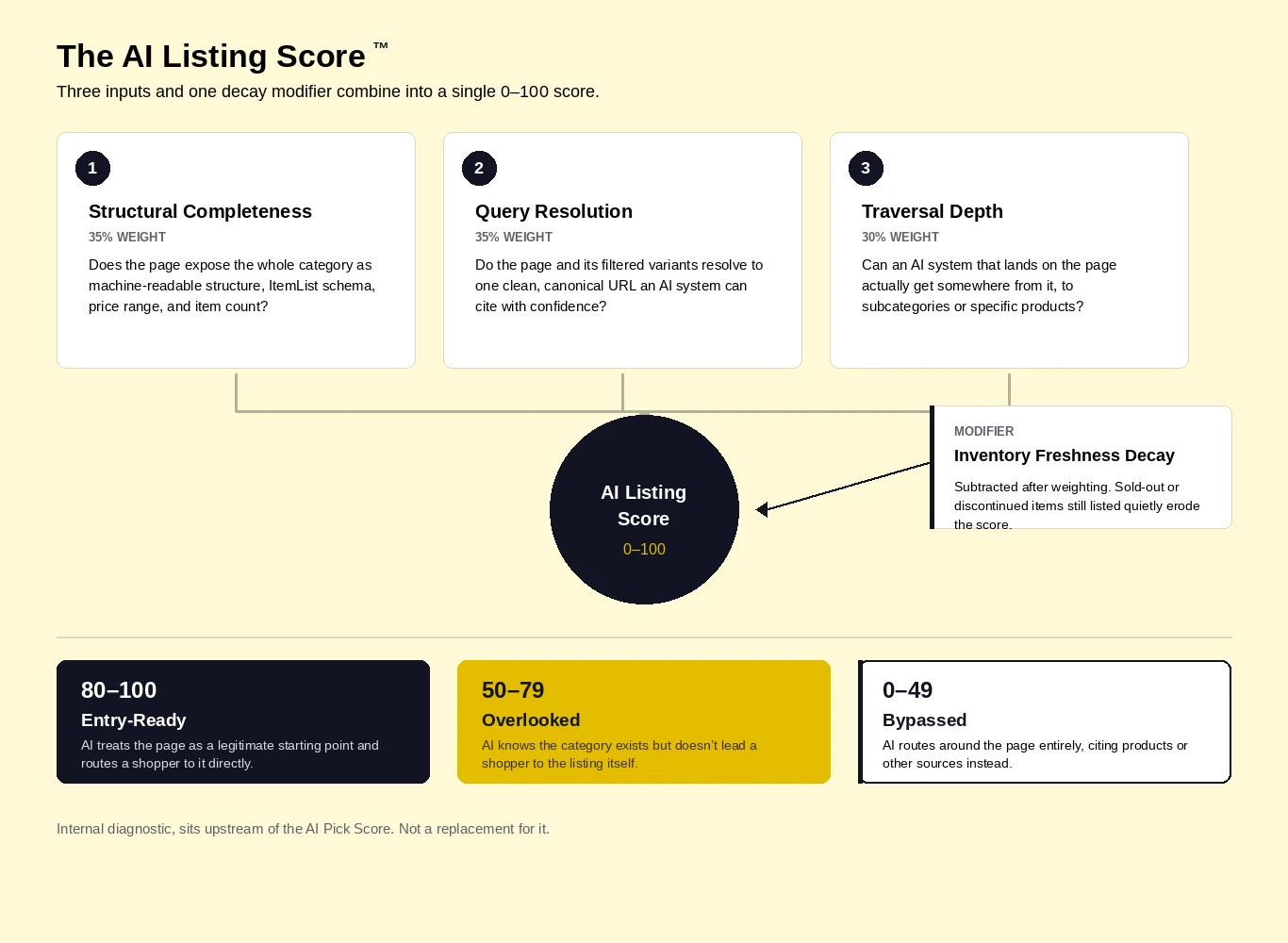
It's our own internal diagnostic, not a claim that category-page AI visibility has never been measured before, and it's built to sit upstream of the AI Pick Score, not replace it.
It runs from 0 to 100, built from three weighted inputs.
Structural Completeness (35%) asks whether the page exposes the whole category as machine-readable structure, ItemList or CollectionPage schema, price range, item count, and filter options, rather than only as something rendered for a human eye.
This is the category-level version of Data Completeness from the Pick Score, just applied to an entire listing instead of one SKU.
Query Resolution (35%) asks whether the page, and its meaningful filtered combinations, resolve to one clean, canonical URL an AI system can cite with confidence.
A shopper asking for "waterproof hiking boots under $150" needs a single authoritative answer, not one of seventeen near-identical faceted permutations that all technically qualify.
Traversal Depth (30%) asks whether an AI system that lands on the category page can actually get somewhere from it, to subcategories, to specific products, to something ultimately citable.
A page can have perfect structure and still be a dead end if the internal linking doesn't go deep enough to reach anything worth citing.
Then there's Inventory Freshness Decay, which isn't a fourth input so much as a tax on the other three.
A category page still listing products that are sold out or discontinued erodes trust the same way stale specs erode trust on an individual product page, and it stacks on top of whatever the three inputs already earned.
What the score means, by band:
80 to 100, Entry-Ready: An AI assistant treats the page as a legitimate starting point and will route a shopper to it directly.
50 to 79, Overlooked: The AI assistant knows the category exists and may mention products from your site, but it doesn't lead a shopper to the listing page itself.
0 to 49, Bypassed: The AI assistant routes around the page entirely, citing individual products, competitors, or other sources instead.
A category page can do everything our own checklist recommends.
A keyword-focused H1, a tight 100 to 200-word intro, clean URLs, and fast mobile load, which matters since more than 70% of eCommerce traffic is mobile.
It can be the kind of page that lifts bounce rate by 30% when the layout matches shopper intent, and it can still score poorly on the AI Listing Score, because none of those signals were ever really about machine legibility in the first place.
Take AI-driven merchandising, the kind that automatically resorts a grid by what's converting or what's likely to ship on time.
This is a real, well-documented tactic for improving category page revenue, and stores using it have seen real lifts.
It solves a genuinely different problem than the one this post is about.
Sorting what's already indexed well is not the same thing as exposing the structured data that lets an external AI system understand the category's scope, price range, and filter logic in the first place.
A page can be brilliantly merchandised for the humans who reach it and still be functionally invisible to the AI system deciding whether to send anyone there.
Worth being precise about what we're claiming here and what we aren't. The stats above are real, sourced from our own category page research.
What we haven't independently measured is how any specific retailer's category pages currently score on AI-citability specifically.
No particular brand is failing at this. Ranking well and being machine-legible are simply solved by different work, and a brand can be excellent at one without having touched the other at all.
Faceted navigation was already a known SEO risk before AI search existed.
Filter combinations generate near-duplicate URLs, they can dilute crawl budget, and getting the canonical tags right has been a standard part of category page hygiene for years.
Our own research already covers this from the search-engine-crawl-budget angle.
AI search makes the same problem worse in a way that's easy to miss. A human filtering by size and color understands, without thinking about it, that they're looking at a subset of a larger catalog.
An AI system trying to answer "best waterproof hiking boots under $150" doesn't have that same tolerance for ambiguity.
It needs the canonical URL for that exact combination to exist, resolve cleanly, and carry accurate schema, price data included, or it simply can't cite the page with confidence.
A search engine with a crawl budget problem might index the page late. An AI assistant with an ambiguity problem just skips it and answers from somewhere else instead.
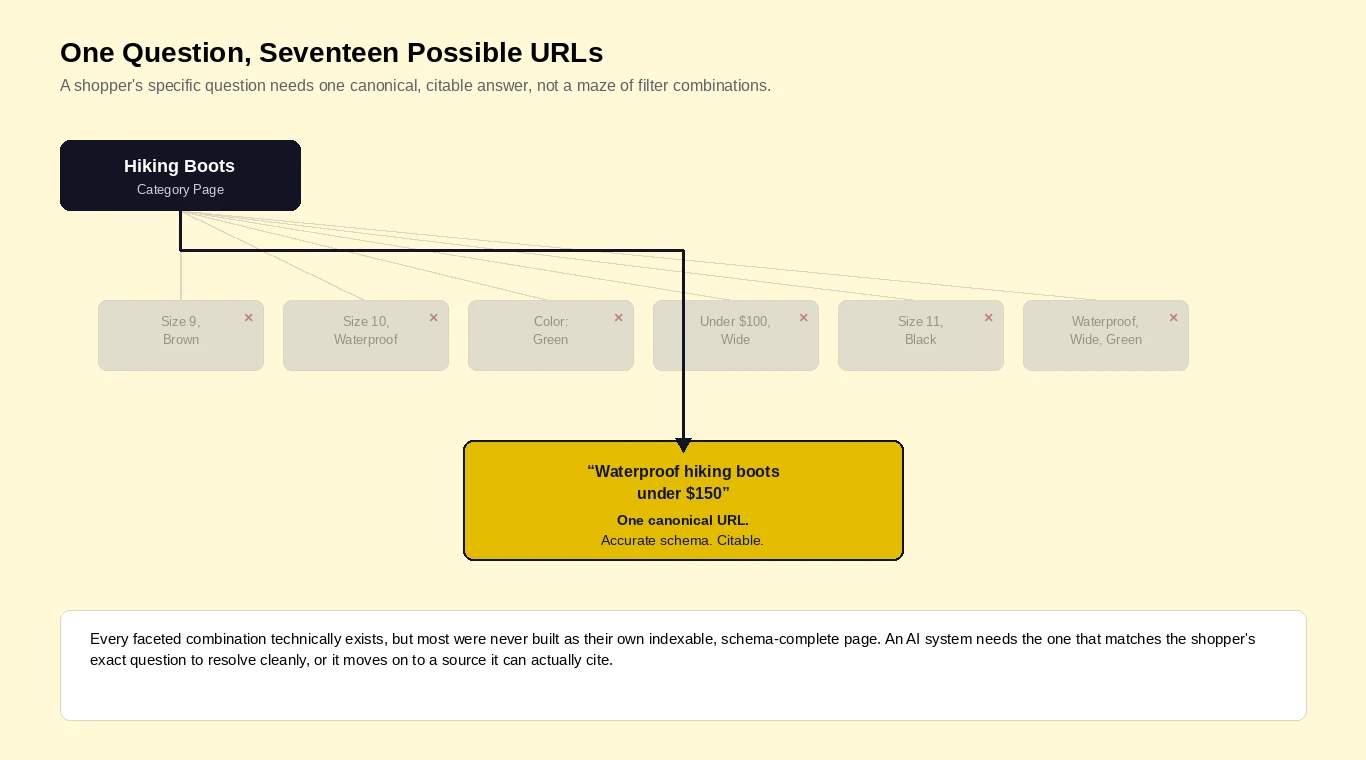
This is why Query Resolution carries as much weight in the score as Structural Completeness does.
A page can have flawless schema on its default view and still fail the test the moment a shopper's actual question requires a specific filtered combination that was never built as its own citable page.
Two things make Structural Completeness concrete. ItemList or CollectionPage schema needs to be present and accurate, price range, item count, and available filter options included, not just a generic category label.
And that 100 to 200 word intro block recommended for human SEO context can do double duty as the direct answer an AI system extracts, but only if it's written to actually answer "what's the best option for this specific need" rather than just describing the category in general terms.
A paragraph that opens with "our collection of hiking boots offers something for everyone" gives an AI system nothing to extract.
A paragraph that states which boots in the collection handle deep water crossings, and which ones don't, gives it something to cite.
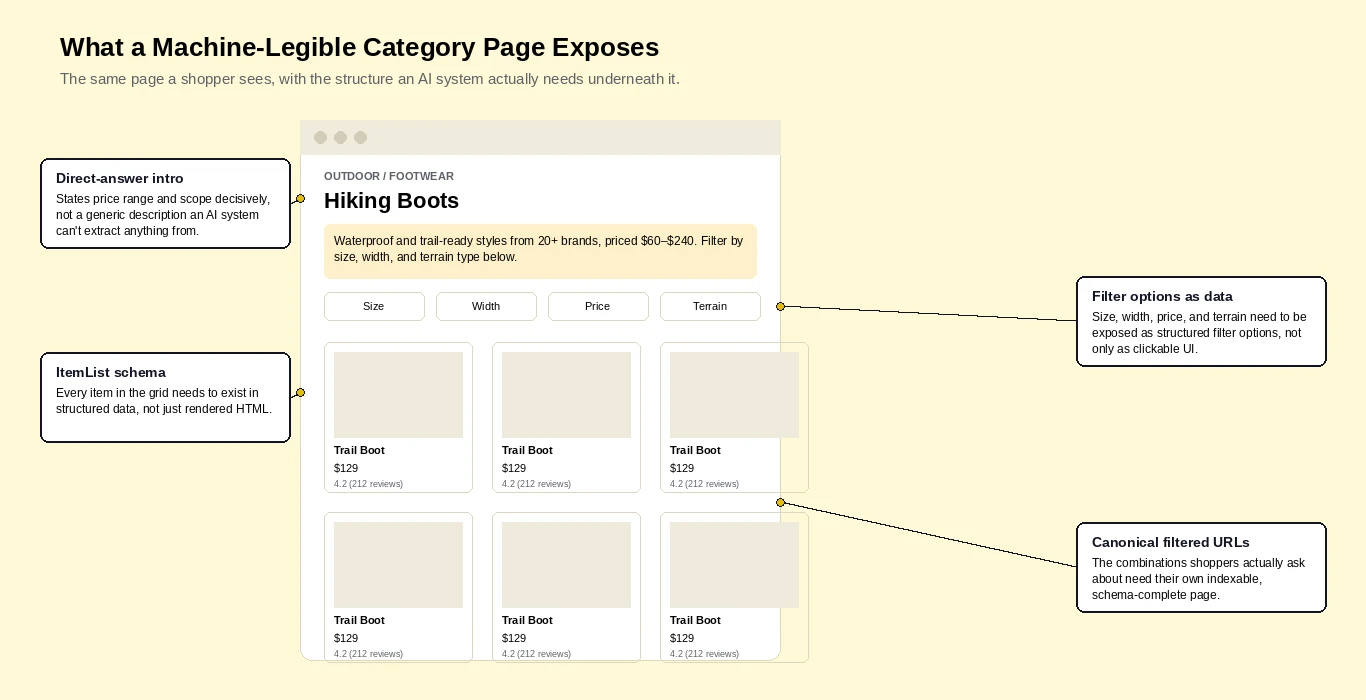
Traversal Depth is more about linking architecture than content. A crawler that reaches a category page needs a path to somewhere more specific, a subcategory, a top-rated product, a comparison page, or it hits a dead end even on a page that scored well on structure alone.
This is the same principle our product-page research called the above-the-fold problem, just one level up: information that exists but isn't reachable might as well not exist at all.
This is what fixing it looks like on one category page, walked through the same way we've walked through individual product fixes before.
A home goods retailer's dining table category page sat at an AI Listing Score of 31, deep in Bypassed territory.
Structural Completeness was the weak point at 22. The page rendered a clean, filterable grid for human shoppers, but the underlying markup carried no ItemList schema, no exposed price range, and no item count, everything a person could see, nothing a crawler could parse without rendering JavaScript first.
The fix was almost entirely structural. CollectionPage and ItemList schema went in, price range and item count were exposed as structured data, and the three most-used filter combinations, by size, by material, by price tier, were given their own canonical, indexable URLs instead of existing only as client-side filter states.
Nothing about the page's layout, copy, or human-facing design changed.
Five weeks later, the same page scored 78, solidly in Overlooked and closing in on Entry-Ready, with Structural Completeness up to 85.
It's a placeholder result until we run this at scale the way we ran the AI Pick Score study, and we'll say so plainly when we publish real numbers.
But the mechanism is the same one that moved individual products from Invisible to Recommend-Ready in that research: the content didn't change. What a machine could parse did.
A product can have a perfect AI Pick Score and still never get evaluated by an AI assistant, if the category page a shopper would naturally land on first is stuck in Bypassed.
The two scores aren't just related conceptually. They're sequential in practice.
This has a practical implication worth acting on before anything else. Fixing the Listing Score is a category-wide, mostly one-time structural project: schema, canonical URLs, linking architecture.
Fixing the Pick Score is a per-product effort that has to happen one SKU at a time.
Doing the Listing Score work first raises the ceiling for every product in that category simultaneously, which makes it the higher-leverage place to start if you're choosing where to spend the next sprint.
Ranking on Google and converting well were never actually proof that a machine could read your category page.
They were just close enough to that proof that nobody had reason to check separately, until AI assistants started making that distinction matter.
The fix is usually structural, not creative. Schema, canonical URLs for the filter combinations that matter, and a linking architecture deep enough for an AI system to actually traverse.
None of it requires rewriting content that already works for human shoppers.
If you haven't read our research on category page optimization, that's the foundation this post builds on for the traditional SEO, UX, and conversion side. And our AI-Ready Product Page research picks up exactly where this one leaves off, once a shopper actually reaches a specific product.
Want to know where your own category pages land? We'll run the AI Listing Score against your catalog and show you exactly where AI is routing around you.
Yes, and it happens often. AI systems can cite individual product pages, other retailers, or review sites directly, bypassing your category page entirely, even if that page would have been the ideal entry point for the query.
Yes, meaningfully different. Product pages use Product, Offer, and Review schema for a single SKU.
Category pages need ItemList or CollectionPage schema describing the collection as a whole, price range, item count, and filter options included.
Google's concern with faceted navigation is mostly about crawl budget and duplicate content.
An AI assistant's concern is more immediate: it needs one canonical, accurate URL for a specific filtered query, or it moves on to a source it can actually cite, regardless of crawl budget.
Not entirely differently, but more precisely. The same intro content that already serves human readers also works for AI extraction, as long as it states specific, decisive information rather than general category description.
The Listing Score measures whether an AI assistant treats a category page as a citable destination. The Pick Score measures whether a specific product then gets recommended once a shopper reaches it.
The Listing Score determines whether the Pick Score ever gets the chance to matter.
Subscribe for more articles like this!


2026 Convertcart, All Rights Reserved
33/1, Castle Street, Ashok Nagar, Bengaluru, India