
.avif)


Let's understand AI product recommendations with the help of an example. We ran the same product search through Google and an AI assistant to see the results.
The query: "best vegan skincare products." What came back differed less in the products themselves than in how each system presented them.
Google's AI Overview returned a shortlist of products and supporting sources.
ChatGPT returned a different shortlist, and attached a reason to each pick, usually a use case or a specific value proposition.
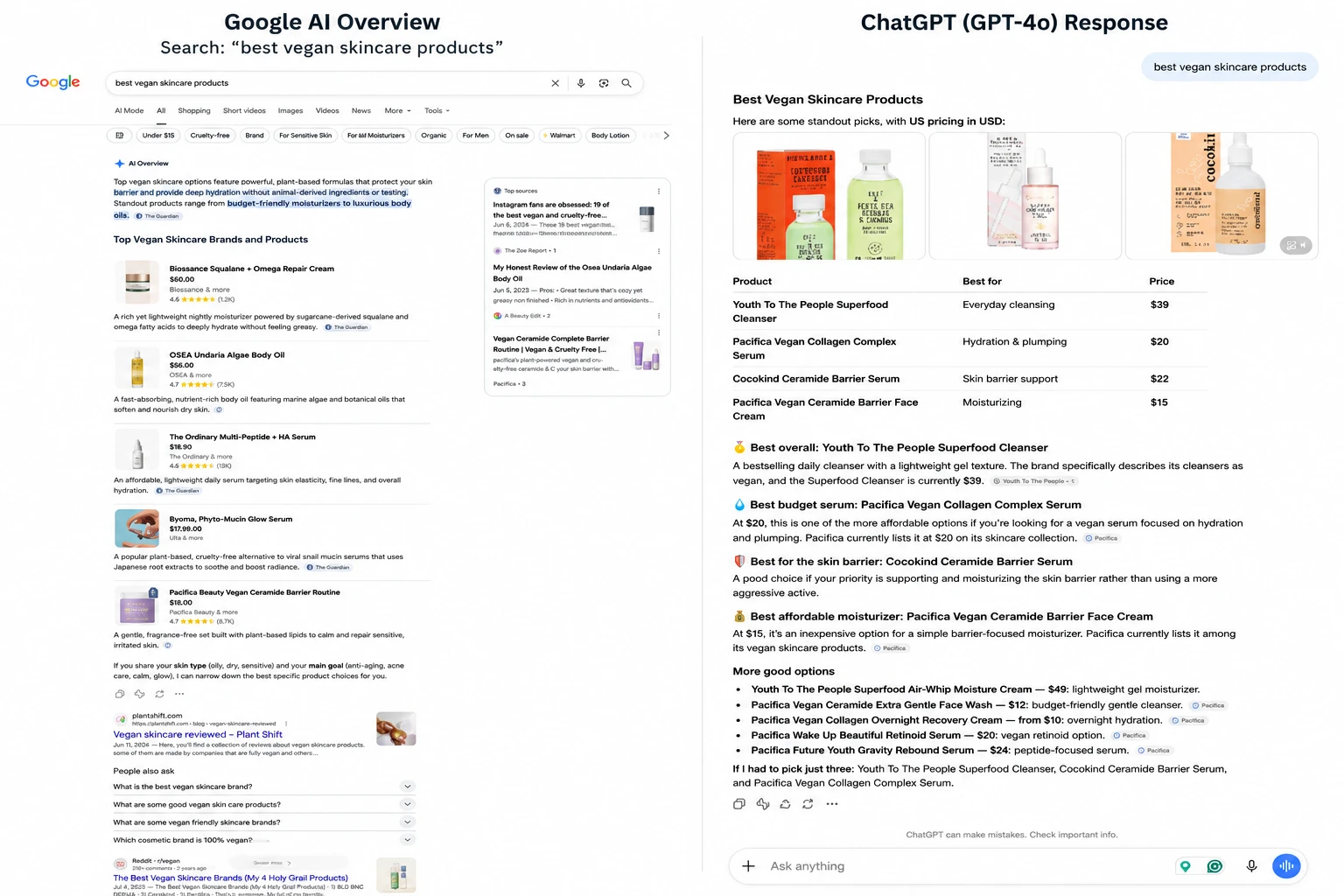
One product made it to both lists, and only one did.
We wouldn't read that as proof that either system ranks products better than the other.
From our experience, we can tell you that results shift with the query, the shopper's location, availability, timing, and whatever sources each system happens to pull from that day.
But here's what it implies. Getting recommended isn't really about visibility for a category. It comes down to whether the system has enough to work with when it decides what role your product should play in the answer.
For instance, a moisturizer might be a solid pick for "vegan skincare." It could be a much stronger pick for "vegan skincare for sensitive skin," or "vegan moisturizer under $40," or "vegan moisturizer that works under makeup."
So, the better move is making it obvious which searches a product should win.
We use a number to track that, and we tested whether moving it actually changes outcomes. Both come next, before we get into the tactics behind them.
We built a diagnostic around a single question: if an AI shopping assistant pulled up this exact product page right now, would it recommend the product with confidence, or hedge?
We call it the AI Pick Score™. It's our own internal diagnostic, not the only framework out there measuring AI shopping readiness, and not a claim that nobody else has approached this problem.
It runs from 0 to 100, built from three weighted inputs.
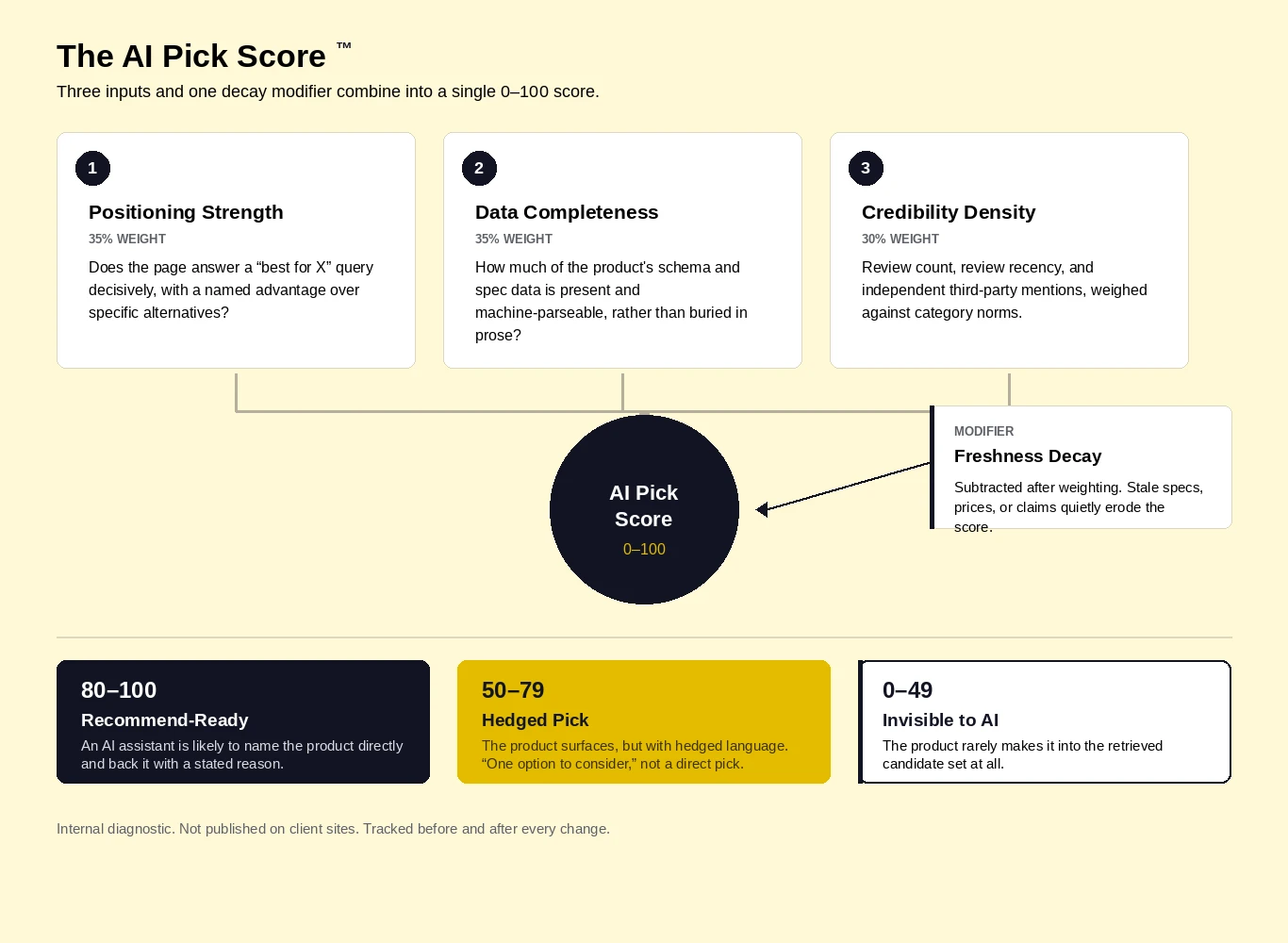
Positioning Strength (35% of the score) looks at whether the page answers a "best for X" query decisively, with a named advantage over named alternatives.
Data Completeness (35% of the score) covers how much of a product's schema and spec data sits in a structured, machine-parseable form.
Credibility Density (30% of the score) is the evidence layer: review count, review recency, and independent third-party mentions. We weigh these against what's normal for the category.
Then there's Freshness Decay, which isn't a fourth input. It's actually a tax on the other three. The longer it's been since you updated specs, prices, or comparison claims, the more points come off, even on a page that scored well when it launched.
Positioning Strength and Data Completeness each carry slightly more weight than
Credibility Density, since a page that fails to answer the query or exposes no usable data rarely gets a second look regardless of how strong its reviews are.
We apply decay after the three inputs are weighed, and land on one number. Here's what each band means:
80 to 100, Recommend-Ready: An AI assistant is likely to name the product directly and back it with a stated reason.
50 to 79, Hedged Pick: In this case, the product shows up, but hedged. "It's one option to consider," but it's not a direct pick.
0 to 49, Invisible to AI: In this case, the product rarely even makes the retrieved candidate set, regardless of how good it actually is.
We track this number before and after every change, so we know a fix worked well before the recommendation data catches up to confirm it.
Let's take you through how we helped three eCommerce brands get their products recommended in AI search: a pet care brand, a fashion retailer, and a footwear brand.
(We've also posted about how we helped these same brands get conversions from AI-driven traffic. Check out that story too.)
For now, let's look at how you can make AI product recommendations work for your own store. Each brand got exactly one change, tied to a different input, so whatever moved is easy to trace back to that single lever.
This one started in a rough spot: it had an AI Pick Score™ of 34 and a Positioning Strength sub-score of just 18.
The product itself wasn't the problem: a joint-support chew for senior dogs, genuinely well formulated.
A search for "joint supplement for senior dogs with mobility issues" turned up plenty of competitors and never once surfaced this one.
While the ingredients and dosage were correctly mentioned, the old copy leaned on a single line, "supports healthy joints."
So, we rewrote the comparison content to name an actual advantage over the specific products it kept losing to, and left everything else alone. We did not add a new schema or a product review.
Our goal was to give a sharper answer to the question a shopper was actually asking.
Five weeks later, the same product sat at an AI Pick Score™ of 81, with Positioning Strength up to 88. It now shows up in 4 of the 5 main search queries we tested in that niche, up from zero before the fix.
This one, a weekender bag, had the opposite problem. While there was nothing wrong with the positioning, and nothing wrong with the reviews, the AI Pick Score™ just couldn't get past 41.
What was dragging it down? It was Data Completeness. Every spec that mattered, including details like weight, laptop compatibility, and capacity, was sitting somewhere inside a paragraph of marketing copy.
The fix here was almost entirely backend work. We added Product and Offer schema and transferred the specs to an actual table an AI system could read without guessing.
We didn't change the positioning or the reviews. This was a data completeness fix.
That alone helped us move the AI Pick Score™ from 41 to 85, straight into Recommend-Ready, with Data Completeness climbing from 25 to 92.
This was the hardest one to watch, honestly, since it was a genuinely good product getting overlooked for reasons that had nothing to do with the product itself.
It was a pair of trail running shoes with a baseline AI Pick Score™ of 29 and a Credibility Density of 21.
A thin review count and zero third-party coverage were sinking a shoe that fit "best trail running shoes for wide feet" about as well as anything in its category.
We fixed review visibility on the PDP; the existing reviews weren't rendering in a crawlable format.
We also tightened up the post-purchase review request flow so recent reviews weren't sitting months stale. We didn't do anything with the positioning or the schema.
The AI Pick Score™ moved from 29 to 76, out of Invisible to AI and into Hedged Pick, and Credibility Density jumped from 21 to 89.
A strong single input was enough to take the product from invisible to viable, but it wasn't enough on its own to close the last gap into Recommend-Ready.
For that, we worked on the other two inputs as well, which is exactly what the rest of this post covers.
Now here's how to move each of these inputs on your own catalog.
We've run 1,103 client experiments between June 2025 and June 2026, and one pattern keeps showing up: product pages often explain why a product is good.
But they're weaker at answering the question a shopper, or an AI assistant, actually asks next.
Why is the product better than the alternatives?
That gap matters for AI recommendations. An assistant isn't just trying to figure out what a product is.
It needs enough to judge whether the product fits the request, and whether it fits better than whatever else is on the table.
Which is why the above-the-fold section of your product page carries so much weight.
Before a shopper or an AI assistant scrolls any further, four things should already be clear: what the product is, who it suits, what sets it apart, and which constraints matter.
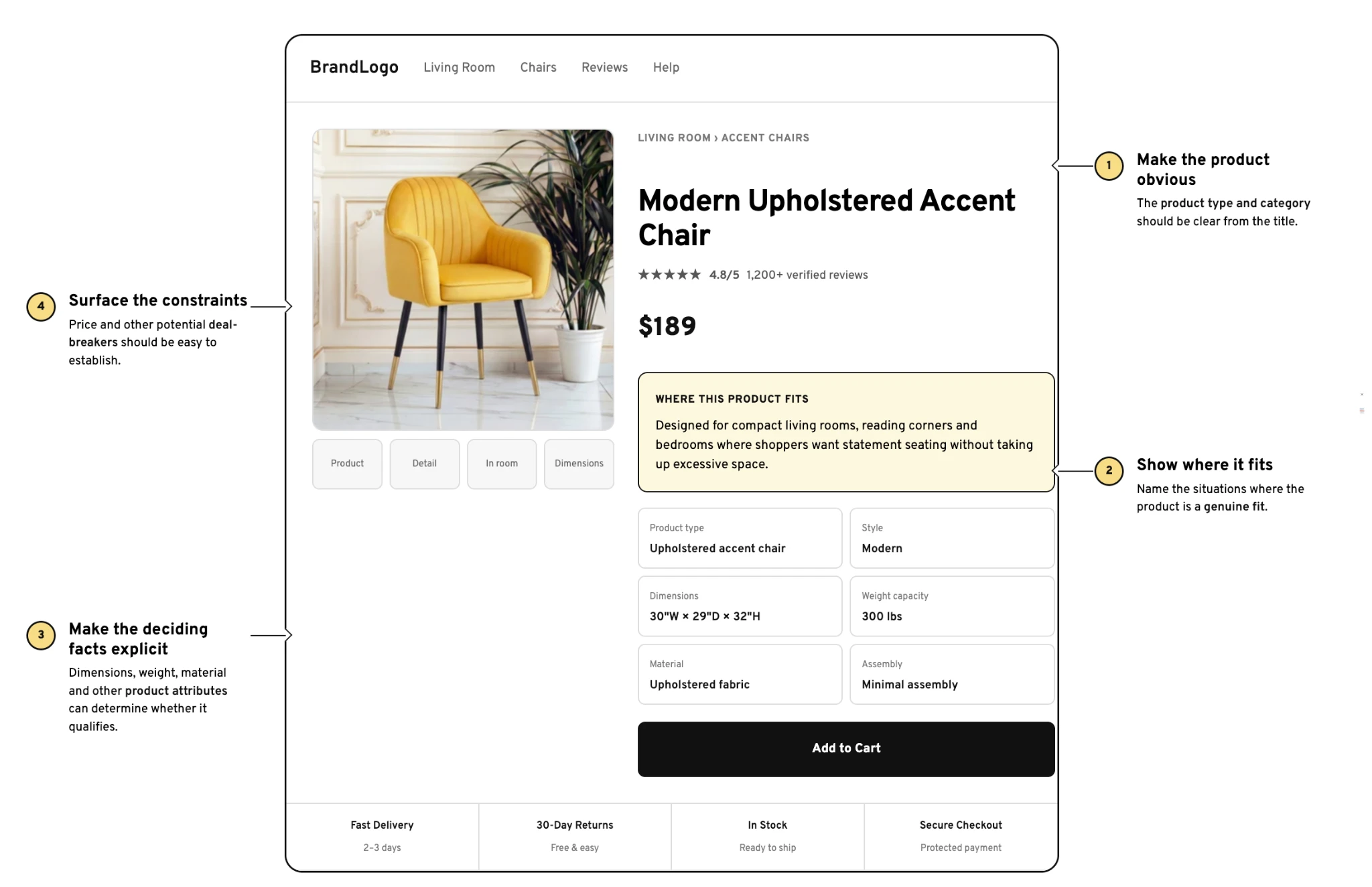
This just means the information that determines fit should be easy to find, and you should make it available in the first fold. You can add depth and evidence in everything down the page.
How do you make your product easy for AI to recommend? Here are four main points to consider.
What helps an AI assistant choose between different products? An AI assistant looks for real numbers like: a weight of 1.1 kg, a 16-inch laptop sleeve, 28 liters of capacity, or even a five-year warranty.
It looks for stuff that can sway a shopper's decision. Ideally, it should be out in the open and not something buried in marketing copy.
Also, things like structured schema, Product, Offer, AggregateRating, and Review communicate to an AI system what you actually stated in your copy.
The ideal way is to use any comparison you're already making, on the PDP or on a dedicated page. It works better as an actual table than as prose.
So, here's the thing: most product pages try to sound right for everyone. But it isn't.
A large backpack might be excellent for overnight travel and a poor fit for a daily commute. A running shoe built for wide feet might not be anyone's first choice for racing.
By naming that boundary, you can help an AI assistant figure out who actually benefits.
Also, the best part is that it produces a better answer for the shopper. "Good for X, not the best choice for Y" works better than "perfect for everyone" every time. Why is that? Shoppers already know nothing is perfect for everyone.
When you're writing "great for sensitive skin," it's best to make more effort and make that claim more believable. How do you do it?
Depending on the product, that could mean ingredients, formulation, certification, lab testing, spec sheets, warranty terms, or documented customer experience.
Your goal isn't to add more claims, but to back the ones that matter. This matters most when an AI recommendation hinges on a claim about performance, safety, compatibility, or quality.
You must also remember that third-party evidence such as certifications, lab results, expert endorsements, and awards carries real weight here. Most of the time, that evidence already exists somewhere, but if you haven't made it visible in the right places, AI won't recommend your products.
A PDP is rarely the only place an AI assistant runs into a product. It sources information from places like structured data, shopping feeds, retailer listings, and review sites.
If a backpack weighs 1.1 kg on your site and 1.4 kg somewhere else, then you must fix this flaw and make it consistent everywhere.
Many times, specs, prices, and comparison claims that were accurate on launch day drift out of date. And that's what stops it from getting recommended by AI assistants.
You need to catch these issues by doing quarterly audits on your specs, pricing, review counts, and comparison claims.
Here's the simple truth: the best overall product doesn't automatically win an AI recommendation.
What we've learnt in audits is that when two products both satisfy a search, whatever's implied in the question usually decides which one gets recommended.
Take "best carry-on for frequent business travel." In this case, capacity matters, sure, but it might not be the deciding factor.
You need to weigh how well it protects a laptop, how easy it is to access mid-flight, durability, any of these could matter more depending on the main use of the product.
So it's best not to try to make a PDP argue that a product wins on every front. You should rather make it obvious which tradeoff it wins on.
The right way is to add clarity to your product page communication. You must remember that whichever product answers "why this, for this shopper" most directly, wins.
A product can look like a strong match for what a shopper wants, but an AI assistant still needs something concrete to point to when it explains the pick. Verifiable product detail is what supplies that.
Let's say a product gets recommended as a lightweight carry-on for business travelers. The page needs its weight, laptop capacity, dimensions, and warranty easy to find, since those are the facts backing up that exact claim.
Recommendation answers "why this product." Citation gives the AI something to point to while it explains that answer.
You need to treat the PDP as one source of truth among several an AI assistant might use, not the only one.
That shifts the job. It's no longer just proving a product is good. It's making the exact reason it's good for a particular shopper easy to find and easy to check.
There's a distinction that doesn't get enough attention in this conversation, and it's also why the AI Pick Score™ only gets you partway there.
AI can register that a PDP mentions recycled materials, a five-year warranty, and a lightweight build. It can understand all three equally well, and a strong score will reflect that.
But none of that means all three deserve equal real estate on the page.
But your CRO data settles that question. Experiments, search behavior, how shoppers actually interact with the page, conversion data, all of it points to which facts move a buying decision.
You might find that AI treats "made with recycled materials" as highly relevant, while your actual shoppers care far more about weight, fit, compatibility, or how fast it ships.
So, you don't need to build a PDP around what AI can parse but a page around what converts. Then it's easy to get AI to parse it. You need to use CRO data to decide what earns the spotlight.
Don't forget that the strongest AI-ready product page isn't the one stuffed with the most information. It's the one where what matters to shoppers is also stated clearly enough for AI to pick up.
Getting a page optimized for AI recommendations and getting a catalog into ChatGPT are two different steps that happen to be related.
ChatGPT Shopping can surface products through merchant and product metadata from third-party providers or directly from merchants.
Shopify sellers already have this covered through Shopify Catalog; other merchants can apply for a direct product feed to OpenAI. None of this guarantees a recommendation on every query.
ChatGPT still weighs relevance to the shopper's intent, along with price, availability, reviews, and the rest of the product data.
Skip trying to game ChatGPT as if it were a ranking system, and start with the product-shopper match instead.
Make it obvious who the product is for, what problem it solves, what sets it apart, and what backs up those claims.
Then keep that information accurate and consistent everywhere AI might come across it.
An internal 0 to 100 number that predicts whether an AI assistant will recommend a product with confidence or skip past it.
Three inputs feed it: Positioning Strength (35%), Data Completeness (35%), and Credibility Density (30%), with a freshness penalty layered on top.
Enough to establish what the product is, who it's for, what makes it different, and whether it clears whatever the shopper actually asked for.
The more constrained the request, the more those specific attributes end up carrying the decision.
Yes, it can. AI recommendations and organic search rankings run on different logic entirely. An assistant can weigh product data, reviews, specs, and availability on their own terms, so a product doesn't need to top Google to earn a solid recommendation elsewhere.
Not really, and building a separate "AI version" of a PDP misses the point. The same qualities that help a human shopper decide, clarity, specificity, evidence, consistency, are what help AI decide too.
They can, and meaningfully so. Reviews often surface real-world qualities, fit, durability, day-to-day comfort, that a brand's own PDP copy tends to leave out. Volume alone isn't the signal that matters most. Whether the reviews say something credible about the qualities a shopper actually cares about is.
Not automatically, and past a point it can work against you by burying the handful of attributes that actually separate the product from its competitors. What counts is whether those attributes stay easy to find.
Give it a few weeks at minimum, since AI tools need time to re-crawl and re-index a page after any change. The changes themselves, schema fixes, new comparison content, better review visibility, can usually go live within days.
Getting a product recommended isn't about arguing it's the best on the market. It's about making the one reason it fits this particular shopper impossible for AI to miss, wherever it happens to look.
The AI Pick Score™ is how we track that internally, and the test earlier in this post is our attempt to show the number means something beyond a dashboard.
Our earlier post, "converting AI-driven traffic in eCommerce", picks up right where this one leaves off. That post covers what happens once a shopper actually lands on your site. This one covers what it takes to get them sent there in the first place.
Want a read on where your own products currently land? We'll run the AI Pick Score™ against your catalog and tell you exactly where you stand.
Subscribe for more articles like this!

.svg)


.svg)

.svg)
.svg)
2026 Convertcart, All Rights Reserved
33/1, Castle Street, Ashok Nagar, Bengaluru, India