
1,103
client experiments


client experiments

tests produced a statistically significant improvement

win rate
Somewhere in the last few years, "you should be A/B testing" became gospel.
But "buy the tool and test" was never the whole instruction. It was only the visible half.
The harder half is building an experimentation program that consistently produces reliable decisions.
That's where most teams struggle. They don't stop because they lack ideas or software. They stop because their win rate stalls, confidence drops, and experimentation slowly becomes another unused initiative.
A 2020 Harvard Business School working paper analyzed a dataset of 6,375 online experiments run on a third-party A/B testing platform. Across that sample, only 10.7% produced a positive, statistically significant result, a baseline the researchers used while studying a different question: how management seniority affects experimentation outcomes.
Our own results, based on 1,103 client experiments conducted between June 2025 and June 2026, produced a 37% win rate: 414 statistically significant improvements.
The interesting question isn't which number is "right." Different platforms, industries, and time periods will always produce different baselines. It's what explains programs that consistently beat the baseline.
Across our 1,103 client experiments, one pattern became impossible to ignore: most experimentation programs don't fail because of one bad test or one bad idea. They fail because there's no culture of experimentation behind them.
A/B testing platforms can split traffic, calculate statistical significance, and report results. They can't decide which ideas deserve testing, whether a page has enough traffic to produce a reliable result, or whether a winning variation is ever implemented.
The highest-performing experimentation teams treat every test as part of a continuous decision-making process rather than an isolated experiment. They challenge the hypothesis before launch, follow statistical discipline while the test is running, implement winning variations, and use every result, whether it wins or loses, to improve the next experiment.
This is why the goal isn't simply to run more A/B tests. It's to make better experimentation decisions.
The Convertcart Experimentation Decision Lifecycle™ below was created from this observation. It shows the stages successful experimentation programs consistently follow and where most programs break down.
Research on false discoveries reinforces why this matters. A 2021 Wharton study analyzing 2,766 A/B tests found that roughly 1 in 5 "winning" results at 95% confidence turn out to be false positives once deployed. Not every statistically significant result represents a lasting business improvement.
Strong experimentation programs are designed to identify changes that continue delivering value after deployment while filtering out results that don't hold up over time.
Successful experimentation programs don't outperform because they run more A/B tests.
They outperform because they follow a repeatable decision-making process before, during, and after every experiment.
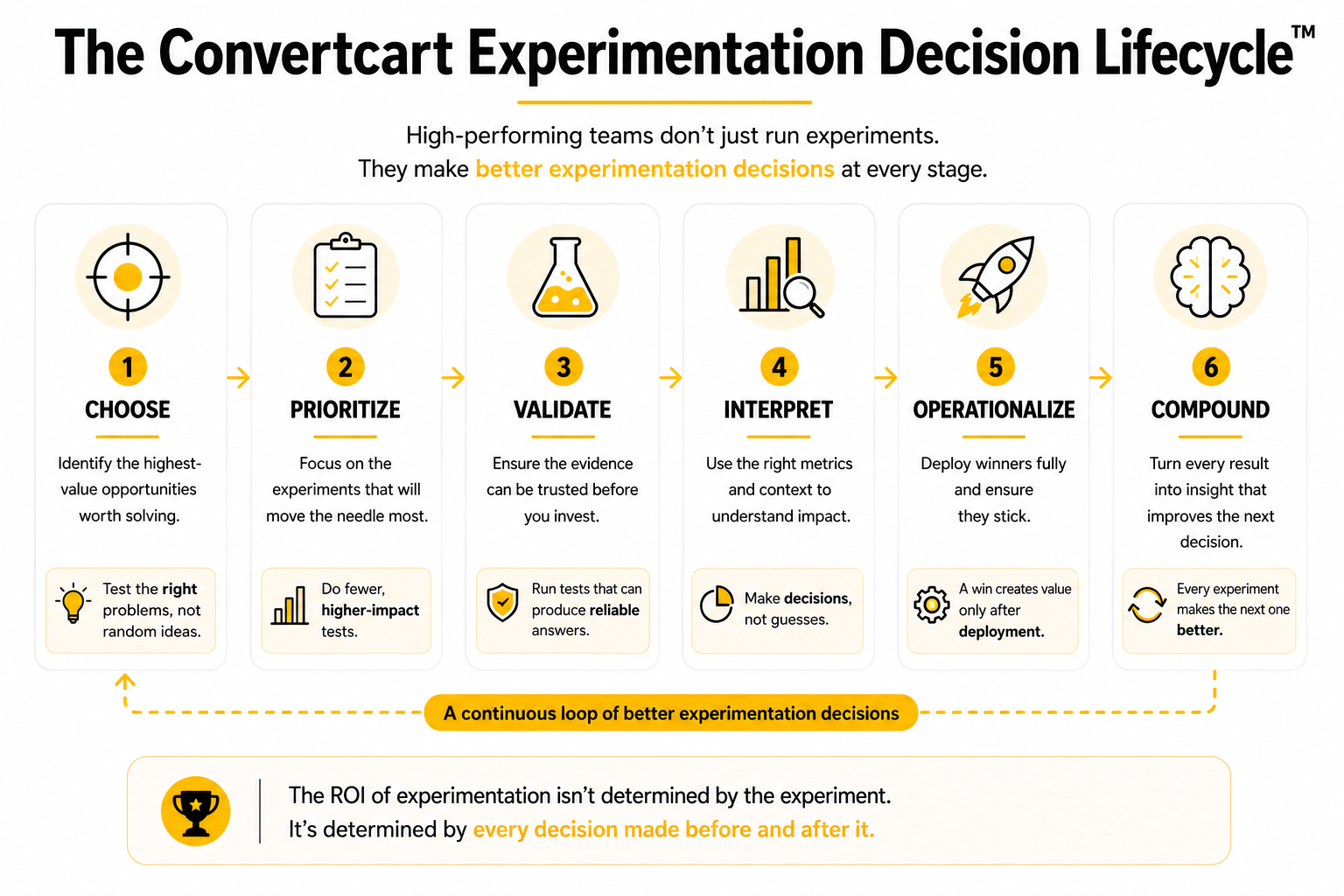
The Convertcart Experimentation Decision Lifecycle™ is based on patterns we observed across 1,103 client experiments. It describes the six stages that consistently appear in high-performing experimentation programs, from choosing the right opportunities to turning every completed experiment into a better future decision.
Every successful experimentation program moves through these six stages. When one or more stages break down, the result is lower win rates, slower learning, and missed revenue opportunities.
The seven failures in this article map directly to these stages and explain where experimentation programs most commonly go wrong and how to fix them
Behind almost every stalled testing program, we found one of these seven problems.
Many A/B testing programs lose more revenue from unimplemented winning experiments than from failed hypotheses.
Implementation delays destroy more revenue than failed hypotheses.
In conversations with store owners, we have repeatedly seen how statistically significant winners sit in backlogs for months or were shipped once and then quietly overwritten in a later site update because no one owned the change.
The test already did the hard work: it isolated a real lift. The revenue simply never got collected.
The failure is rarely intentional. A winner gets logged, then de-prioritized, then forgotten.
Then four months later the team wonders why last quarter’s testing program didn’t move revenue. The answer is that it did, but nobody shipped it or protected it.
How to Fix it:
This simple accountability step often recovers more revenue than most advanced testing tactics. The gap between knowing and doing is frequently the largest leak in an experimentation program.
Experimentation programs produce better long-term results when each test builds on the previous one instead of existing in isolation.
Most experimentation programs don’t fail because individual tests are bad. They fail because the tests never build on each other.
The highest-performing teams don’t learn faster by running more experiments. They learn faster because every test answers the question the previous one raised. A real program compounds. A backlog just churns.
This is why many founders say “testing didn’t do anything for us.” It’s rarely that zero tests won.
It’s that the wins never added up into anything larger.
Start with a clear view of where the funnel is leaking and why. Then deliberately sequence the next test to answer the open question left by the last one.
When every experiment feeds the next, the program itself becomes the advantage, not the tool.
An experimentation program starts losing momentum when teams stop proposing their highest-impact ideas.
If shipping one experiment means filing a ticket and waiting two sprints, the testing program is already dying, it just hasn’t realized it yet.
Engineering constraints quietly reshape what gets tested. Over time, teams stop proposing high-impact ideas because those ideas require real development work. The silent calculation becomes: “This needs three days of engineering, the team is booked until March, and it’s not a guaranteed win.” So the idea never gets suggested. Neither does the next one.
Within a quarter, the only tests still running are the ones cheap enough to build in the visual editor on a Thursday afternoon copy tweaks, button colors, minor layout shifts. The test count still looks healthy. The win rate may even rise, because safe, small changes are easier to win.
What’s missing is every meaningful experiment that no one bothered to propose.
A caution, though. The fix isn't "run more tests." Velocity is a diagnostic, not a target. Chasing higher test volume usually produces a flood of low-impact experiments and a scoreboard that looks busy. The real goal is simpler: make “is this worth an engineering ticket?” stop being the filter that decides the roadmap.
When high-impact ideas can move without constant negotiation, the program recovers its ability to find real gains.
An A/B test can only produce reliable results if the page receives enough traffic to reach statistical significance.
More inconclusive tests are caused by traffic limitations than by bad ideas.
The most common technical reason a test fails is simple: it was mathematically incapable of producing a result in the first place.
If your baseline conversion rate is 3% and you want to detect a 5% relative improvement, the sample size required is often far larger than the page receives in a sensible time window. The test runs for weeks, returns “inconclusive,” and the team concludes that testing does not work for a business of their size.
It was not testing that failed. It was arithmetic.
Inconclusive is not a result. It is a test that was never able to produce one. The uncomfortable part is that this is knowable before anything is built. You can calculate, in advance, whether the traffic on that page can detect the effect you are hoping for. Most teams skip this step. They launch the test, wait six weeks, and discover the limitation the expensive way. When the result comes back flat, they blame the tool, the idea, or experimentation itself.
The fix takes ten minutes:
Before building the variant, run the sample-size calculation using three inputs -
If the calculation shows fourteen weeks, you have a clear decision: move the test further up the funnel where traffic is higher, or do not run the experiment at all. Either choice saves you from waiting six weeks for an answer the math could have given you immediately.
Many store owners ask us, "Should I stop an A/B test early if it's already winning?"
Stopping an A/B test too early increases the risk of making decisions based on random variation rather than real customer behavior.
This is the mistake almost everyone knows about and still makes. You stop the test the moment the dashboard looks green.
Statistical discipline is not hard because the math is complicated. It is hard because waiting is uncomfortable. The test goes live on Monday. By Wednesday the variant is up 8% and someone has already screenshot it for Slack. By Friday it is being called a clear winner, and the question becomes why you would wait another two weeks to confirm what you can already see.
What you can already see is noise. Early results swing wildly. If you keep checking, the numbers will eventually swing in your favor. Stopping at that moment does not produce a valid experiment. It produces a coincidence you decided to ship.
Every time you peek at a running test and consider ending it early, you increase the chance of a false positive.
This is why roughly one in five “wins” at standard confidence levels fail to hold up once the change is fully deployed. Some of those wins were never real. They were simply tests stopped at a flattering moment.
The rule is non-negotiable.Set the required sample size and duration before the test starts. Then do not look at the results until you reach them.
The real discipline is not in the statistics. It is in the two weeks of not looking.
Another question store owners often ask is "Does a losing A/B test mean the underlying idea was wrong?"
However, a failed A/B test usually tells you that one execution didn't work and not that the underlying hypothesis was "wrong".
An A/B test does not validate your idea. It validates one specific execution of that idea.
When a test loses, you have learned far less than it feels like. The underlying idea may be sound while the execution was simply wrong.
Killing the idea at that point throws away something that could have worked, just because one version of it failed.
This pattern appears repeatedly across failed tests. A comparison guide that added friction instead of removing it.
Social proof placed below a sticky add-to-cart button where most shoppers never scrolled.
Reviews shown before a product was even selected. A free-shipping message triggered too early in the journey.
Different brands, same verdict: right idea, wrong placement, wrong moment, or wrong audience. What we rarely conclude is that the idea itself was flawed.
When a test loses, the useful question is not “Was I wrong about my customer?”It is “Was this the only way to test the idea?”
Before discarding a concept, examine whether a different placement, moment, or audience segment could produce a different outcome. A losing test earns a post-mortem, not an immediate verdict.
Choosing the wrong success metric can make an unsuccessful experiment look like a winning one.
A team celebrates a 12% increase in add-to-cart clicks and declares the experiment a success. Three weeks later, sales have not moved.
Proxy metrics are attractive because they are easier to move. They produce results faster, need less traffic, and make the testing program look productive.
They can also create a false sense of progress.
We have seen tests where add-to-cart rates rose while completed purchases fell. More shoppers showed intent, yet fewer actually bought.
If add-to-cart is treated as the definition of success, that experiment gets shipped even though it hurt the business.
This is why Convertcart is deliberately strict about what counts as a winning test.
Between January and June 2026 we ran 623 experiments.
Of those, 43 used a micro-conversion as the primary success metric. 24 of them met our predefined win criteria. These 43 cases were limited to stores that lacked enough traffic to detect a reliable revenue impact in a reasonable timeframe.
Even in those situations we did not treat every micro-conversion as equal.
We selected metrics such as add-to-cart, cart views, or checkout views only when they were the strongest available indicators of downstream purchase intent.
The critical step is deciding the micro goal before the experiment begins.
Choose it not because it is the easiest number to improve, but because you have already established that movement in that metric reliably predicts revenue.
Otherwise you are not measuring business impact. You are measuring activity.
Understanding where a problem occurs is often the fastest way to identify the right fix. A low win rate, for example, can result from poor planning before a test, statistical mistakes during execution, or implementation failures after a winning variation has been identified.
The framework below maps the seven experimentation failures discussed in this article to the stage where they most commonly occur.
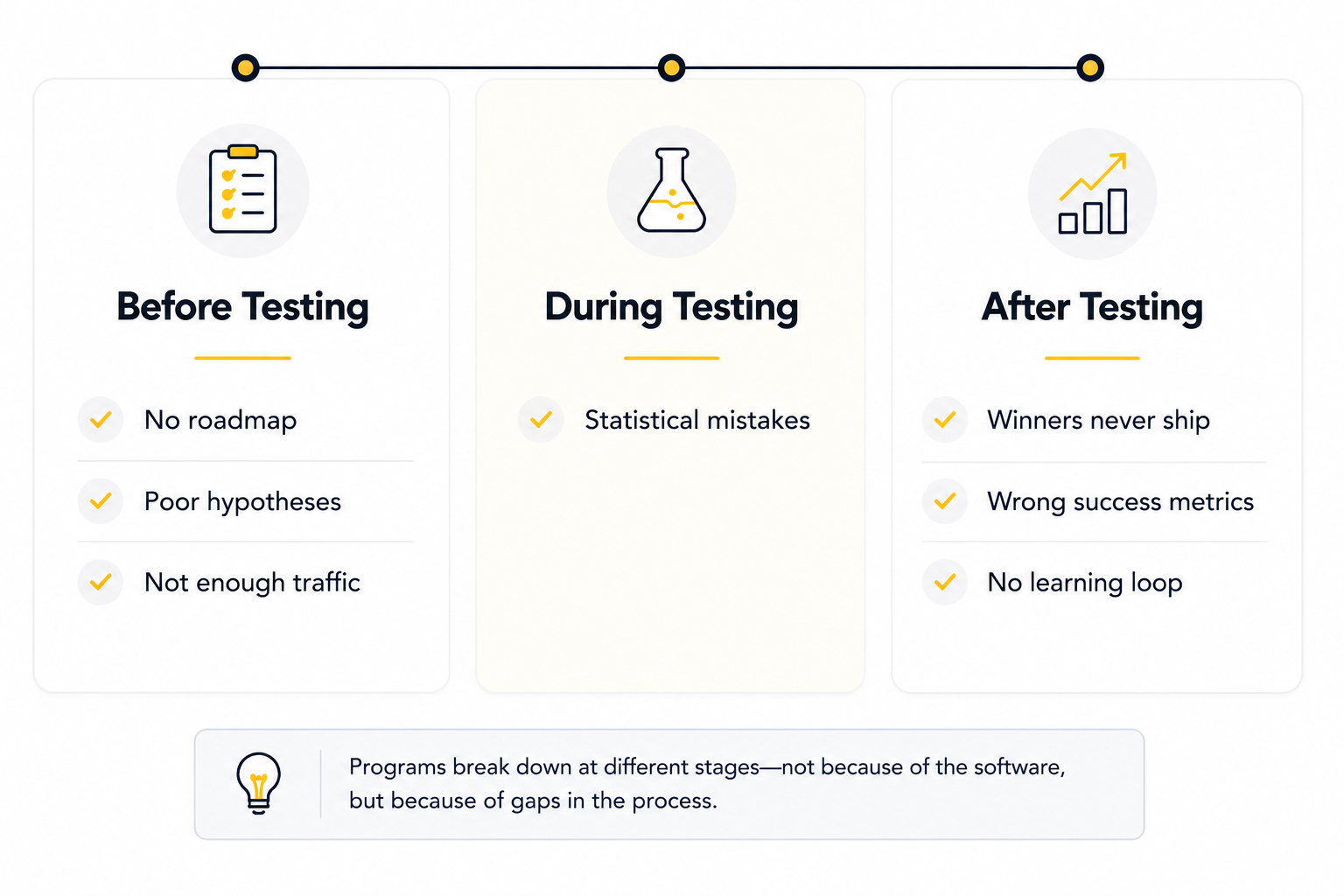
The strongest experimentation programs improve every stage of the process, not just the experiment itself.
They identify better opportunities before testing, maintain statistical discipline while experiments are running, and ensure winning ideas are implemented and used to improve future experiments.
Not every ecommerce store is ready for A/B testing.
That's an uncomfortable truth, because many businesses invest in an A/B testing platform before they're in a position to get reliable answers from it.
As a general benchmark, a store needs somewhere around 15,000+ monthly visitors or 300+ monthly orders to reach statistical significance within a reasonable timeframe. Below that range, even a well-designed experiment can run for weeks without producing a statistically reliable result, not because the idea was wrong, but because there was never enough traffic to detect it.
We know because we run this assessment on every account we take on.
We don't run split tests for those clients and call the results wins.
Instead, we audit their site to identify where enough traffic already exists and focus experimentation on the pages with sufficient visitors and orders to produce a meaningful signal. Sometimes that means combining mobile and desktop into a single experiment rather than splitting an already thin audience. Sometimes it means being honest and saying a page simply can't be tested yet.
Nobody selling testing software is likely to tell you this.
We're saying it because we've seen what happens when businesses try to force A/B testing before they're ready. They spend weeks waiting for results that were never mathematically possible in the first place.
So before you spend another month running an experiment that can't conclude, be honest about your traffic. If you're not there yet, you haven't failed at experimentation. You've simply chosen a method that doesn't match your current scale.
Ship the change to every visitor, then compare a clean period before the change with a clean period after it.
This approach is less rigorous than a true A/B test because seasonality, promotions, and external factors can influence the outcome.
Treat the results as directional rather than conclusive. For lower-traffic stores, however, directional evidence is often more valuable than a split test that will never reach statistical significance.
Don't assume the product page is always the best place to experiment.
If your product page receives 800 visitors each month but your site receives 12,000, move the experiment to something every visitor encounters, such as your navigation, homepage messaging, shipping threshold, or promotional offer.
Higher-traffic pages reach statistically meaningful conclusions much faster.
Many low-traffic stores test the page closest to the purchase because that's where the revenue is. In reality, it's often the page with the smallest sample size.
Not every valuable experiment has to improve conversion rate.
Repeat purchase rate, refund rate, customer support requests, email engagement, and post-purchase journeys can often be measured reliably with far fewer customers than a traditional conversion-rate experiment requires.
If your store processes 400 orders each month, you already have enough data to optimize your post-purchase emails, packaging inserts, onboarding experience, or returns flow.
Those experiments can improve revenue while your traffic continues to grow.
Here's something worth leaving with: the A/B test was never the real experiment.
The real experiment is your company's ability to decide what's worth testing, protect a result long enough to trust it, and act on it when it lands.
What determines whether testing pays isn't the test itself, it's everything a team does before and after it. That's why two companies can run the identical experiment and get opposite returns. One has a program. The other has a habit.
That also changes how you should think about the team running your experimentation program. The question isn't simply whether to hire internally or work with a managed CRO partner, but which model can consistently produce trustworthy learning from your investment.
So the honest question was never "Is A/B testing worth it?"
It's "Is our organization built to learn?"
A team that can't ship a winner or won't kill a bad idea doesn't have a testing problem, it has a decision-making problem that testing simply made visible.
That's the harder work, and it's the work Convertcart does.
If you want to know where your own program actually stands, an audit will show you which of these foundations you're missing before you spend another dollar chasing a test that was never going to move the number that matters.
Because a "win" and a "shipped, permanent change" aren't the same thing. Statistically significant winners commonly sit in a backlog for months, or get shipped once and quietly overwritten in a later site update because no one was assigned ownership of the change. The fix is procedural: assign a named owner for every winning test, and schedule a verification check 2 to 3 weeks post-launch to confirm the change is still live. A test isn't complete when results are declared. It's complete when the winning version becomes the permanent default.
There's no fixed number, and chasing volume is itself a common failure mode. Test velocity is a diagnostic, not a target: a program running many small, safe tests (button colors, copy tweaks) can look active while avoiding the higher-effort, higher-impact ideas that actually move revenue. The better question isn't "how many tests," but whether the ideas being tested each month are ones that could plausibly produce a meaningful lift if they won.
Neither is inherently better, but they answer different questions and carry different risks. Small changes (copy, button color) are cheap to build and quick to read, but rarely move revenue meaningfully on their own. Large changes (page redesigns, new flows) can produce bigger lifts but take longer to build, need more traffic to isolate what caused the result, and are harder to diagnose if they lose. A healthy testing roadmap usually includes both, sequenced so small tests inform what's worth building bigger.
A clean null result (not an early stop, not underpowered) usually means one of three things: the change was genuinely too small to matter to customers, it solved a problem that wasn't actually a significant friction point in the funnel, or it helped one segment while hurting another in a way that canceled out in the aggregate. Segmenting results by device, traffic source, or new vs. returning customers before writing off the idea can reveal whether a real effect existed for part of the audience.
Yes. A/B testing integrates directly with Shopify (and most major ecommerce platforms) via scripts or apps rather than requiring a separate site. Convertcart's CRO360, for example, runs A/B testing as one part of a fully managed conversion rate optimization service, with a dedicated team building, coding, and analyzing the experiments rather than leaving that work to the store owner. The platform question matters less than whether the store has enough traffic and orders to reach statistical significance, and whether there's a process in place to act on results, since those are what actually determine whether testing produces revenue. Stores below that traffic range are generally better served by directional testing methods rather than standard split testing.
Subscribe for more articles like this!


.avif)
.svg)


.svg)

.svg)
.svg)
2026 Convertcart, All Rights Reserved
33/1, Castle Street, Ashok Nagar, Bengaluru, India