In-House CRO vs. Managed CRO: What Does It Really Cost?
The better way to compare in-house CRO vs. managed CRO is Cost Per Trustworthy Experiment (CPTE), not salary or monthly fees.
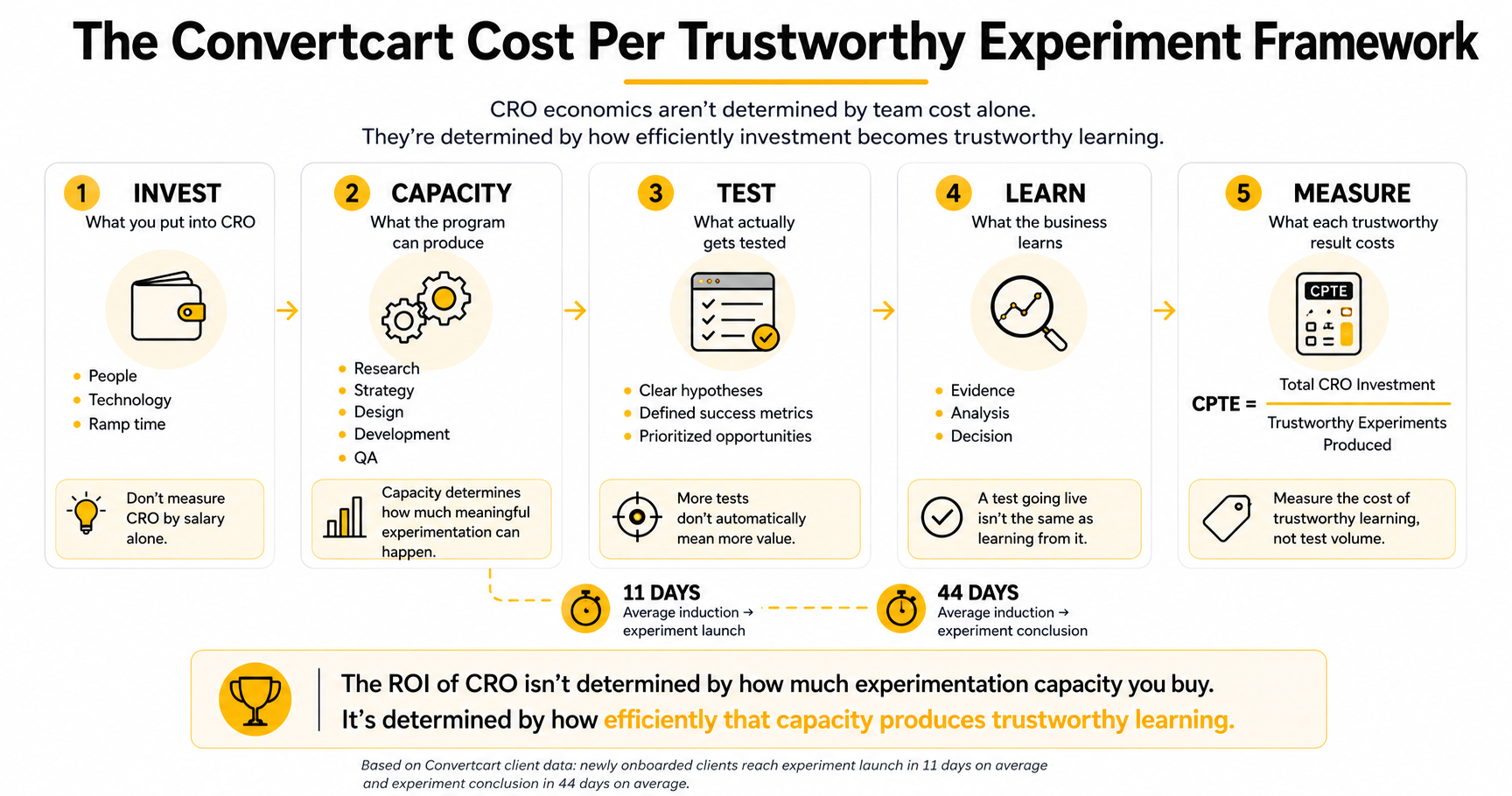
CPTE = Total CRO investment ÷ trustworthy experiments produced
A trustworthy experiment reaches its defined decision criteria and produces evidence the business can confidently act on.
In-House CRO
Managed CRO
Best for
Continuous, high-volume testing with mature internal processes
Limited CRO bandwidth, or starting experimentation without hiring a full team
Investment
About $532,000 a year in salaries alone (analyst, developer, UX designer, QA, project manager)
Monthly or project-based fee, no hiring or tooling overhead
Time to result
Ramp time to hire and onboard before testing starts
11 days average to launch, 44 days average to conclusion (Convertcart client data)
Pros
Full control over strategy; deep product and customer knowledge; no per-experiment fee
Faster launch and conclusion; no hiring or ramp cost; predictable CPTE from month one
Cons
High fixed cost; risk of low throughput if backlog can't keep the team busy
Less day-to-day control; ongoing retainer or subscription cost
The right choice depends on your traffic, experimentation demand, and whether you have the capacity to sustain a full-time team. The full breakdown, including how to calculate your own CPTE, is below.
Most companies comparing an in-house CRO team vs. managed CRO start with salaries.
That's the wrong comparison. Conversion Rate Optimization is an investment in experimentation capacity, so the more useful question is how efficiently that investment produces trustworthy experiments.
This article explains how to calculate that cost, what an in-house CRO team actually costs, and when building internally makes more sense than managed CRO.
What Is Cost Per Trustworthy Experiment (CPTE)?
If you're deciding whether to build an in-house CRO team or outsource CRO, salary is not the most useful number to start with.
The better question is: what does it cost to produce a trustworthy experiment?
That's the idea behind Cost Per Trustworthy Experiment (CPTE).
CPTE = Total CRO investment ÷ trustworthy experiments produced
A trustworthy experiment is more than a test that goes live. It starts with a clear hypothesis and appropriate success metric, reaches enough evidence to support a decision, and produces a result the business can confidently act on.
That means the true economics of conversion rate optimization include more than salaries:
People: Analysts, developers, designers, QA, and project management.
Technology: Testing platforms, analytics, session recordings, research, and other tools.
Ramp time: Recruiting, onboarding, learning the business, and getting the team productive.
Testing capacity: How many meaningful experiments the team can take from idea to launch.
Experiment quality: How many experiments produce reliable evidence rather than inconclusive results.
So instead of asking "How much does an in-house CRO team cost?", ask:
How much are we investing to produce each trustworthy experiment, and how quickly can we produce it?
That is the core idea behind CPTE and the lens we'll use to compare in-house CRO vs. managed CRO throughout this article.
What Does an In-House CRO Team Actually Cost?
A full in-house CRO team typically needs several capabilities working together: analytics to identify opportunities, development to build experiments, UX to design them, QA to validate them, and project management to keep the program moving.
Here's what those five roles cost on an annual basis in the US:
Role
Average Annual Salary
Data Analyst
$93,454
Frontend Developer
$124,100
UX Designer
$108,393
QA Engineer
$101,311
Project Manager
$104,759
Total
$532,017
Source: Glassdoor
The team still needs testing and research technology, recruiting and onboarding, management, and time to become productive.
That $532K figure gives us the fixed-cost base. The more important question is what that investment actually produces: how quickly the team starts testing, how many experiments it can run, and how many produce trustworthy results.
Time to Result: The Hidden Cost of In-House CRO
Building an in-house CRO team is only the beginning. The team has to move from onboarding to launching an experiment, and then from launch to a conclusion the business can act on.
At Convertcart, experiments for newly onboarded clients take an average of 11 days from induction to launch and 44 days from induction to conclusion.
Onboarding
↓
11 days
Average time to launch
↓
Experiment launches
The variation goes live
↓
44 days
Average time to conclusion
↓
Experiment concludes
Evidence supports a decision
↓
Business learns
Data methodology:
Based on ConvertCart clients onboarded between April and June, we measured
the elapsed time from client induction to experiment launch and from
induction to experiment conclusion. Across this cohort, experiments took
an average of 11 days to launch and
44 days to conclude. The figures reflect observed client
timelines during this onboarding period.
The distinction matters: launching an experiment is not the same as learning from it.
A CRO program creates value when an experiment reaches a trustworthy conclusion, not simply when a variation goes live.
That makes time to launch and time to conclusion useful measures of CRO efficiency. They show how quickly a program can move from setup to experimentation and, ultimately, to actionable learning.
Why Cost Per Experiment Isn't Enough
The simplest way to measure CRO economics is:
Cost Per Experiment = Total CRO investment ÷ experiments shipped
For example, if an in-house CRO program costs $550,000 a year and ships 24 experiments, the cost is $22,917 per experiment. If it ships 48, that falls to $11,458 per experiment.
But cost per experiment measures testing activity, not necessarily useful learning. A test can launch without producing evidence the business can confidently act on.
CPTE goes one step further by measuring the cost of producing trustworthy experiments.
That's why Cost Per Trustworthy Experiment is a more useful measure of CRO efficiency than test volume alone.
The goal isn't to run the most tests. It's to produce the most trustworthy learning from the investment.
The Economics Change When Experiment Throughput Changes
Once the fixed cost of a CRO program is established, experiment throughput becomes an important part of the economics.
A CRO team creates value by turning its people, technology, and time into a consistent stream of experiments. But throughput isn't simply the number of tests launched.
A high-volume program can still produce weak results if experiments are poorly prioritized, inconclusive, or don't generate enough evidence for a decision.
How many trustworthy experiments can we produce without compromising quality?
That is the difference between testing activity and experimentation capacity.
And this is where Cost Per Trustworthy Experiment (CPTE) becomes useful.
If two CRO programs make similar investments, but one consistently produces more trustworthy experiments, its effective cost per result is lower.
Remember: The goal isn't maximum test volume. It's maximum trustworthy learning from the investment.
You can see what that looks like in practice in Convertcart’s work with Gloves.com, where experimentation became a continuous program rather than a series of isolated tests.
ConvertCart Case Study
What Sustained Experimentation Looks Like: Gloves.com
The economics become clearer when you look at a real eCommerce conversion rate optimization program rather than a hypothetical team.
95+
Experiments run
41%
Experiment success rate
The program included experiments across product discovery, mobile shopping, delivery uncertainty, promotions, and navigation.
+9.27%
Increase in conversion rate
A mobile Quickview experiment addressing high category-page abandonment resulted in a 9.27% increase in conversion rate.
+22%
More users completing orders
A real-time shipping countdown designed to reduce delivery uncertainty increased the number of users completing their orders by 22%.
The important point isn't any single experiment. It's the ability to continuously identify conversion problems, turn them into hypotheses, test them, and use the results to decide what to improve next.
When Should You Build an In-House CRO Team?
Managed CRO isn't always the better choice. An in-house team can make sense when experimentation is already a strategic capability and the business has enough demand to keep the team productive.
Pros of Building an In-House CRO Team
Experimentation is already a core capability. You have established analytics, UX, engineering, QA, and experimentation processes that can support a continuous CRO program.
You have a large, continuous testing backlog. Enough traffic and conversion opportunities can keep a dedicated team productive rather than leaving capacity underused.
You already have the supporting team structure. If analytics, development, design, QA, and project management are already in place, adding dedicated CRO ownership can be more practical.
You need experimentation deeply embedded in the business. An internal team can build long-term institutional knowledge around your customers, products, data, and experimentation process.
The economics improve with sustained throughput. A fixed in-house investment can become more efficient when the team consistently produces a high volume of trustworthy experiments.
Cons of Building an In-House CRO Team
The cost starts before the first experiment. A five-role US CRO team covering data analysis, frontend development, UX, QA, and project management represents about $532,017 in annual salaries, before technology, recruiting, onboarding, management, and other operating costs.
It takes time to become productive. Hiring and onboarding create a ramp period before the team can operate at full experimentation capacity.
Experiment volume isn't the same as experimentation value. A team can launch many tests without producing enough reliable evidence to support decisions.
Existing teams can become the bottleneck. Developers, designers, analysts, or QA resources may already be committed to other priorities, slowing experimentation even when CRO demand is high.
The real cost depends on trustworthy output. Comparing salary against a managed CRO fee misses the more useful question: how much does it cost to produce each trustworthy experiment?
Time to learning matters. ConvertCart's observed data for newly onboarded clients shows an average of 11 days from induction to launch and 44 days from induction to conclusion. The benchmark to compare is not simply how quickly a test goes live, but how quickly the program produces evidence the business can act on.
When Managed CRO Makes More Sense
You have traffic and conversion opportunities but limited CRO bandwidth.
You have developers or designers but no dedicated experimentation team.
CRO ideas regularly sit in the backlog because other work takes priority.
You want to establish a structured experimentation program without hiring five separate capabilities.
You want to test the economics of experimentation before committing to a full internal team.
Cons of Managed CRO
Less day-to-day control. Prioritization, roadmap, and experiment selection are shared with an external team rather than owned entirely in-house.
Institutional knowledge builds more slowly. A vendor team ramps on your business, customers, and data, but that knowledge doesn't compound inside your organization the way it does with a permanent internal hire.
Capacity depends on the vendor's bandwidth. Your testing velocity is shaped by their backlog and resourcing across other clients, not just your own priorities.
A retainer or subscription fee continues for as long as the program runs, unlike a fixed team where cost stabilizes once hiring is complete.
Highly specific or technically complex experiments may require closer integration with internal engineering than a managed model is built for.
Compare CRO Models by Cost Per Trustworthy Experiment
The better comparison isn't in-house salary vs. managed CRO fees. It's what each model produces from the investment.
CPTE = Total CRO investment ÷ trustworthy experiments produced
A trustworthy experiment reaches its defined decision criteria and produces evidence the business can confidently act on.
When comparing models, look at four things:
Total CRO investment: people, technology, recruiting, onboarding, management, and operating costs.
Time to result: how quickly the program moves from setup to launch and from launch to a trustworthy conclusion.
Trustworthy experiments produced: not just tests shipped, but experiments that generate actionable evidence.
Cost Per Trustworthy Experiment (CPTE): the cost of producing each experiment the business can confidently learn from.
The goal isn't maximum test volume. It's maximum trustworthy learning from the investment.
The Bottom Line: Measure CRO by What It Produces
The right way to evaluate in-house CRO vs. managed CRO isn't to compare salaries with subscription fees.
It's to compare what each model produces from the investment.
Use four measures:
Total CRO investment
Time to launch and reach a trustworthy conclusion
Trustworthy experiments produced
Cost Per Trustworthy Experiment (CPTE)
For some eCommerce businesses, an in-house CRO team will be the better investment. For others, managed CRO will make more sense. The right choice depends on whether the business has enough traffic, experimentation demand, supporting capabilities, and capacity to sustain the model.
Don't measure CRO by how much capacity you bought. Measure it by how much trustworthy learning that capacity produces.
Subscribe for more articles like this!
Thank you - we'll see you in your inbox soon!
Oops! Something went wrong while submitting the form.

.avif)



.svg)


.svg)

.svg)
.svg)