Waiting for launches, rewards, or exclusive events
Build anticipation
Product drops, early access launches, reward expiries
1. Using a countdown timer to compress decision time
Most eCommerce countdown timers fail because brands use them everywhere rather than deploying them at the exact moment when purchase intent peaks.
During Convertcart CRO audits, our team found that the best-performing countdown timers do not create urgency from scratch. They compress an already active buying decision.
Effective countdown marketing focuses less on pressure and more on accelerating decisions shoppers were already close to making.
In Convertcart's work with Gloves.com, we saw how delivery countdown timers make a difference.
On the product page, a shopper has already viewed the product, checked the price, and evaluated if they are going to buy.
To improve decision time, we added a clear message with a timer:
Place an order within 10 Hrs 58 Mins 31 Sec for the item to ship today.
This meant that shoppers would lose out if they delayed.
The Result: Shipping cutoff timers helped Gloves.com reduce cart abandonment and increase conversions by 24%.
The same principle applies to flash sales, lightning deals, weekend offers, seasonal campaigns, and last-chance alerts.
The strongest sales countdown timers stay simple.
A clear shipping cutoff, discount ending tonight, or sitewide countdown consistently outperforms busy animated urgency widgets. These along with a countdown sticker on your Instagram Stories, can do wonders.
Great eCommerce countdown timers do not convince shoppers to want the product.
They reduce the gap between wanting it and buying it.
⚠️
Why aren’t browsers turning into paying customers?
Product discovery – barriers that prevent shoppers from finding items
Category/collection pages – improvements that drive deeper product exploration
Product page – what to optimize to convert 2–3x more buyers
Cart – ways to ease hesitation and speed up purchase decisions
“The report was deep and super insightful. Can’t believe it’s free.”
Logan Christopher CEO, Empire Herbs
2. Reducing buyer anxiety with countdown timers
During Convertcart CRO audits, our team found that many top-performing countdown timers actually reduce buyer anxiety rather than create pressure.
Shoppers often already want the product but hesitate due to delivery uncertainty or fear of missing key dates.
In these cases, the timer shifts from urgency to reassurance.
We saw this clearly with delivery countdown timers.
Same-day shipping timers, holiday order cutoffs, and checkout delivery timers performed strongly because they instantly answered: Will this arrive in time?
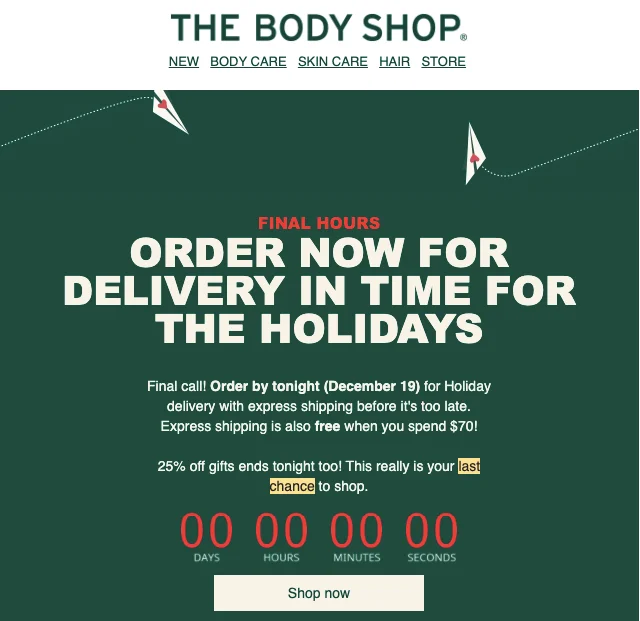
See how The Body Shop uses this.
Their timer reassures shoppers they still have time for safe holiday delivery instead of pushing discounts aggressively.
The same effect appears in timed free shipping thresholds and exit-intent pop-ups.
These formats give hesitant shoppers a confident second chance without feeling manipulated.
The highest-performing countdown timers do not always force urgency.
Sometimes they simply remove uncertainty so shoppers can act with confidence before the window closes.
3. Re-engaging shopper attention to bring them back to purchase
Shoppers get interrupted, open competitor tabs, or simply forget to return.
This is where effective eCommerce countdown timers work as attention recovery tools.
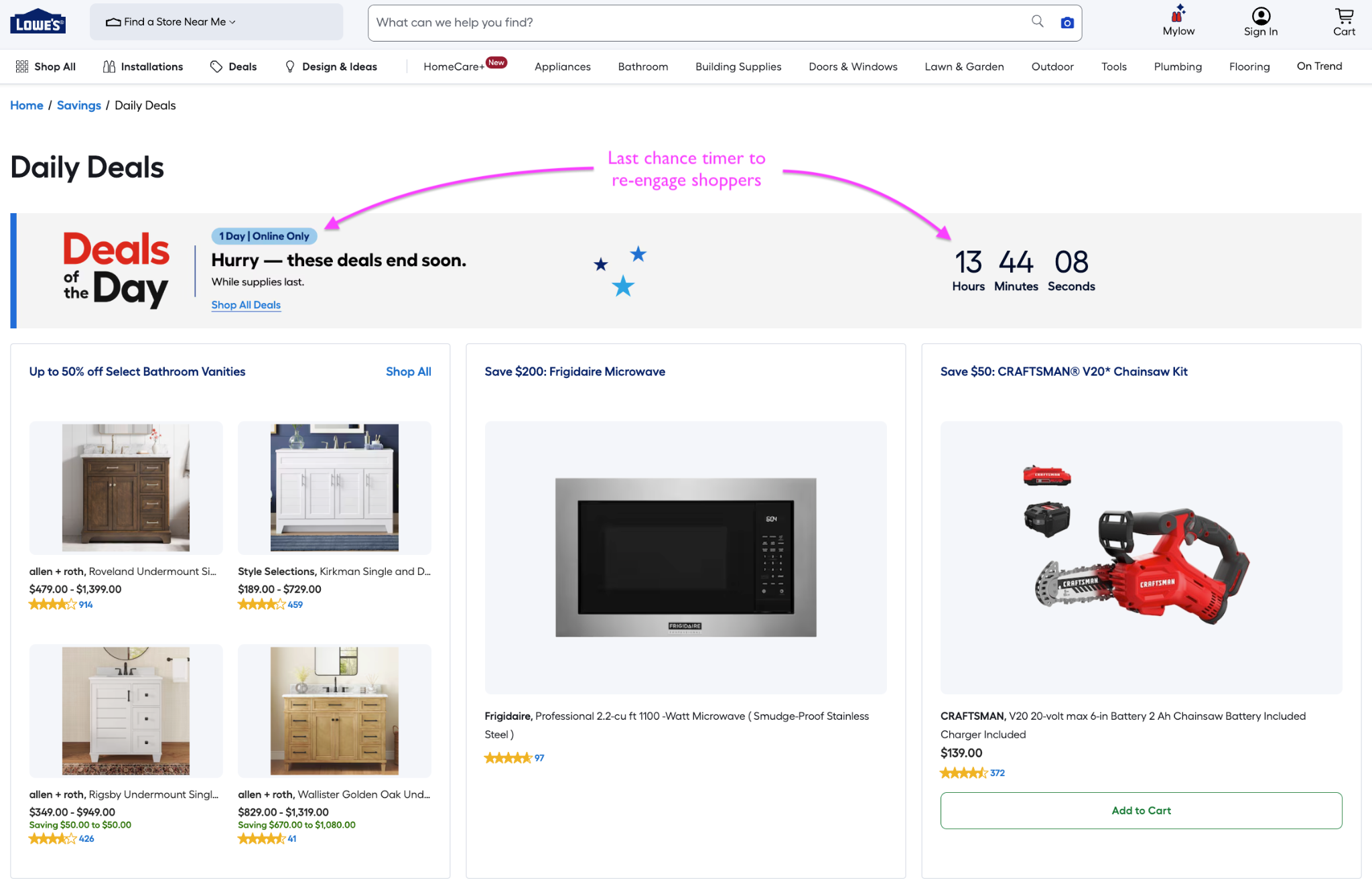
The Lowe’s example shows this well.
A prominent countdown on the Daily Deals page reminds visitors that the offer has a clear expiration.
For shoppers who browsed earlier and planned to return, the countdown timer UI acts as a re-engagement trigger.
We saw similar results in abandoned cart campaigns, timed winback emails, and SMS reminders.
Shoppers who already showed intent don’t need more convincing; they need help resuming their decision.
Timed exit-intent countdown pop-ups and “Time’s Up” messages also performed strongly by capturing attention right before it disappeared.
The best countdown marketing examples serve as interruption-recovery systems.
They revive stalled purchase journeys and help shoppers complete what they started.
Why visitors don’t trust your store within 3 seconds
Why shoppers can’t find what they’re ready to buy
What’s stopping 2-3x more shoppers from clicking “Add to Cart”
Where buyers hesitate right before purchase
Why high-intent shoppers still drop off
“The report was deep and super insightful. Can’t believe it’s free.”
Logan Christopher CEO, Empire Herbs
4. Creating anticipation to boost retention with timers
During Convertcart CRO audits, our team found that some of the most effective eCommerce countdown timers were not focused on immediate purchases.
Instead, they created anticipation for future events.
When shoppers know a valuable product drop, exclusive reward, limited freebie, or early-access event is coming, they develop a habit of returning.
Over time, these experiences build strong retention loops.
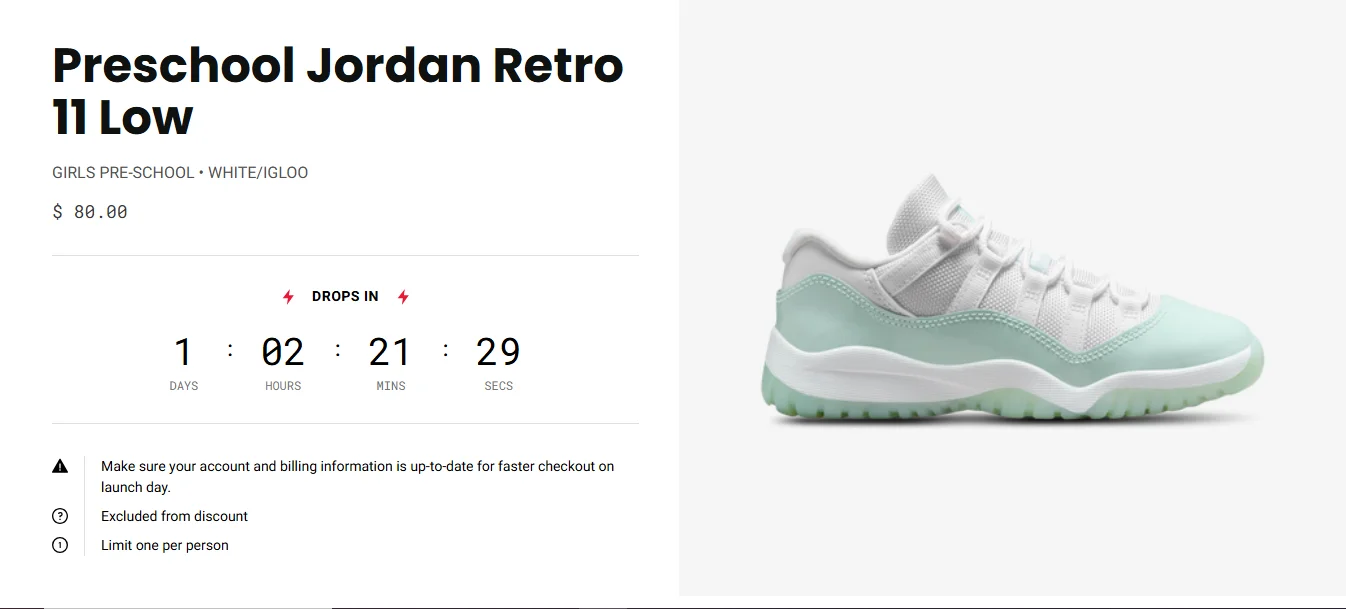
See the example above.
The countdown is tied to an upcoming product release rather than a discount. Shoppers know exactly when the item becomes available, giving them a reason to revisit the site multiple times before launch.
We observed similar performance with cyclical new collection launches, timed freebies, festive campaigns, and gamified emails.
Timed contests also drove multiple return visits as participants checked progress and unlocked rewards.
The strongest countdown timer UI examples in this category function as anticipation engines. They make future events visible and worth returning for.
This retention-focused countdown marketing differs from urgency-based sale countdown timers.
Instead of accelerating today’s purchase, it conditions shoppers to come back for the next opportunity.
The Final Audit: Your Countdown Implementation Scorecard
Before you push that timer live, rate your strategy against these four criteria.
If you score less than a 12/16, your timer is likely creating friction rather than urgency.
1. Intent Match (0–4 Points)
0 pts: The timer is static and shown to everyone (e.g., a "Sale Ends" bar that never actually ends).
4 pts: The timer type matches the page intent (e.g., a "Shipping Cutoff" on the PDP to solve delivery anxiety).
2. Transparency & Truth (0–4 Points)
0 pts: The timer resets when the page refreshes (Fake Urgency).
4 pts: The deadline is real, honest, and backed by inventory or carrier data.
3. Visual Hierarchy (0–4 Points)
0 pts: The timer is the biggest thing on the page, flashing in neon colors.
4 pts: The timer is high-contrast but integrated into the UI (e.g., placed near the "Add to Cart" or "Shipping Info").
4. The "So What?" Factor (0–4 Points)
0 pts: The timer ends, and nothing happens.
4 pts: The timer clearly communicates the consequence (e.g., "Order in 2h 10m to get it by Tuesday").
Score
The Verdict
0 - 5
The Dark Pattern: Your timers are likely hurting your brand trust and long-term LTV.
6 - 11
The Noise: Your timers are being ignored by shoppers who have "urgency blindness."
12 - 16
The Accelerator: Your timers are successfully removing hesitation and compressing the decision window.
Where eCommerce Countdown Timers Work Best Across the Funnel?
Funnel Stage
Best Timer Type
Primary Goal
Homepage
Flash Sale Timer
Capture attention and create immediate interest
Collection / Category Page
Deal of the Day Countdown
Encourage product exploration
Product Detail Page (PDP)
Shipping Cutoff Timer
Reduce hesitation and accelerate decisions
Product Detail Page (PDP)
Free Shipping Threshold Timer
Increase purchase motivation
Cart
Reserved Cart Timer
Prevent abandonment and push completion
Checkout
Offer Expiry Countdown
Reduce checkout drop-off
Exit Intent
Countdown Pop-Up
Recover abandoning visitors
Email
Winback Timer
Re-engage inactive shoppers
SMS
Countdown Reminder
Recover interrupted purchase intent
Product Launch Page
Early Access Countdown
Build anticipation and repeat visits
Loyalty Program
Reward Expiry Timer
Encourage repeat engagement
Seasonal Campaigns
Holiday Countdown Timer
Drive time-sensitive purchases
Not every countdown timer UI belongs on every page.
Timer performance depends heavily on where it appears in the customer journey.
A flash sale timer that performs well on a homepage often fails at checkout.
In contrast, delivery countdown timers that reduce hesitation on product pages rarely create a meaningful impact at the awareness stage.
Matching the timer to the shopper's mindset is what makes countdown marketing effective.
Countdown Timer Placement Strategy
Structure
Placement
Best Use Case
Sticky Bar
Sitewide
Promote flash sales, seasonal campaigns, and limited-time offers across the entire store
Product Detail Page (PDP)
Near pricing, CTA, or delivery information
Create shipping urgency and reduce purchase hesitation
Cart Page
Above checkout CTA
Reinforce reserved items, limited inventory, or checkout deadlines
Checkout Page
Order summary or payment section
Prevent drop-off by highlighting expiring offers or delivery cutoffs
Email Header
Top of promotional emails
Increase visibility for flash deals, holiday campaigns, and expiring discounts
Exit-Intent Popup
Triggered before abandonment
Recover abandoned visitors with limited-time incentives
Collection Page
Above product grid
Highlight storewide promotions and encourage browsing urgency
Product Launch Page
Hero section
Build anticipation for upcoming releases and early-access events
Loyalty Dashboard
Rewards section
Encourage redemption before rewards expire
SMS Campaign
Embedded within a promotional message
Create urgency around time-sensitive offers and reminders
As a general rule, delivery countdown timers perform best on product and checkout pages where fulfillment concerns influence purchase decisions.
Sale countdown timers tend to perform best in high-visibility placements such as sticky bars, collection pages, and email headers.
Meanwhile, recovery-focused timers are most effective inside exit-intent popups, abandoned cart emails, and SMS reminders.
The highest-performing countdown marketing campaigns match both the timer type and the placement to the shopper's intent at that moment.
Effective limited-time offers usually combine clear deadlines with genuine value rather than relying on pressure tactics alone.
See what matters when limited-time offer.
Ready to stop guessing and start converting more of your existing traffic?
We didn’t guess. We didn’t rely on “best practices” or gut feel.
Instead, we designed and ran rigorous, data-backed CRO experiments across real eCommerce stores, testing everything from product page layouts and trust signals to checkout friction, urgency elements, and personalization triggers.
If you’re tired of throwing money at traffic while watching too many visitors leave without buying, this is for you.
Our team will identify your biggest conversion leaks and give you a clear, prioritized list of quick wins and high-impact tests.


.png)




.avif)
.svg)


.svg)

.svg)
.svg)
