How Do You Improve eCommerce Conversion Rate With FOMO Marketing?
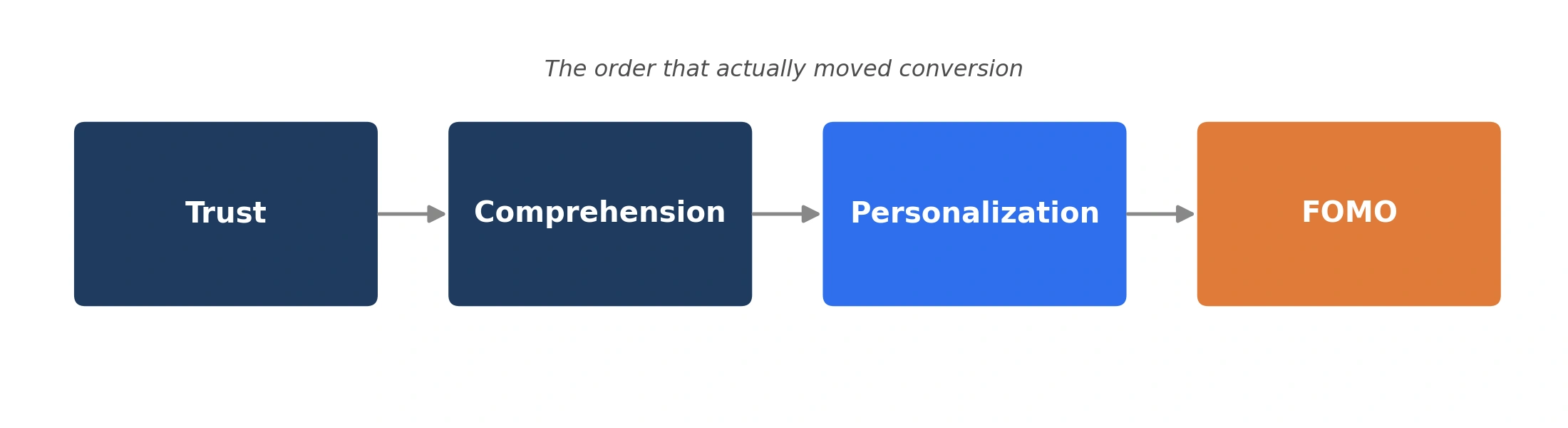
Using FOMO marketing to increase eCommerce conversion rate starts with a rule most teams get backward: urgency amplifies trust, but it cannot replace it. Make sure shoppers understand what they are buying and trust the price in front of them first, since decision anxiety kills more sales than a lack of urgency ever does. Only once that comprehension and purchase confidence are in place does FOMO marketing actually work, whether that means a genuine FOMO sale with a real deadline, a bestseller badge acting as social proof, or FOMO messaging that simply tells shoppers the truth about demand. That order alone pushed conversions up by as much as 79% in our own testing.
Here is how we helped an eCommerce store increase its conversion rate by 79% using FOMO marketing.
The store sold electronics and appliances, but with a twist. Instead of fixed prices, shoppers made an offer and waited to hear back.
Many gave up before a deal ever closed, mostly because they did not trust the process: they could not tell if a real person reviewed the price or if the silence just meant no.
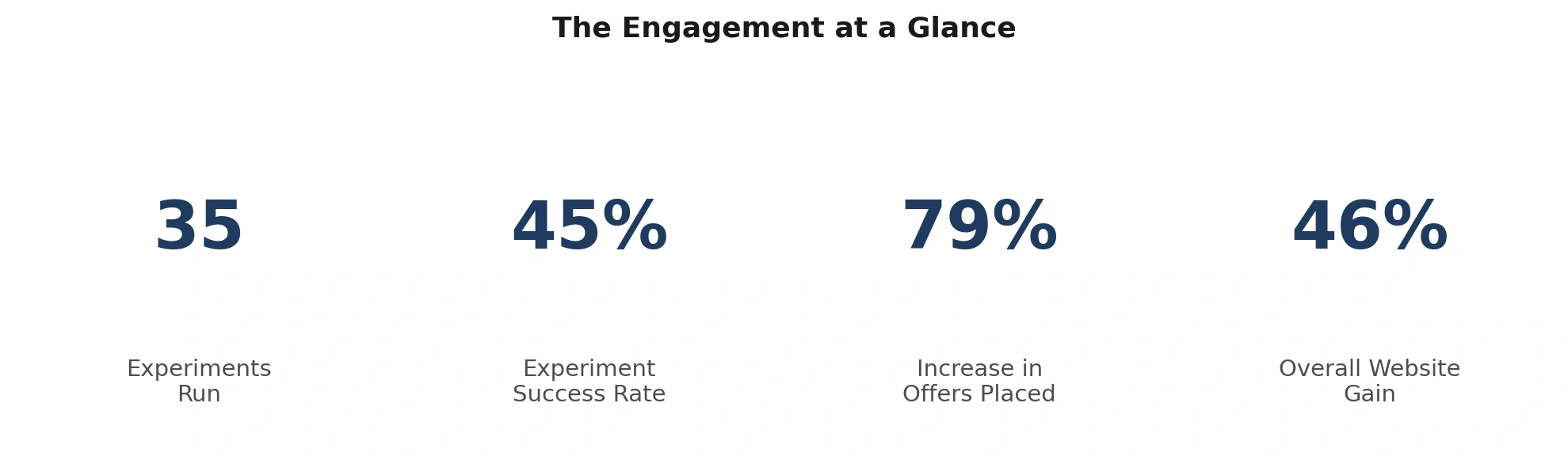
We ran 35 experiments over the engagement, landed a 45% experiment success rate against an industry average of 20 to 30%, and pushed the number of offers placed up by 79%, with a 46% gain across the site overall.
FOMO marketing played a real part in that number, but only after we fixed two things first: whether shoppers understood the buying process, and whether they trusted the price.
A bestseller badge and a time-boxed sale only started working once both of those were true.
That order held throughout the engagement, and it is the framework behind everything that follows.
1. The FOMO Marketing Mistake We Managed to Avoid
Most teams facing a conversion rate that refused to budge reached for urgency first, treating scarcity marketing and urgency marketing as a shortcut rather than a last step.
That was, in fairness, the marketing equivalent of turning up the radio when the car started making a strange noise.
An urgency tactic felt like the fastest option available: no rebuild, no new photography, no rewritten copy, just a plugin and a countdown clock.
In our experience, FOMO sales only worked when they sat on top of an experience shoppers found trustworthy.
Adding urgency to a page that already made people anxious did not create motivation. It made the anxiety louder.
So before anything resembling FOMO messaging went near the site, we fixed three things first, in this order.
Fix One: The Mobile Product Page
The old version buried the details a shopper needed before making a decision, and mobile felt the friction hardest. The rebuilt layout surfaced those details up front instead of burying them.
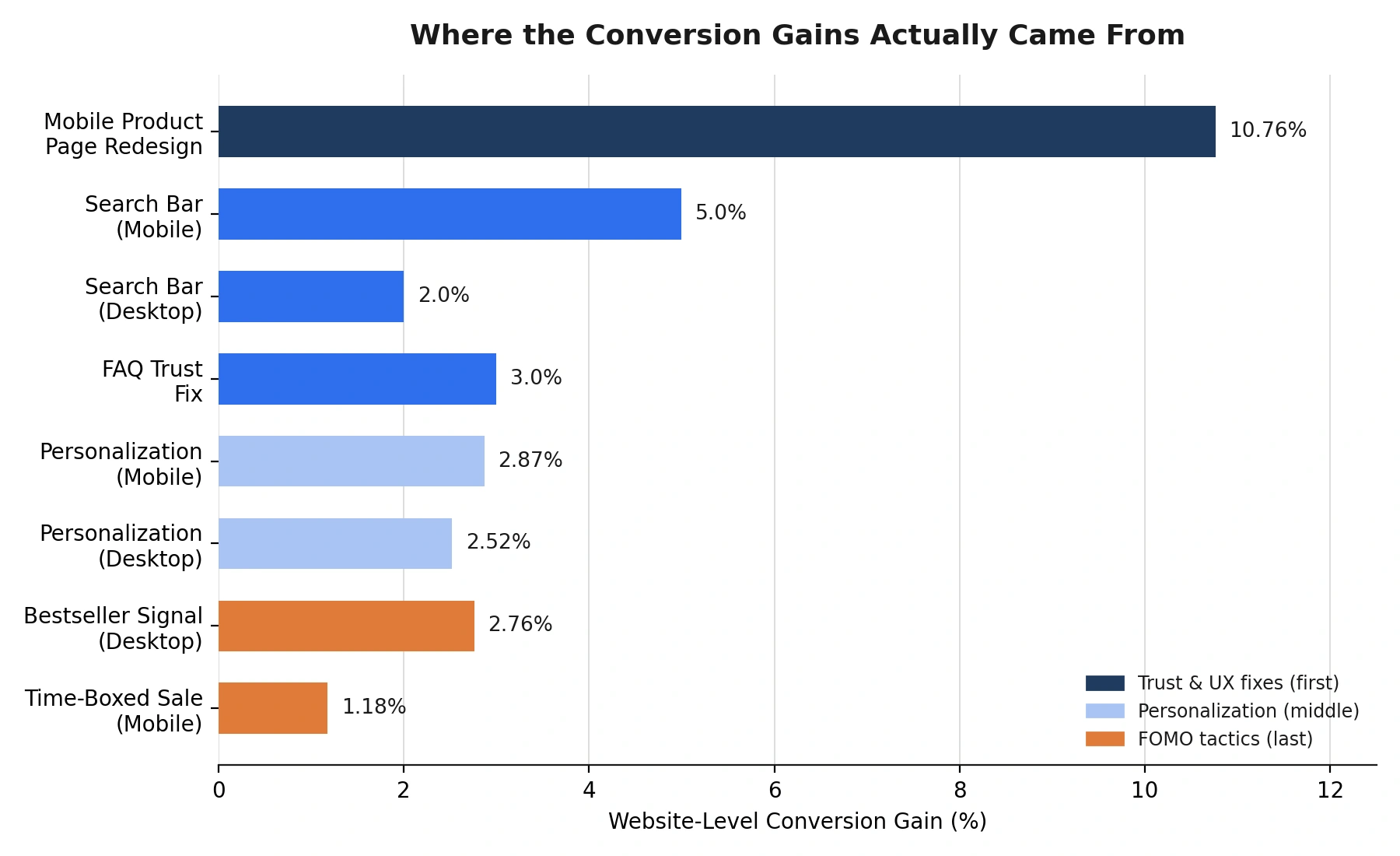
The redesign alone produced a 9.83% lift in conversions for the experiment and a 10.76% increase across the entire site, the kind of number that made us go back and put together everything we know about improving add-to-cart rate.
Nothing else in the whole engagement beat it, FOMO included.
Fix Two: The Search Bar
Shoppers on both desktop and mobile struggled to find products, and every failed search gave them one more excuse to leave.
Making the search bar easier to see and use, on both platforms, fixed that. Search usage climbed 25% on desktop and 67% on mobile.
The mobile experiment delivered a 12.17% campaign gain and a 5% website gain. Desktop added a smaller but still meaningful 2% gain.
Fix Three: The Trust Gap in the Pricing Model
A "name your price" checkout invited a specific kind of decision anxiety: the fear of doing it wrong.
That kind of hesitation shows up on far more pages than pricing, which is why we ended up collecting so many examples of it in ways to build trust fast on your eCommerce store.
Rebuilding purchase confidence took nothing exotic, just clarity applied consistently.
Two fixes addressed it. FAQs explained how the pricing worked, and a short explainer video walked shoppers through the process step by step.
The FAQ placement increased offers placed by 34% during that experiment, produced a 6.5% campaign gain, and delivered a 3% gain at the website level.
The video added another 4% lift in conversions on top of that. Only once these three fixes were live did we bring in anything resembling urgency or social proof.
2. How We Actually Tested FOMO Marketing Tactics
Here is why we trusted these numbers enough to build a strategy around them. No single test earned trend status around here, no matter how favorably we squinted at it.
A dedicated pod ran the engagement: a project manager, a data analyst, developers, designers, and QA.
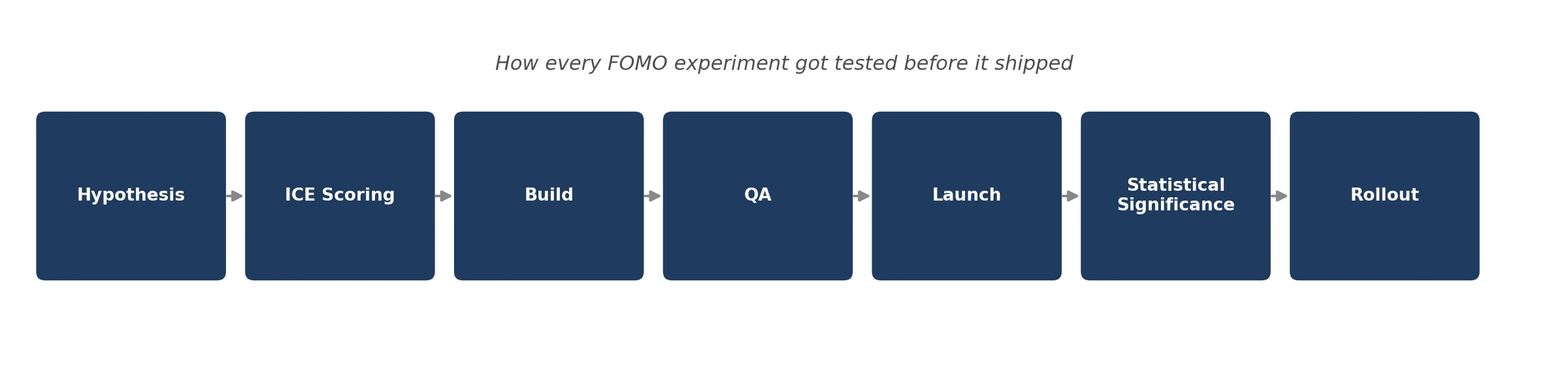
Every experiment went through structured hypothesis testing before it reached a shopper, the same discipline that separates conversion psychology from guesswork about buying psychology.
We scored ideas for impact, confidence, and ease before building them, and held every test to statistical significance before calling it a winner or a loser, rather than a hunch that happened to pan out.
That mattered because FOMO tactics tempt teams into skipping the rigor.
A countdown timer feels obviously good, and everyone has seen one convert somewhere, so it is easy to assume it will convert everywhere.
In our audits, this assumption costs stores real money more often than any other single mistake, which is why we did not take it on faith here either.
The approach was simple. Test the foundational friction first, measure it properly, and only then move on to urgency and scarcity, measured with the same discipline.
3. Where FOMO Marketing Actually Worked
Once we cleared the foundational friction, we introduced two FOMO marketing plays, one built on social proof and one on urgency, tested separately rather than lumped together.
The Bestseller Signal: FOMO Messaging on Desktop
A simple bestseller line, added directly to the product page, let shoppers know when an item ranked among the top sellers in its category.
Modest, on paper: just a sentence of FOMO messaging sitting quietly near the price.
That modest line drove a 6.43% increase in shoppers moving further down the funnel toward placing an offer, with an 8.51% campaign gain and a 2.76% gain site-wide.
The modesty was likely exactly why it worked: information, not a sales pitch.
The Time-Boxed FOMO Sale on Mobile
This one was an honest FOMO sale: a genuinely time-boxed discount rather than the vague "limited time" language shoppers have learned to ignore.
It relied on the scarcity principle in its most literal form, a real deadline, not an implied one- the same kind of tips we tried to bottle into the eCommerce flash sale playbook.
The sale produced a 9.65% campaign gain and contributed a 1.18% gain at the website level.
The Personalization Test in Between
Between the trust fixes and these two FOMO experiments, we ran a personalization test that explained a lot about why the FOMO plays worked as well as they did.
The recommendation modules, built separately for mobile and desktop, matched product suggestions to what a shopper had already browsed instead of showing the same generic grid to everyone, the digital equivalent of a shop assistant who actually remembers what you looked at last week.
Mobile delivered a 6.96% campaign gain and a 2.87% gain at the website level. Desktop delivered a 4.69% campaign gain and a 2.52% gain at the website level.
Both device types responded, which told us shoppers were ready to feel understood before we asked them to feel urgency.
We deliberately avoided piling every FOMO trick onto the page at once, testing the bestseller line and the time-boxed sale as separate, hypothesis-driven experiments rather than bundling them into one loud redesign.
A bestseller badge only worked because shoppers believed it, and the fixes that came before it had already earned that belief.
4. Why FOMO Marketing Sequence Mattered More Than We Expected
We held one rule sacred here: fix trust before you introduce urgency.
In our experience, nearly every one of the fomo marketing examples worth learning from followed this same shape, because urgency and scarcity amplified a decision a shopper was already leaning toward.
Both are psychological triggers, not standalone tactics, which is why neither works in isolation.
They rarely manufactured one out of nothing. Had we opened with a countdown timer instead of the FAQ fix, we would have asked confused shoppers to act fast on a process they still did not understand.
That was not FOMO, that was pressure, and pressure without trust pushed conversion rates down rather than up.
Urgency asked a shopper to skip deliberation and act now, which only worked if the shopper had already done the deliberating and simply needed a nudge to stop procrastinating.
Skipping the deliberation stage entirely would have meant asking someone to make a decision they were not ready to make, the kind of shopper who felt rushed and closed the tab rather than opened their wallet.
Once the bestseller badge and the time-boxed sale went live, we were not nudging someone who was still confused.
We were nudging someone who already knew what they wanted and just needed permission to stop comparing and start buying.
Urgency asked a shopper to skip deliberation and act now, which only worked if the shopper had already done the deliberating and simply needed a nudge to stop procrastinating.
Skipping the deliberation stage entirely would have meant asking someone to make a decision they were not ready to make, the kind of shopper who felt rushed and closed the tab rather than opened their wallet.
Once the bestseller badge and the time-boxed sale went live, we were not nudging someone who was still confused.
We were nudging someone who already knew what they wanted and just needed permission to stop comparing and start buying.
⚠️
Find out what's stopping your store visitors from buying
Product discovery – barriers that prevent shoppers from finding items
Category/collection pages – improvements that drive deeper product exploration
Product page – what to optimize to convert 2–3x more buyers
Cart – ways to ease hesitation and speed up purchase decisions
“The report was deep and super insightful. Can’t believe it’s free.”
Logan Christopher CEO, Empire Herbs
5. Applying FOMO Marketing to a Store Like Yours
If your site has any kind of built-in friction, custom pricing, negotiation, made-to-order products, subscriptions with fuzzy terms, you will feel a strong pull toward FOMO as a first move, because urgency looks like the fastest fix on the shelf.
Before you touch anything urgency-related, it is worth stepping back to consider how to increase eCommerce conversion rate, which lays out the broader framework this whole piece has been an example of.
Resist it until you can answer two questions honestly.
a. Does the shopper understand what they are buying?
b. Do they trust the number they are looking at?
Once both are true, a well-placed bestseller line or an honestly time-limited sale will earn its keep.
Before that, you are just adding noise on top of confusion, and no amount of countdown timer urgency will fix a page nobody trusts yet.
Before that, you are just adding noise on top of confusion, and no amount of countdown timer urgency will fix a page nobody trusts yet.
The same audit mindset applies well beyond pricing.
Check whether your homepage actually orients a new visitor fast, whether your category pages help people narrow down instead of scroll forever, and whether your product descriptions explain enough to remove hesitation on their own.
If part of your catalog moves slowly, the cause is usually a trust and comprehension gap rather than the product itself, and proven ways to sell slow-moving inventory is a reasonable place to start untangling it.
Once comprehension and trust hold up, the downstream tactics start compounding. Cart recovery emails and their subject lines convert better.
Tiered discounts and product bundling lift average order value.
Even out-of-stock products and impulse purchases turn into opportunities instead of dead ends, and small microcopy changes start to matter because shoppers are finally reading the page instead of bouncing off it.
That compounding effect is really the whole argument behind this piece, and it is the same one we make at greater length in eCommerce website optimization.
Repeat purchases tend to show up last, once everything upstream of them already works.
Conclusion
Urgency amplifies trust. It cannot replace it. We said a version of this at the start, and the whole case proved it.
Fixing comprehension and trust before ever reaching for urgency turned hesitant shoppers into a 79% increase in offers placed, and it was the order we brought to every engagement.
If you want to know what we would test first on your store, you can sign up for a free audit. We will show you exactly where your funnel loses trust before urgency ever gets involved, at no cost to you.
Frequently Asked Questions
What Is the Actual Difference Between FOMO Marketing and Just Slapping Urgency on Everything?
FOMO marketing works when it is specific and earned: a real bestseller ranking, a real, time-limited FOMO sale, sitting on top of an experience the shopper already trusts.
When you drop generic urgency onto a confusing checkout, you tend to raise the bounce rate rather than the conversion rate.
Should FOMO Tactics Be the First Thing You Test on a Low-Converting Site?
Usually not, and this case is a good example of why. The single largest gain came from a mobile product page redesign, not from urgency or scarcity messaging.
How Do You Know if a FOMO Tactic Is Actually Working Rather Than Just Adding Noise?
Test it on its own. We ran the bestseller badge and the time-boxed sale as two separate experiments instead of bundling them together, which let us credit the lift to each mechanism individually rather than guessing at some combined effect.
Is Social Proof or Urgency the Stronger FOMO Lever?
It depends entirely on the page and the audience, which is exactly why we test both rather than picking one on instinct.
Here, the bestseller signal on desktop and the time-boxed sale on mobile both delivered meaningful gains, through different mechanisms, on different devices.
How Long Should You Wait Before Adding FOMO Tactics to a New Site?
Long enough to fix anything that makes shoppers hesitate for reasons that have nothing to do with urgency.
In this case, that meant a mobile redesign, a better search bar, and two separate trust fixes before we touched anything resembling scarcity or social proof.
Does FOMO Marketing Work on Every Kind of eCommerce Store?
It works best on stores where shoppers already understand the product and the process.
Stores with unusual models, custom pricing, negotiation, or made-to-order goods need to earn comprehension first. Skip that step and even a well-designed FOMO sale will underperform.
Should I Worry About Category Pages if My Product Pages Already Convert Well?
Yes, because a category page decides whether a shopper ever reaches those product pages in the first place.
We go into this at more length in eCommerce category page optimization, but the short version is that a confusing or overloaded category page turns browsing into scrolling, and scrolling rarely turns into a sale, no matter how well the destination page converts once someone actually lands on it.
Do Product Descriptions Matter as Much as the Rest of the Product Page?
The same comprehension gap that slowed offers down on this electronics store shows up just as often in a description that assumes too much prior knowledge from the shopper.
Short, specific copy tends to close that gap faster than a longer, more polished paragraph.
What Should a Store Do When a Bestseller Goes Out of Stock?
Treat it as a lead-capture moment instead of a dead end.
We cover exactly how in making "out of stock" products a conversion driver, waitlists, restock notifications, and substitute recommendations among them, each of which turns a temporary supply problem into a future sale rather than a lost one.
Is Impulse Buying Worth Designing for in a Considered-Purchase Category Like Electronics?
It becomes worth the effort once shoppers are actually reading the page instead of bouncing off it.
Do Cart Recovery Emails Perform Better After You Fix Trust on the Site Itself?
Yes, and the gap tends to be larger than most teams expect.
We break this down in the 4-step cart recovery email framework: the email itself, plus the subject line that gets it opened in the first place, both convert better once the page has already earned some trust, since the email is reinforcing a decision a shopper nearly made rather than making the case from scratch.
What Is the Fastest Way to Increase Average Order Value After Fixing Conversion?
Both work by giving a shopper who has already decided to buy a reason to add one more item, rather than trying to convince someone who has not decided anything yet.
AOV Has Stayed Flat Even Though Traffic Is Growing. What Should Get Checked First?
If that is happening to you, AOV stuck even when traffic is growing is a reasonable place to start, since a flat average order value alongside rising traffic usually points to a traffic mix problem, more low-intent visitors coming in, rather than a pricing or bundling problem.
Fix the traffic quality question before touching bundling or discount structure.
Where Do Repeat Purchases Fit Into All of This?
Last, and only once everything upstream already works.
We have collected what that looks like in brilliant ways to boost eCommerce repeat sales, though the tactics there tend to show results only after a store has already earned a shopper's trust once.
Subscribe for more articles like this!
Thank you - we'll see you in your inbox soon!
Oops! Something went wrong while submitting the form.
Read by 5000+ ecommerce store owners
Subscribe for more articles like this!
Thank you - we'll see you in your inbox soon!
Oops! Something went wrong while submitting the form.





.avif)
.svg)


.svg)

.svg)
.svg)
