Most luxury email marketing advice focuses on aesthetics, templates, or discounts.
But after analyzing high-performing luxury email campaigns across industries, our CRO teams at Convertcart noticed a deeper pattern:
The best luxury emails systematically reduce hesitation, build desire, and create emotional ownership over time.
Strategic Question
Strategic Focus
What These Emails Actually Do
Relative Business Impact
What should luxury brands optimize first?
Reduce Buying Anxiety
Remove hesitation around purchasing expensive products online
Highest impact
— directly influences purchase confidence and conversion quality
What drives the biggest conversion lift?
Increase Reassurance & Service
Replicate the confidence and assistance of an in-store luxury experience
High impact
— reduces decision friction and improves shopper confidence
What brings shoppers back?
Build Desire & Exclusivity
Increase anticipation, aspiration, and perceived rarity
Moderate impact
— strengthens emotional demand and perceived value
What creates long-term retention?
Create Emotional Ownership & Belonging
Make customers feel emotionally invested in the brand ecosystem
Compounding long-term impact
— strengthens loyalty, attachment, and brand affinity
HIGHEST IMPACT
What should luxury brands optimize first?
Reduce Buying Anxiety
Remove hesitation around purchasing expensive products online
Directly influences purchase confidence and conversion quality
HIGH IMPACT
What drives the biggest conversion lift?
Increase Reassurance & Service
Replicate the confidence and assistance of an in-store luxury experience
Reduces decision friction and improves shopper confidence
MODERATE IMPACT
What brings shoppers back?
Build Desire & Exclusivity
Increase anticipation, aspiration, and perceived rarity
Strengthens emotional demand and perceived value
LONG-TERM IMPACT
What creates long-term retention?
Create Emotional Ownership & Belonging
Make customers feel emotionally invested in the brand ecosystem
Strengthens loyalty, attachment, and brand affinity
Knowing this email sequence is important, but the real difference comes from tracking the right metrics and steering clear of the common traps that hurt luxury brands.
How Smart Luxury Brands Use the Email Conversion Sequence
The First Step: Reduce Buying Anxiety
One thing our CRO teams at Convertcart noticed after analyzing dozens of luxury email marketing campaigns is that high-performing luxury brands rarely rush shoppers toward the purchase.
Instead, they reduce hesitation first.
That hesitation is different in luxury eCommerce email marketing because shoppers aren’t just evaluating the product itself.
They’re evaluating the entire purchase decision:
“Will this actually feel premium in person?” “What if I choose wrong?” “Will this justify the price?” “Will this fit into my lifestyle the way I expect it to?”
This is especially true for luxury products with higher emotional and financial involvement.
That’s why many effective luxury brand email examples focus less on aggressive promotion and more on reassurance, clarity, and conversational trust-building.
We noticed this pattern repeatedly across several luxury email campaigns in our analysis.
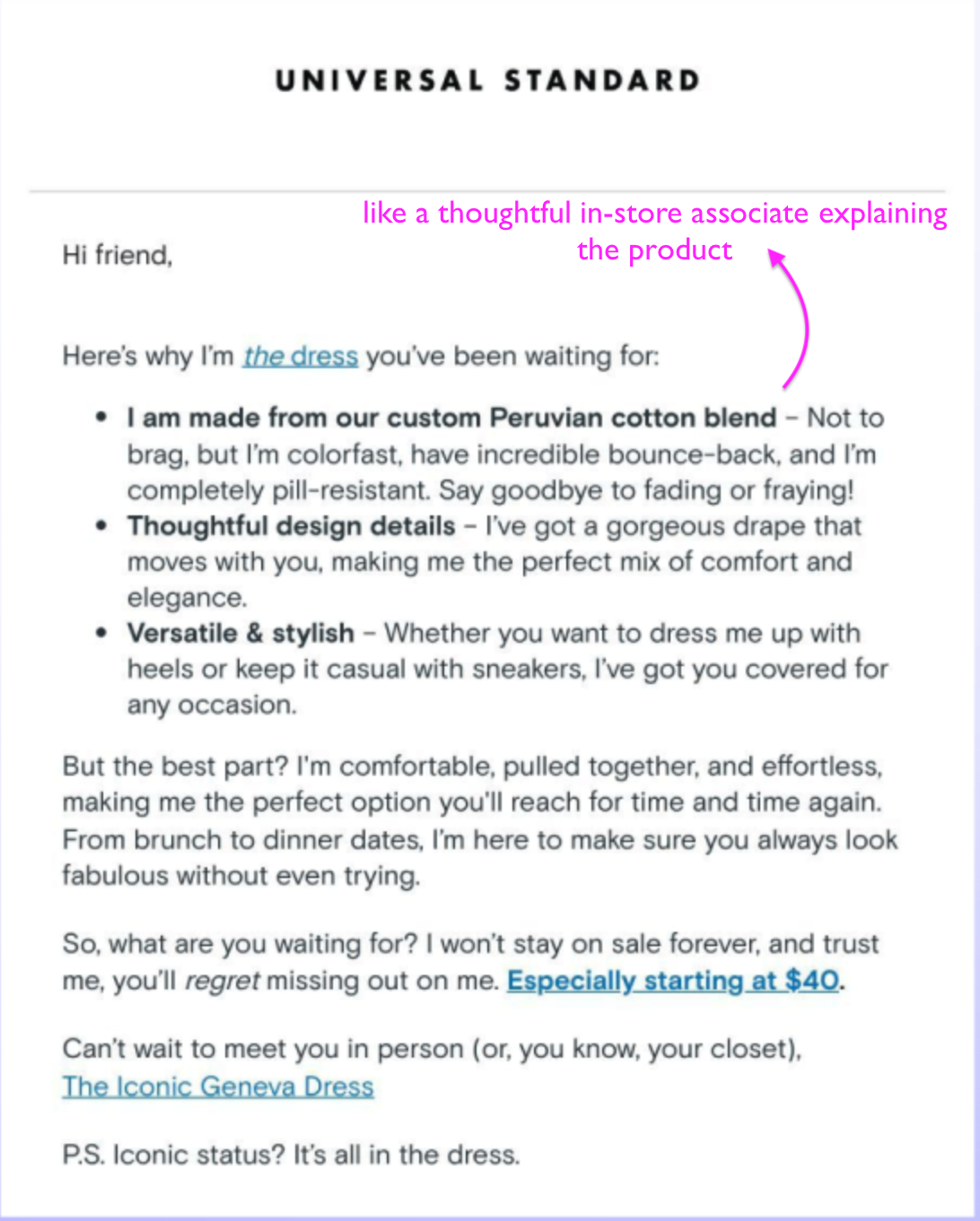
Take Universal Standard’s abandonment email, for example.
Instead of pushing urgency immediately, the brand writes from the perspective of the product itself, almost like a thoughtful in-store associate explaining why the dress deserves consideration.
The email calmly addresses durability, comfort, styling versatility, and fabric quality before subtly introducing scarcity later. That sequence matters.
The shopper first receives reassurance:
the material won’t fade,
the fit works across occasions,
the design feels effortless,
and the product will justify repeat wear.
Only then does the brand introduce urgency. This is a subtle but important difference in luxury email design.
Mass-market eCommerce emails often lead with pressure. Sophisticated luxury email marketing usually leads with confidence-building.
Our experimentation teams have seen similar behavior during CRO tests as well.
For luxury shoppers, pressure can sometimes increase hesitation instead of conversions.
In several cases, softer messaging built around reassurance, delivery confidence, product quality, or styling flexibility outperformed heavily promotional copy.
And for luxury eCommerce brands, this has a direct business impact.
Reducing uncertainty through email can improve:
purchase confidence,
engagement from high-intent shoppers,
conversion quality,
and long-term brand perception without relying heavily on discounts.
The best luxury newsletter examples don’t make shoppers feel pushed. They make shoppers feel certain.
⚠️
What’s making shoppers hesitate to buy from your store?
Product discovery – barriers that prevent shoppers from finding items
Category/collection pages – improvements that drive deeper product exploration
Product page – what to optimize to convert 2–3x more buyers
Cart – ways to ease hesitation and speed up purchase decisions
“The report was deep and super insightful. Can’t believe it’s free.”
Logan Christopher CEO, Empire Herbs
2. Then Move On To: Increasing Reassurance & Service
After analyzing dozens of luxury email marketing campaigns across fashion, home, jewelry, and lifestyle brands, our CRO teams at Convertcart noticed something interesting:
Many luxury brands invest heavily in aesthetics.
But the highest-performing luxury email campaigns usually go one step further — they actively guide shoppers toward confidence.
That distinction matters because luxury shoppers rarely want to feel like they’re navigating a purchase alone.
They want reassurance that the quality will match expectations, the purchase feels justified, and the brand understands their preferences before they commit.
This is where advanced luxury eCommerce email marketing starts behaving less like marketing — and more like high-end customer service.
Several of the strongest luxury brand email examples in our analysis focused heavily on reducing decision friction through guidance and reassurance.
Some brands used quizzes to help shoppers discover products more confidently.
Others brought stylists and experts directly into the inbox to recreate the confidence of an in-store consultation.
We also noticed that many effective luxury newsletter examples spent time showing the post-purchase experience instead of immediately pushing the next sale.
One especially strong example comes from Italic’s towel campaign.
At first glance, the email looks visually premium. But the real persuasion happens through reassurance.
The brand carefully explains manufacturing quality, material sourcing, durability, hotel-grade comparisons, and customer experiences before asking the shopper to buy.
The email almost feels like a luxury retail associate calmly answering objections in real time.
That’s a recurring pattern we noticed across many high-performing luxury emails.
The best campaigns don’t just create desire. They create confidence.
Our experimentation teams have seen similar behavior through CRO tests as well. For luxury shoppers, reassurance often outperforms pressure.
In many cases, emails focused on service, expertise, and guidance generated stronger engagement than heavily promotional messaging because they reduced cognitive load and helped shoppers feel more certain about the purchase decision.
And for luxury eCommerce brands, this can have a significant impact beyond immediate conversions.
Reducing friction through service-oriented emails often improves purchase confidence, strengthens post-purchase trust, and creates a smoother path toward long-term customer loyalty, especially for products with higher consideration cycles.
3. Next: Build Desire & Perceived Exclusivity Before the Purchase Happens
After analyzing high-performing luxury email marketing campaigns across fashion, beauty, jewelry, and lifestyle brands, our CRO teams at Convertcart noticed that the strongest luxury emails rarely rely on hard selling alone.
Instead, they carefully shape emotional desire before the purchase even happens.
That’s an important distinction in luxury eCommerce email marketing.
Because luxury shoppers are often buying more than utility. They’re buying aspiration, identity, emotion, status, taste, and the feeling associated with ownership itself.
This is why many effective luxury brand email examples focus heavily on atmosphere, storytelling, anticipation, and emotional immersion.
Some brands create exclusivity through product launches and limited access. Others build desire through storytelling, editorial-style visuals, or subtle FOMO. Several brands in our analysis also used self-care narratives and lifestyle framing to make the product feel emotionally meaningful long before checkout.
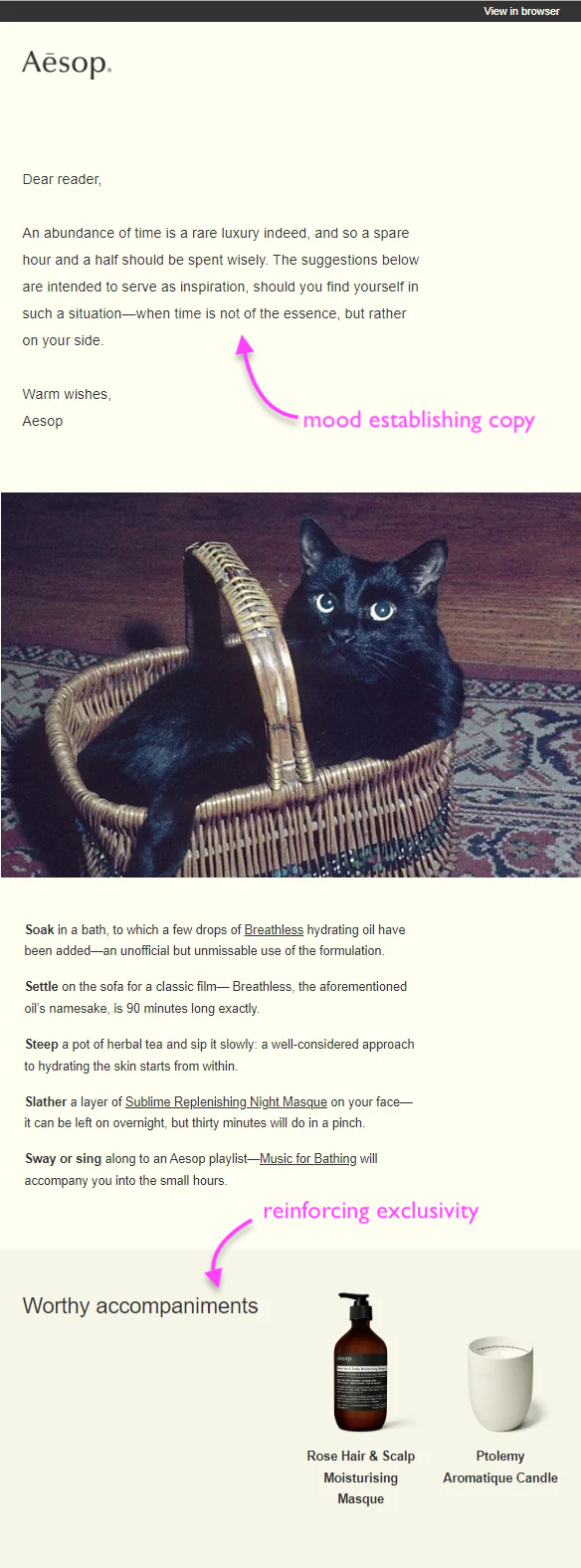
Aesop’s self-care email is a strong example of this approach.
The email barely behaves like traditional eCommerce marketing at all.
Instead of aggressively pushing products, Aesop creates a mood.
The copy slows the reader down, paints rituals around rest and comfort, and subtly integrates products into an aspirational lifestyle experience.
Even the visual direction, the warm tones, relaxed pacing, and understated imagery, reinforce calm exclusivity instead of urgency.
That’s what makes many sophisticated luxury newsletter examples different from standard promotional emails.
They don’t simply present products.
They shape emotional context around ownership.
We noticed another recurring pattern here during CRO analysis and experimentation:
Luxury emails tend to perform better when they create anticipation before they introduce persuasion.
In many cases, desire-building elements like storytelling, launch teasers, editorial copy, craftsmanship narratives, or emotionally immersive visuals generated stronger engagement than overt promotional pressure.
And for luxury eCommerce brands, this has an impact far beyond opens or clicks.
Emails that successfully increase emotional desire and perceived exclusivity often strengthen brand recall, improve pricing perception, and make shoppers more emotionally invested in ownership before the purchase even occurs.
4. And Finally: Create Emotional Ownership & Belonging
After analyzing a wide range of luxury email marketing campaigns, our CRO teams at Convertcart noticed that the strongest luxury brands don’t just focus on selling products repeatedly.
They focus on making customers feel emotionally connected to the brand itself.
That difference is important in luxury eCommerce email marketing because long-term retention rarely comes from convenience alone.
It comes from identity, recognition, and emotional attachment.
The most effective luxury brand email examples consistently made shoppers feel like insiders instead of subscribers.
Some brands welcomed customers into exclusive member ecosystems.
Others used community events, co-creation campaigns, or personalized incentives to create a stronger emotional connection early in the customer journey.
Several brands also reinforced belonging through loyalty programs, customer celebrations, gifting narratives, and feedback-driven product updates.
One especially strong example comes from HBX’s private sale email.
At first glance, the campaign looks promotional. But the real strategy sits underneath the discount itself.
The email frames the sale as exclusive access reserved for HBX Pro members. The shopper isn’t simply receiving an offer — they’re being reminded that membership unlocks privileges other customers don’t receive.
That subtle positioning changes the emotional dynamic completely.
Instead of competing on price alone, the brand reinforces insider status and exclusivity.
We noticed this pattern repeatedly across many high-performing luxury newsletter examples.
The strongest luxury brands don’t just reward purchases. They reward participation and belonging.
Our experimentation teams have seen similar behavior during CRO analysis and A/B testing as well.
For luxury shoppers, emotional recognition often increases retention more effectively than constant promotional pressure.
Emails centered around exclusivity, recognition, community, or personalized experiences frequently create stronger long-term engagement because they make customers feel emotionally invested in the brand ecosystem itself.
And for luxury eCommerce brands, this creates effects far beyond short-term performance metrics.
When shoppers begin identifying with the brand emotionally, loyalty becomes harder to replace.
Customers engage more consistently, return more naturally, and often develop a stronger attachment to future launches, experiences, and community-driven campaigns.
⚠️
Why don’t more visitors trust your store enough to buy?
Why visitors don’t trust your store within 3 seconds
Why shoppers can’t find what they’re ready to buy
What’s stopping 2-3x more shoppers from clicking “Add to Cart”
Where buyers hesitate right before purchase
Why high-intent shoppers still drop off
“The report was deep and super insightful. Can’t believe it’s free.”
Logan Christopher CEO, Empire Herbs
Luxury Email Marketing Metrics That Actually Matter
Metric
Why It Matters for Luxury Email Marketing
What It Usually Reveals
Click-to-Open Rate (CTOR)
Luxury shoppers often open emails out of curiosity or brand affinity first. CTOR shows whether the actual email experience creates enough desire or confidence to drive action.
Whether your copy, storytelling, product positioning, and luxury email design are emotionally compelling
Browse Abandonment Recovery Rate
Luxury shoppers usually have longer consideration cycles. Recovering browse abandons is often a stronger signal than immediate purchases from campaigns.
Whether your emails successfully reduce hesitation and rebuild purchase confidence
Repeat Purchase Rate From Email
Strong luxury email campaigns should deepen customer attachment over time — not just generate one-off purchases.
Whether your emails are strengthening loyalty, exclusivity, and long-term customer relationships
Engagement by Customer Segment
High-intent VIP shoppers, first-time buyers, and loyal customers respond differently to luxury messaging. Segment-level engagement often matters more than overall averages.
Whether your personalization, exclusivity, and lifecycle strategy are aligned with customer intent
Unsubscribe Rate After Promotional Campaigns
Luxury brands can damage perceived exclusivity when emails become overly promotional or too frequent.
Whether your messaging is preserving brand equity, or creating fatigue and lowering perceived value
Click-to-Open Rate (CTOR)
WHY IT MATTERS
Luxury shoppers often open emails out of curiosity or brand affinity first. CTOR shows whether the actual email experience creates enough desire or confidence to drive action.
WHAT IT REVEALS
Whether your copy, storytelling, product positioning, and luxury email design are emotionally compelling
Browse Abandonment Recovery Rate
WHY IT MATTERS
Luxury shoppers usually have longer consideration cycles. Recovering browse abandons is often a stronger signal than immediate purchases from campaigns.
WHAT IT REVEALS
Whether your emails successfully reduce hesitation and rebuild purchase confidence
Repeat Purchase Rate From Email
WHY IT MATTERS
Strong luxury email campaigns should deepen customer attachment over time — not just generate one-off purchases.
WHAT IT REVEALS
Whether your emails are strengthening loyalty, exclusivity, and long-term customer relationships
Engagement by Customer Segment
WHY IT MATTERS
High-intent VIP shoppers, first-time buyers, and loyal customers respond differently to luxury messaging. Segment-level engagement often matters more than overall averages.
WHAT IT REVEALS
Whether your personalization, exclusivity, and lifecycle strategy are aligned with customer intent
Unsubscribe Rate After Promotional Campaigns
WHY IT MATTERS
Luxury brands can damage perceived exclusivity when emails become overly promotional or too frequent.
WHAT IT REVEALS
Whether your messaging is preserving brand equity, or creating fatigue and lowering perceived value
Common Mistakes Luxury Brands Make With Email Marketing
After reviewing dozens of luxury email marketing campaigns, our CRO teams at Convertcart noticed that many luxury brands don’t necessarily struggle with aesthetics.
They struggle with balance.
The strongest luxury emails feel exclusive, reassuring, emotionally engaging, and commercially effective, all at the same time.
But many brands unintentionally weaken that experience through a few recurring mistakes.
Mistake
Why It Hurts Luxury Ecommerce Brands
Overusing discounts and urgency
Constant promotions can reduce perceived exclusivity and train shoppers to wait for offers instead of buying at full price
Sounding too transactional
Luxury shoppers expect emotional connection and thoughtful communication — not generic campaign blasts
Treating luxury shoppers like impulse buyers
Most luxury purchases involve longer consideration cycles, emotional evaluation, and higher perceived risk
Overdesigning emails
Excessive visuals, cluttered layouts, and too many CTAs often increase cognitive load instead of creating elegance
Ignoring post-purchase experience
Many luxury brands focus heavily on acquisition while underinvesting in reassurance, onboarding, and post-purchase trust-building
Using the same messaging for every customer segment
VIP shoppers, first-time buyers, and loyal customers respond differently to exclusivity, storytelling, and promotional messaging
Creating urgency too aggressively
Heavy-handed FOMO can damage brand perception when it feels disconnected from the luxury buying experience
Focusing only on aesthetics
Strong luxury email design matters — but design alone rarely drives long-term engagement or loyalty without emotional relevance
Sending too many promotional campaigns in a row
Repetitive promotional messaging can create fatigue and weaken anticipation around future launches or product drops
Failing to build emotional ownership over time
The best luxury brand email examples gradually make shoppers feel recognized, included, and emotionally connected to the brand ecosystem
Overusing discounts and urgency
WHY IT HURTS
Constant promotions can reduce perceived exclusivity and train shoppers to wait for offers instead of buying at full price
Sounding too transactional
WHY IT HURTS
Luxury shoppers expect emotional connection and thoughtful communication — not generic campaign blasts
Treating luxury shoppers like impulse buyers
WHY IT HURTS
Most luxury purchases involve longer consideration cycles, emotional evaluation, and higher perceived risk
Overdesigning emails
WHY IT HURTS
Excessive visuals, cluttered layouts, and too many CTAs often increase cognitive load instead of creating elegance
Ignoring post-purchase experience
WHY IT HURTS
Many luxury brands focus heavily on acquisition while underinvesting in reassurance, onboarding, and post-purchase trust-building
Using the same messaging for every customer segment
WHY IT HURTS
VIP shoppers, first-time buyers, and loyal customers respond differently to exclusivity, storytelling, and promotional messaging
Creating urgency too aggressively
WHY IT HURTS
Heavy-handed FOMO can damage brand perception when it feels disconnected from the luxury buying experience
Focusing only on aesthetics
WHY IT HURTS
Strong luxury email design matters — but design alone rarely drives long-term engagement or loyalty without emotional relevance
Sending too many promotional campaigns in a row
WHY IT HURTS
Repetitive promotional messaging can create fatigue and weaken anticipation around future launches or product drops
Failing to build emotional ownership over time
WHY IT HURTS
The best luxury brand email examples gradually make shoppers feel recognized, included, and emotionally connected to the brand ecosystem



.png)



.avif)
.svg)


.svg)

.svg)
.svg)
