Most jewelry email marketing advice focuses too heavily on discounts and urgency. But jewelry shoppers usually need inspiration, trust, and personalization before they buy.
In this guide, we’re breaking down the strategies that consistently perform well across modern email marketing for jewelry stores.
Send generic discount emails, use templated welcome flows, and send 1–2 abandoned cart reminders with little personalization
Build emotional connection first, personalize product discovery, reduce buying hesitation, and recover carts with urgency, social proof, scarcity, and reassurance
Treating first-time visitors like discount seekers instead of high-intent shoppers who need confidence and trust
Week 2:
Browse Abandonment +
Post-Purchase
Ignore browse intent, stop nurturing after purchase, and rely heavily on promotional campaigns
Re-engage shoppers based on browsing behavior, educate customers post-purchase, cross-sell intelligently, and increase repeat purchases through lifecycle personalization
Treating the purchase as the end of the customer journey instead of the beginning of retention
Week 3:
Reviews + UGC
Send plain “leave a review” emails—or skip review collection entirely
Turn customers into brand advocates through UGC campaigns, incentivized reviews, styling inspiration, community-driven content, and social proof loops
Asking for reviews without creating excitement, recognition, incentives, or a sense of community participation
Week 1: Welcome Flow + Cart Abandonment
Most Brands Do
Send generic discount emails, use templated welcome flows, and send 1–2 abandoned cart reminders with little personalization
High-Performing Brands Do Instead
Build emotional connection first, personalize product discovery, reduce buying hesitation, and recover carts with urgency, social proof, scarcity, and reassurance
Biggest Mistake to Avoid
Treating first-time visitors like discount seekers instead of high-intent shoppers who need confidence and trust
Week 2: Browse Abandonment + Post-Purchase
Most Brands Do
Ignore browse intent, stop nurturing after purchase, and rely heavily on promotional campaigns
High-Performing Brands Do Instead
Re-engage shoppers based on browsing behavior, educate customers post-purchase, cross-sell intelligently, and increase repeat purchases through lifecycle personalization
Biggest Mistake to Avoid
Treating the purchase as the end of the customer journey instead of the beginning of retention
Week 3: Reviews + UGC
Most Brands Do
Send plain “leave a review” emails—or skip review collection entirely
High-Performing Brands Do Instead
Turn customers into brand advocates through UGC campaigns, incentivized reviews, styling inspiration, community-driven content, and social proof loops
Biggest Mistake to Avoid
Asking for reviews without creating excitement, recognition, incentives, or a sense of community participation
My team has tested dozens of jewelry email marketing welcome flows, and the biggest difference usually comes down to pacing.
The strongest-performing brands don’t immediately jump into discounts or crowded product grids. Instead, they ease shoppers into the brand story first.
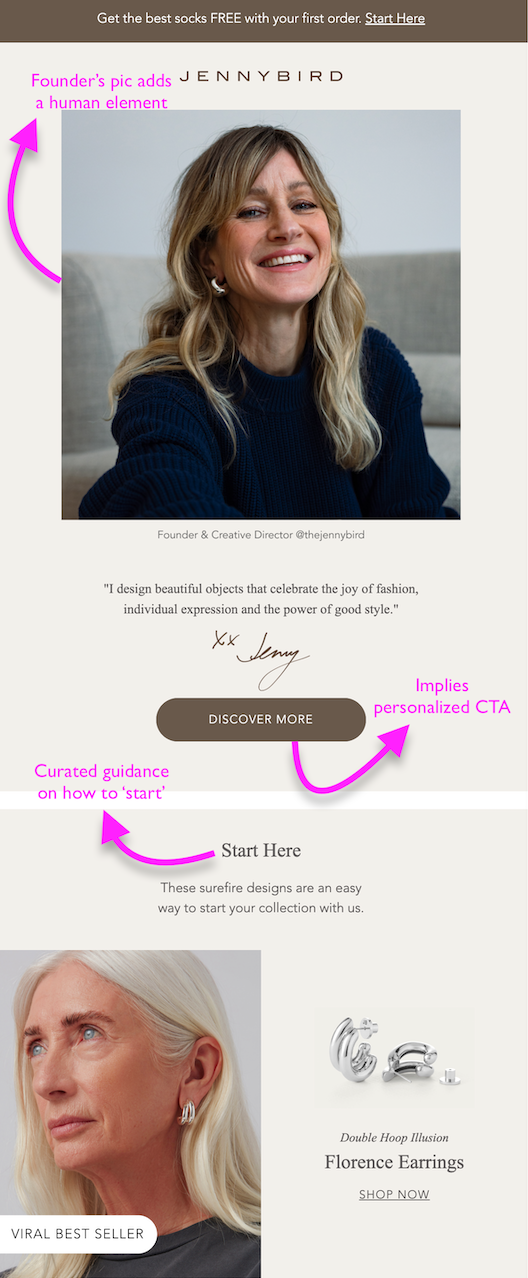
Jenny Bird’s email is a great example of this approach.
The founder note creates a sense of familiarity before introducing shoppers to bestselling collections, making the experience feel more personal than promotional.
In several email marketing for jewelry brands experiments, we’ve also noticed that welcome flows perform better when brands gradually build customer profiles over time through:
double opt-ins
birthday capture
curated product discovery
It’s one of the reasons strong jewelry newsletter campaigns often feel more like guided discovery than a sales push.
Another pattern my team keeps seeing is that cart abandonment emails work best when they reduce hesitation rather than increase urgency.
Monica Vinader’s email is a strong example because the message stays clean and focused.
The reminder copy is simple, the CTA is clear, and the additional product suggestions help shoppers continue browsing naturally instead of feeling pressured.
Across several jewelry marketing campaigns, we’ve found that abandoned cart emails become even more effective when brands layer in subtle conversion triggers like:
“almost gone” inventory messaging
VIP promotion reminders
free gift thresholds
complementary product recommendations
These nudges tend to recover more revenue without making the email feel overly aggressive.
For many brands, cart recovery remains one of the highest-converting automations in email marketing for jewelers.
Product discovery – barriers that prevent shoppers from finding items
Category/collection pages – improvements that drive deeper product exploration
Product page – what to optimize to convert 2–3x more buyers
Cart – ways to ease hesitation and speed up purchase decisions
“The report was deep and super insightful. Can’t believe it’s free.”
Logan Christopher CEO, Empire Herbs
WEEK 2 - Browse Abandonment + Post-Purchase for eCommerce Jewelry
My team has noticed that browse abandonment emails in jewelry email marketing perform best when they continue the shopper journey instead of immediately pushing discounts.
The strongest-performing brands usually treat browsing behavior like a wishlist in progress by featuring:
recently viewed products
personalized discovery
styling guidance
quiz-based recommendations
BaubleBar’s “Wrapped” email is a great example.
Instead of a generic reminder, it turns browsing history into a playful recap shoppers actually want to revisit.
In several email marketing for jewelry brands experiments, my team found that recap-style emails featuring:
“your favorites”
trending collections
personalized picks
consistently outperform generic promotional reminders because the experience feels curated instead of automated.
Consequently, some of the biggest revenue improvements in email marketing for jewelry stores happen after the first purchase.
My team has tested post-purchase flows where brands focus on helping customers enjoy their purchase first before selling again. The strongest-performing sequences usually include:
jewelry care tips
replenish reminders
mix-and-match styling ideas
cross-sell recommendations
Kendra Scott’s email works especially well because it uses purchase history intelligently.
The shopper bought one piece, so the brand introduced complementary products from the same collection instead of random bestsellers.
Across multiple jewelry marketing campaigns, we’ve consistently seen that cross-sells based on style affinity and purchase history drive stronger repeat purchases without relying heavily on discounts.
WEEK 3 - Reviews + UGC Emails for Jewelry Brands
My team has tested enough jewelry newsletter campaigns to know that reviews alone rarely move conversions; the way brands present them matters more.
The strongest-performing emails usually combine customer reviews with visual trust signals like “As Seen In” mentions, creator endorsements, or real customer styling photos.
Brilliant Earth’s incentivized review email works because it makes feedback feel valuable instead of transactional.
In several email marketing for jewelry business experiments, we also noticed that review requests sent shortly after delivery consistently outperform delayed asks because excitement around the purchase is still high.
Furthermore, some of the highest engagement rates we’ve seen in email marketing for jewelers come from emails that make customers feel part of a community instead of just an audience.
Brands using “Styled By You” galleries, influencer collaborations, and lookbook-inspired campaigns often create stronger repeat engagement because shoppers can visualize how pieces fit into real life.
Live shopping events (like how Hillberg & Berk do it) are especially interesting for jewelry email marketing because they blend entertainment with product discovery.
Subject Line Patterns That Work for Jewelry
One thing becomes obvious when analyzing high-performing jewelry email marketing campaigns:
Shoppers rarely respond to subject lines that sound overly promotional from the start.
Jewelry is emotional, personal, and highly visual, so curiosity usually outperforms hard-selling language.
The strongest-performing subject lines in email marketing for jewelry brands often lean into identity, exclusivity, or styling inspiration instead of discounts alone.
Subject lines like:
“Your Next Signature Piece Is Here”
“Styled Just for You”
“A Little Something Sparkly Just Dropped”
tend to generate stronger engagement because they feel aspirational rather than transactional.
Another interesting pattern across successful jewelry newsletter campaigns is that softer exclusivity often beats louder urgency.
Phrases like:
“Private Access”
“Early Preview”
“Back in Your Favorites”
“Just Released”
create curiosity without sounding overly aggressive, which matters especially for premium jewelry shoppers.
Across several email marketing for jewelry stores experiments, personalization also had a noticeable impact on open rates.
Subject lines tied to browsing behavior, birthdays, anniversaries, or previous purchases consistently performed better because the message felt curated to the shopper’s taste.
One of the biggest missed opportunities in email marketing for jewelers is treating every campaign like a clearance sale.
Jewelry buyers usually need inspiration before urgency.
The brands that balance storytelling, exclusivity, and personalization in their subject lines are often the ones building stronger long-term engagement, not just temporary spikes in clicks.
Why visitors don’t trust your store within 3 seconds
Why shoppers can’t find what they’re ready to buy
What’s stopping 2-3x more shoppers from clicking “Add to Cart”
Where buyers hesitate right before purchase
Why high-intent shoppers still drop off
“The report was deep and super insightful. Can’t believe it’s free.”
Logan Christopher CEO, Empire Herbs
Common Mistakes Jewelry Brands Make
One of the biggest mistakes in jewelry email marketing is turning every email into a promotion.
Many brands send discount after discount without building any emotional connection first.
Over time, shoppers stop buying at full price. They simply wait for the next sale.
Another common problem in email marketing for jewelry brands is focusing too much on aesthetics.
Yes, jewelry emails should look beautiful. But beautiful visuals alone rarely drive conversions.
Shoppers still need quick answers:
Why is this piece special?
How do I style it?
Why is it worth the price?
This matters even more on mobile, where oversized images and cluttered layouts often hurt engagement instead of helping it.
A lot of email marketing for jewelry stores also misses easy personalization opportunities.
Shoppers already reveal valuable intent through browsing behavior, wishlist activity, anniversaries, and past purchases.
Yet many campaigns still feel like mass emails sent to everyone.
The strongest jewelry newsletter campaigns usually feel curated. Almost like a stylist picked the products for you.
Another overlooked mistake is ignoring post-purchase engagement. Many brands work hard to get the first sale, then go silent afterward.
But some of the highest-converting flows actually happen after checkout through:
jewelry care tips
styling recommendations
VIP access
And finally, there’s urgency fatigue.
Constant “LAST CHANCE” messaging eventually loses credibility. Especially in premium jewelry, where shoppers expect inspiration and discovery before they buy.
The brands that usually grow faster are the ones balancing storytelling, personalization, and timing instead of relying on discounts for every campaign.
Email is one channel, but the brands that grow fastest treat it as part of a bigger picture. For the full playbook across channels, see these jewelry eCommerce marketing ideas.
Feeling Inspired for Your Jewelry Email Marketing?
Email marketing for your jewelry store can be just what it takes to drive 3X conversions.
However, most jewelry store owners don’t see email as a serious revenue stream.
Ask them about the importance of email marketing, and you'll hear: “we don’t really have a major strategy,” “we mostly use generic templates,” or “we just send emails to people on our list.”
BUT AT THE SAME TIME:
There are stores out there that drive 30%+ of their revenue from email marketing.





.avif)
.svg)


.svg)

.svg)
.svg)
