Here's the honest diagnosis of why most eCommerce promotions underperform: founders pick tactics based on what a competitor ran last week, not based on what problem they're actually trying to solve.
If you already know your KPI but aren't sure which specific promotion to reach for, use this table.
The Promotion Playbook: What to Run, When, and Why
Find your current business problem in the left column, the right columns tell you which tactic fits, why it works, and where it can go wrong.
Business Goal
Best Promotion
The Strategy
Expert Catch (Risk)
Margin Impact
Lift AOV
Seasonal Bundling, Tiered Discounts
Incentivize larger carts by offering a perceived reward for bulk behavior.
Pantry loading: customers buy enough to skip their next 2-3 purchase cycles.
Medium
Clear Stagnant Inventory
Flash Sales, BOGO Rebirth
Velocity: Collapse the decision window with 48-hour hard deals.
High frequency trains users to never pay full price, eroding premium status.
Zero-Party Data: Trade immediate value for preferences and contact info.
If the product isn't sticky, you lose money on fulfillment cost.
Low
Break Banner Blindness
Gamified Offers, Mystery Offers, Scratch Cards
Dopamine Loops: Use curiosity to re-engage the tired browser.
Can attract deal hunters with zero brand loyalty, leading to high churn.
Low
Protect Profit
Gift Card Giveaways, Free Shipping Thresholds, Value-Add Services
Non-transactional: Lift value without cutting unit price.
If the bonus feels like junk, it won't move the needle.
Low
At Convertcart, we suggest our customers to follow a three-tier framework for choosing the right promotion, based on actual business goals, not gut feeling.
The Convertcart Promotion Tier Framework
The three tiers below exist because promotions have fundamentally different jobs:
Trade short-term cost for long-term behavioral data and repeat habits.
High cost upfront. Requires a 90-day horizon to measure true ROI.
Low
The Rule Before You Start: Always pick one tier per campaign. Mixing tactics from different tiers in a single promotion creates confused messaging and split incentives. Run a Tier 1 promotion when you need revenue this week. Run a Tier 3 promotion when you need customers who come back next quarter. Never confuse the two.
Convertcart Insight
Running a promotion every week is the fastest way to permanently damage your brand's perceived value. When a customer sees a "sale" banner every time they visit, the sale price becomes their reference price and your full price begins to feel like a scam.
True authority brands run fewer, more strategic promotions. The goal is to make customers feel lucky they caught it, not to train them to wait for it.
OK, let's dive into the 3 promotional tiers now:
TIER 1: TRANSACTIONAL PROMOTIONS
Goal: Solve for immediate conversion lift use when you need revenue this week, not next quarter.
Tier 1 promotions work by doing one thing: collapsing time. They remove the customer's ability to defer a decision without consequence. The mechanism is always some version of scarcity — a deadline, a quantity limit, a threshold. When deployed correctly, they are the fastest way to generate revenue in eCommerce. When deployed too frequently, they are also the fastest way to permanently anchor your customers' expectations to a discounted price.
The expert rule for Tier 1: run these promotions with surgical precision. The moment a flash sale or free shipping offer becomes something customers expect, it stops being a promotion and starts being your pricing.
1. Flash Sales: Boosting Conversion Rates by Up to 35% If You Do Them Right
A flash sale done right doesn't just move inventory — it can lift your conversion rate by up to 35%, and as high as 78% when the discount hits 80% off.
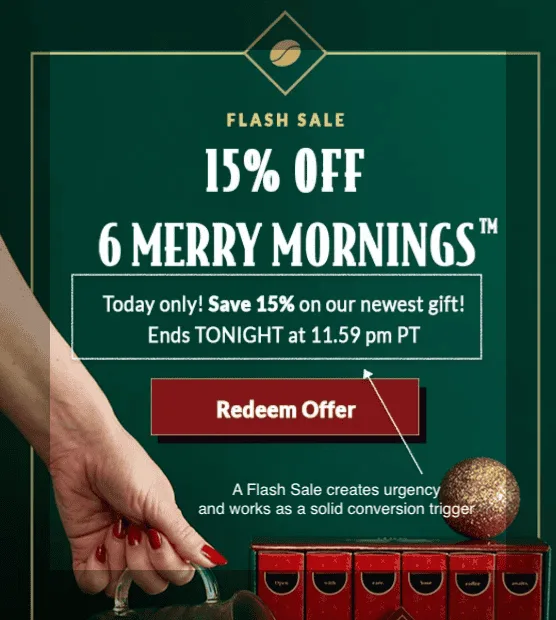
What's oddly human is that we want things more when we might not get them. Retailers have known this for decades. What's changed is the precision with which eCommerce stores can now deploy it. Bean Box does this beautifully with their "6 Merry Mornings" holiday flash sale — 15% off, one day only, with the deadline explicitly stated ("Ends TONIGHT at 11:59 PM PT"). Clean offer. Hard stop. Single CTA. Dead simple and extremely effective.
The 5–6 Week Rule: Run flash sales no more than every 5–6 weeks, and never more than 3 times during peak season — or urgency stops feeling urgent.
State the Deadline Explicitly: "Ends TONIGHT at 11:59 PM PT" outperforms vague language like "limited time" every time.
Single CTA Only: Every extra choice you offer during a flash sale is a reason not to buy. One offer, one button.
Margin Check: Flash Sales
At 80% off, you need extraordinary volume to protect profitability. Run flash sales at 15–30% off for most SKUs. Reserve deep discounts for end-of-season inventory you genuinely need to clear.
2. Run Seasonal Discounts: Built for a $257.8 Billion US Holiday Market
US consumers spent $257.8 billion online during the 2025 holiday season — a 6.8% increase over 2024, with 25 separate days where daily online spending hit $4 billion or more.
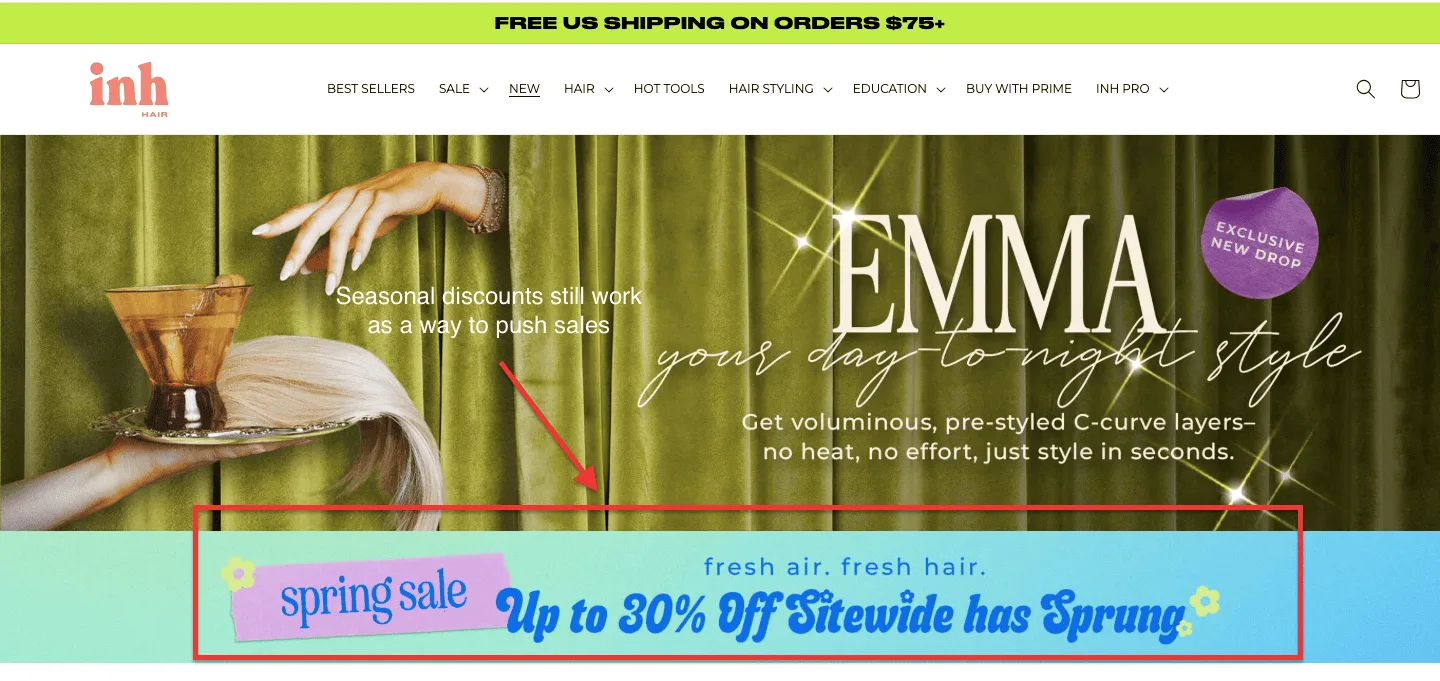
Seasonal discounts aren't a nice-to-have — they're the single most predictable demand wave of the entire year. The question isn't whether to run them; it's whether your store is positioned to catch the wave. INH Hair does this well by anchoring their Spring Sale to a seasonal narrative — "Fresh Air, Fresh Hair" — giving the discount a logical "why" that protects perceived value while creating real urgency.
Plan 8 Weeks Ahead: The brands that win seasonal peaks start building email lists, ad audiences, and inventory positioning months before the sale.
Give the Discount a "Why": Anchoring to a season creates context — "Spring Sale" feels more legitimate than a generic "Sale," which starts to feel permanent.
Use Visual Pattern Interrupts: Seasonally-relevant creative (colors, imagery, copy) signals something special and temporary is happening — driving urgency without a countdown timer.
How do the best online stores use psychological triggers to speed up the purchase decision? Explore these optimized ways to implement a countdown timer eCommerce layout that actually lifts revenue.
3. Use Free Shipping Thresholds: They Cause 93% of Shoppers to Add More to Their Cart
58% of shoppers actively add items to their cart to qualify for free shipping — and of those, a remarkable 93% follow through and purchase more items to hit the threshold.
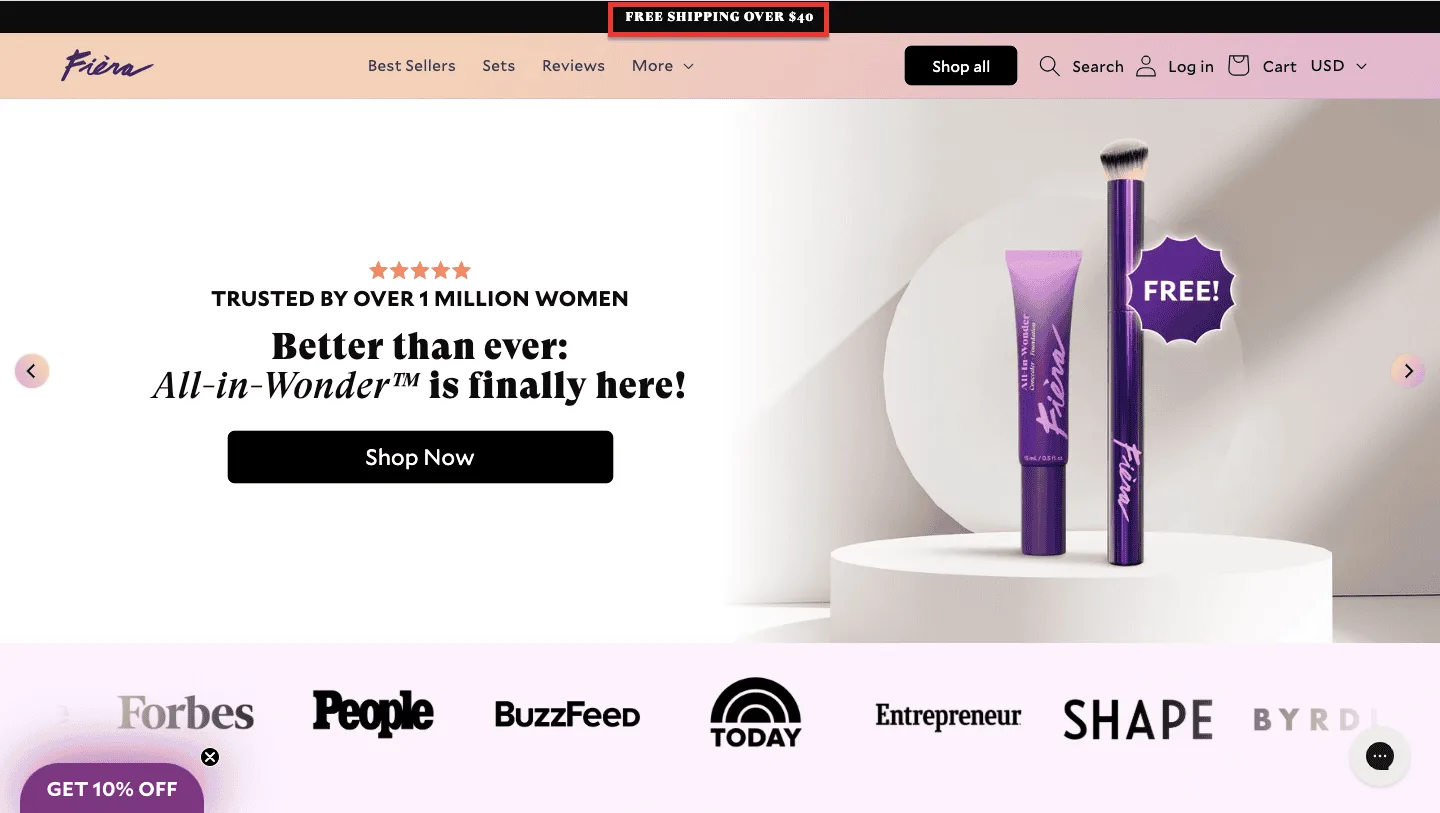
Free shipping is no longer a perk — it's a psychological baseline. The mastery lies in the threshold. Fièra places its threshold in the most valuable real estate on the site: the sticky top banner. By announcing "FREE SHIPPING OVER $40" before a single product is viewed, they anchor the customer's target spend from the first second on-site. It reframes the transaction: the shopper isn't spending more — they're saving on shipping.
Set Your Threshold at AOV + 15–20%: This maximizes the number of customers who are just close enough to stretch, without making the goal feel impossible.
Display Progress in the Cart: A real-time "You're $X away from free shipping" message drives more add-to-cart behavior than a static banner.
Address Shipping Costs Upfront: Surfacing the threshold before checkout removes one of the primary reasons for drop-off at the final stage.
TIER 2: PERSUASION PROMOTIONS
Goal: Solve for AOV stretch and decision-stage friction use when you need customers to buy more, not just buy faster.
Tier 2 promotions work differently from Tier 1. Instead of collapsing time, they expand the perceived value of the transaction. A customer in the decision stage isn't asking "should I buy this?" — they've already decided that. They're asking "how much should I buy, and is this the right bundle?" Tier 2 promotions answer that question in your favor.
The risk in Tier 2 is subtler than Tier 1. A badly structured bundle can reduce perceived quality. A tiered discount with too small a gap between thresholds won't move behavior. The mechanics need to feel mathematically obvious — the moment a customer has to think hard about whether the deal is worth it, the promotion has failed.
4. The BOGO Rebirth: The Promotion 3x More Shoppers Choose Over a Percentage Discount
When presented with a BOGO deal versus a percentage-off offer of equivalent value, three times as many US consumers choose the BOGO which tells you something important about how the human brain processes the word "free" versus the word "off."
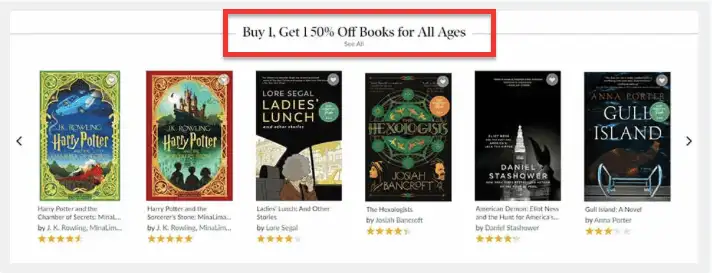
Barnes & Noble has mastered the art of making customers feel like scholars while they're essentially participating in a very polite buy-one-get-one frenzy. By offering 50% off a second item, they aren't just shifting inventory — they're whispering to the customer that one book is a purchase, but two is a collection. That framing shift is worth more than the discount itself.
Curated Inventory Clearance: Don't apply BOGO to everything. Target specific categories to clear stock without devaluing your entire brand.
The "Collection" Mindset: Frame the promotion as an opportunity to "build a set" — this encourages shoppers to find a second item they didn't know they needed.
Clear Value Signaling: Calculate the discount instantly in the cart so shoppers see the reward for their behavior in real time.
5. Seasonal Bundling: Lifts AOV by Up to 30% Without Discounting a Dollar
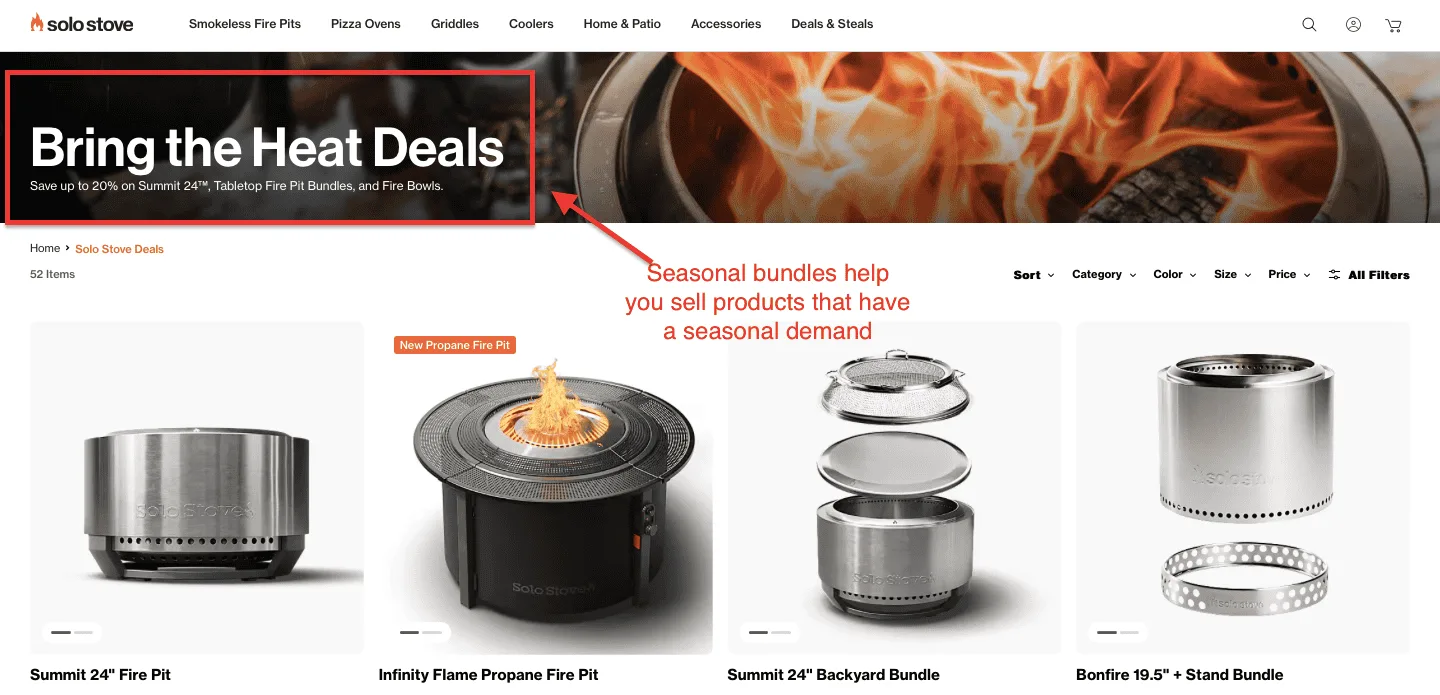
Well-designed seasonal bundles consistently deliver 20–30% AOV improvements, with best-in-class implementations pushing conversion rates up by as much as 40% — all without touching your margins.
Most US eCommerce founders reach for a discount the moment a seasonal slump hits. The smarter play is bundling — because it increases the perceived value of the transaction without reducing unit economics. Solo Stove realized that selling a fire pit without its accoutrements is like selling a car without wheels. By bundling the core product with stands, shields, and shelters, they transform a singular product into a complete backyard experience. The customer feels they've won a great deal; Solo Stove ensures their product works perfectly from day one.
The "Total Solution" Hook: Frame your bundle as a "Complete Kit" — it solves the customer's unspoken fear of missing a critical component.
Bundle by Outcome, Not Category: Group products around a specific customer goal ("complete campfire setup") rather than just product type.
Inventory Balancing: Use bundles to move high-margin accessories alongside hero products, protecting overall margins even during a sale.
6. The Routine Bundle: Why the Second Purchase Is Worth More Than the First
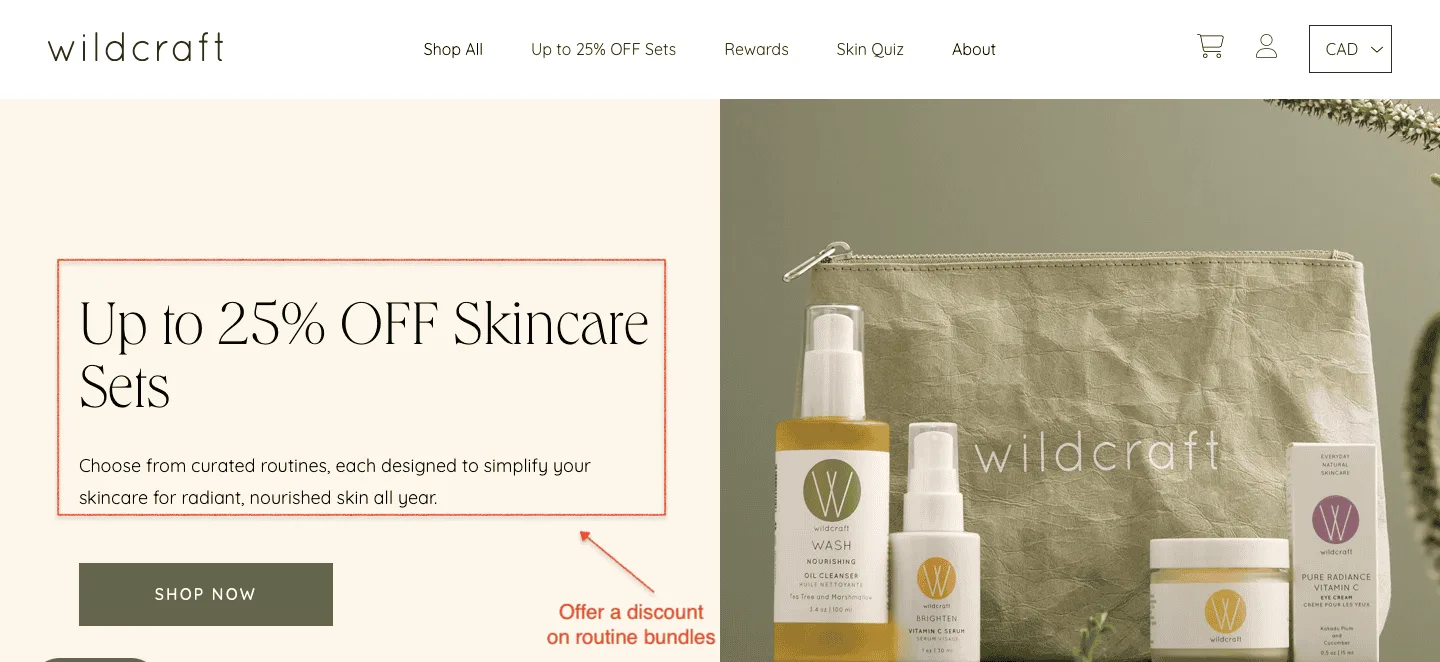
Customer return rates jump from 27% to 54% after a second order — which means a routine bundle isn't just a promotion, it's your most efficient retention tool.
Bundling doesn't just lift AOV — it accelerates the path to loyalty. Wildcraft leans into this by offering curated routine bundles that do the thinking for the customer. These sets reduce the cognitive load that leads to cart abandonment by selling a result, not individual products. At 25% off, they're not selling bottles — they're selling radiant skin. That distinction changes how customers evaluate the price.
Outcome-Oriented Naming: Use labels like "Complete Skincare Routine" to shift focus from individual products to the desired final result.
Bundle by Intent: Group products around a specific customer goal rather than just a product category.
Frictionless Discovery: Place these sets prominently on the homepage to attract users seeking an expert-led starting point.
7. Grow Your AOV with Tiered Discounts: Lifting Average Order Size by 28%
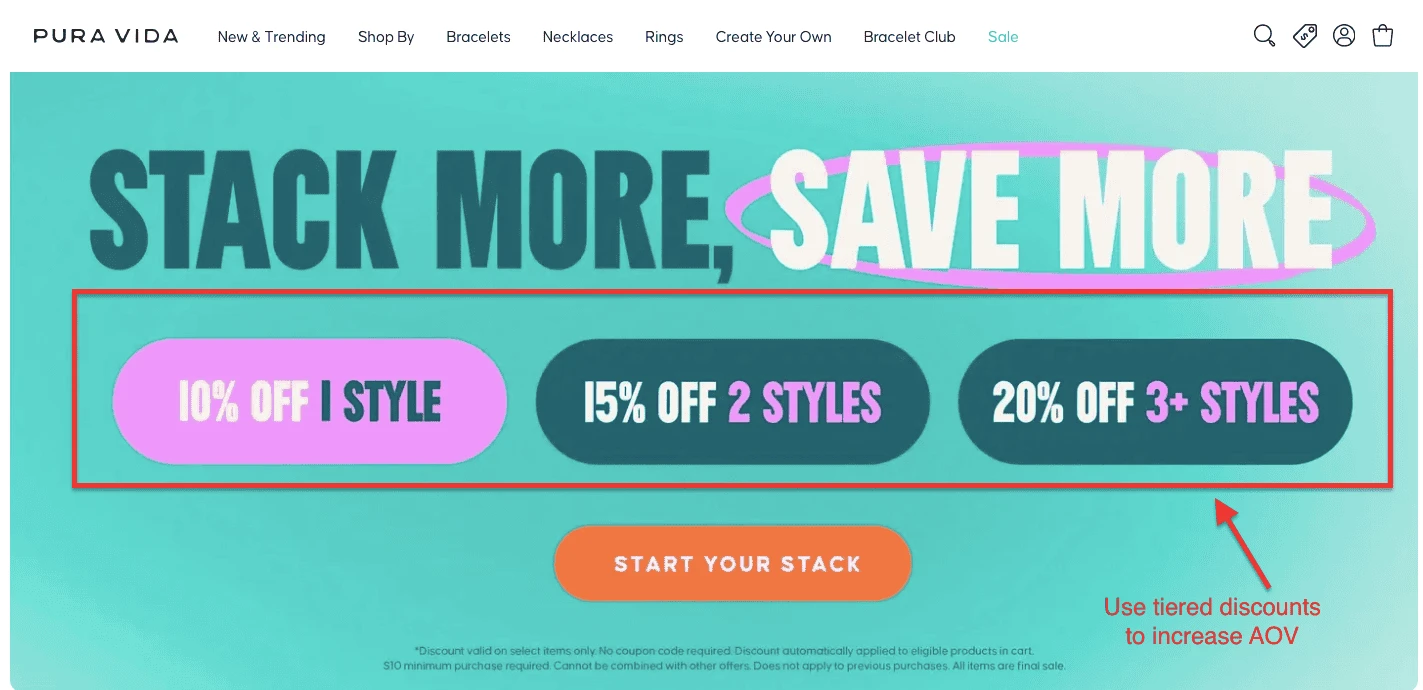
According to a 2024 Retail Dive survey, brands offering tiered discounts — "Buy 2, get 10% off" or "Buy 3, get 20% off" — report a 28% average increase in units per transaction.
The average shopper doesn't just want a discount — they want to win one. Pura Vida's "Stack More, Save More" campaign turns the checkout process into a strategic game. By offering a modest 10% off for a single style, they lower the initial barrier to entry. The jump to 15% for two, and 20% for three or more, is engineered to trigger a mathematical "why not?" in the shopper's mind. "Start Your Stack" isn't a CTA. It's a mission.
Set a Reachable First Tier: If entry-level discount requires two items, make sure those two items pair naturally. Friction at the first tier kills the whole strategy.
Gamify the Language: "Start Your Stack" converts better than "Add Two Items for 15% Off." Give the customer a mission, not a transaction.
Protect Your Third Tier: The highest discount tier must still be profitable at your COGS. Model this before launch, not after
Margin Check: Tiered Discounts
A tiered discount that drives volume at zero margin is worse than no promotion at all. Know your floor before you set your ceiling.
TIER 3: STRATEGIC PROMOTIONS
Goal: Solve for retention intent and lifetime value use when the goal is customers who come back, not just customers who convert.
Tier 3 is where most eCommerce brands don't play — and where the biggest long-term advantages are built. These promotions don't generate a spike on a dashboard. They generate the repeat purchase behavior, zero-party data, and brand trust that make every future promotion cheaper and more effective.
The Tier 3 trade-off is real: these promotions have higher upfront costs and longer feedback loops. A free sample program won't show its full ROI in 30 days. A loyalty program takes months to compound. If your business needs revenue next week, this is not your tier. If your business needs defensible customer relationships next year, this is the only tier that matters.
8. Offer Free Product Samples: 35% of US Shoppers Buy the Moment They Try
A product sampling study by Arbitron and Edison Media Research found that 35% of customers who try a sample will buy the sampled product in the same shopping trip — one of the few promotions in eCommerce where the gap between awareness and conversion is measured in minutes, not weeks.
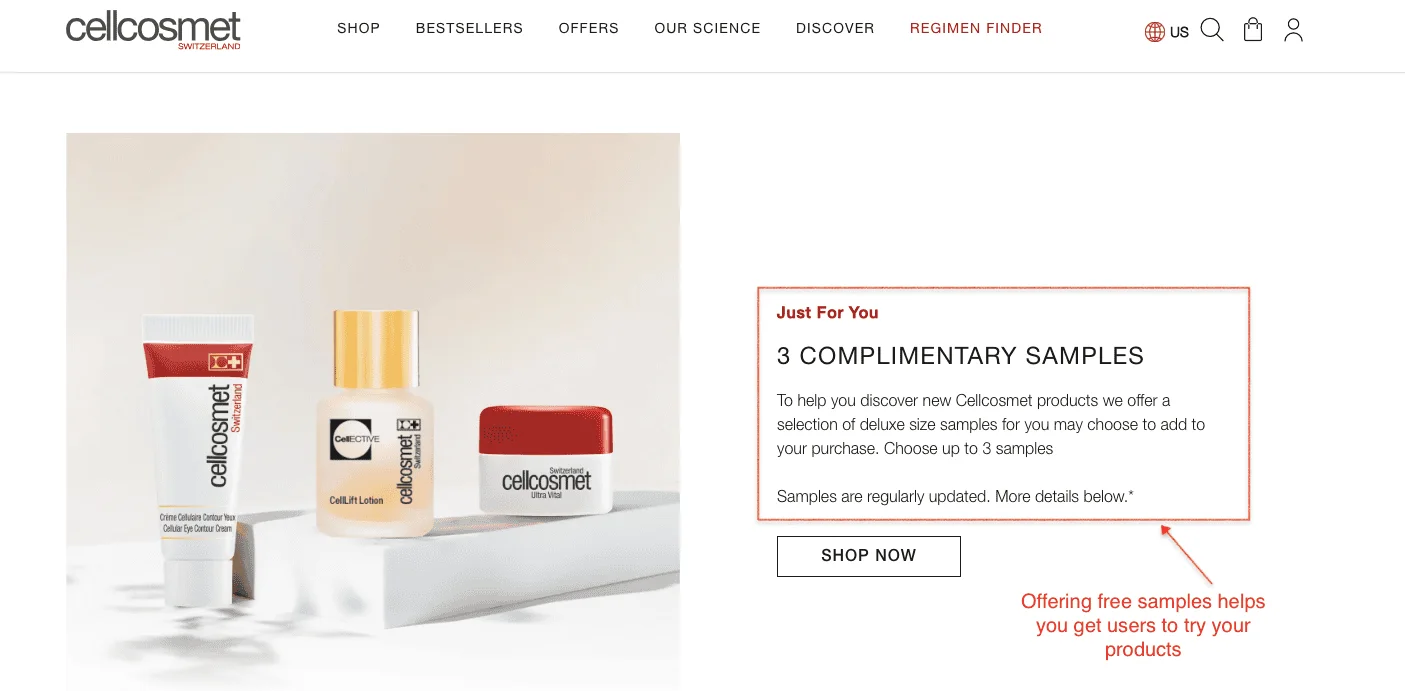
Cellcosmet has mastered the "slow burn" by offering three complimentary samples with every purchase. Once a shopper physically holds a deluxe-sized sample, the psychological barrier to a future full-sized purchase virtually disappears. It's the endowment effect at work: what was unfamiliar becomes, after a single use, "their" product. The conversion from sample to sale isn't a marketing question — it's a product quality question.
The "Just For You" Frame: Present samples as a curated gift rather than a random throw-in — this increases perceived value and signals editorial judgment.
Use Samples for High-Consideration SKUs: Let customers test-drive premium items before committing to a higher-AOV purchase.
Inventory as a Discovery Tool: Regularly update your sample selection to introduce loyal customers to new product lines.
Profitability Warning
Free samples have real Cost of Goods Sold (COGS). If your product isn't sticky enough to generate repeat purchases, you will lose money on the sample and never recoup it.
Run a 90-day retention analysis on sampled customers before scaling this program.
9. The Free One-Month Trial: The Trust Accelerator That Converts 1 in 4
The average trial-to-paid conversion rate for subscription businesses sits between 15–25% — meaning one in four shoppers who wouldn't have bought cold will hand over their credit card after experiencing the product first.
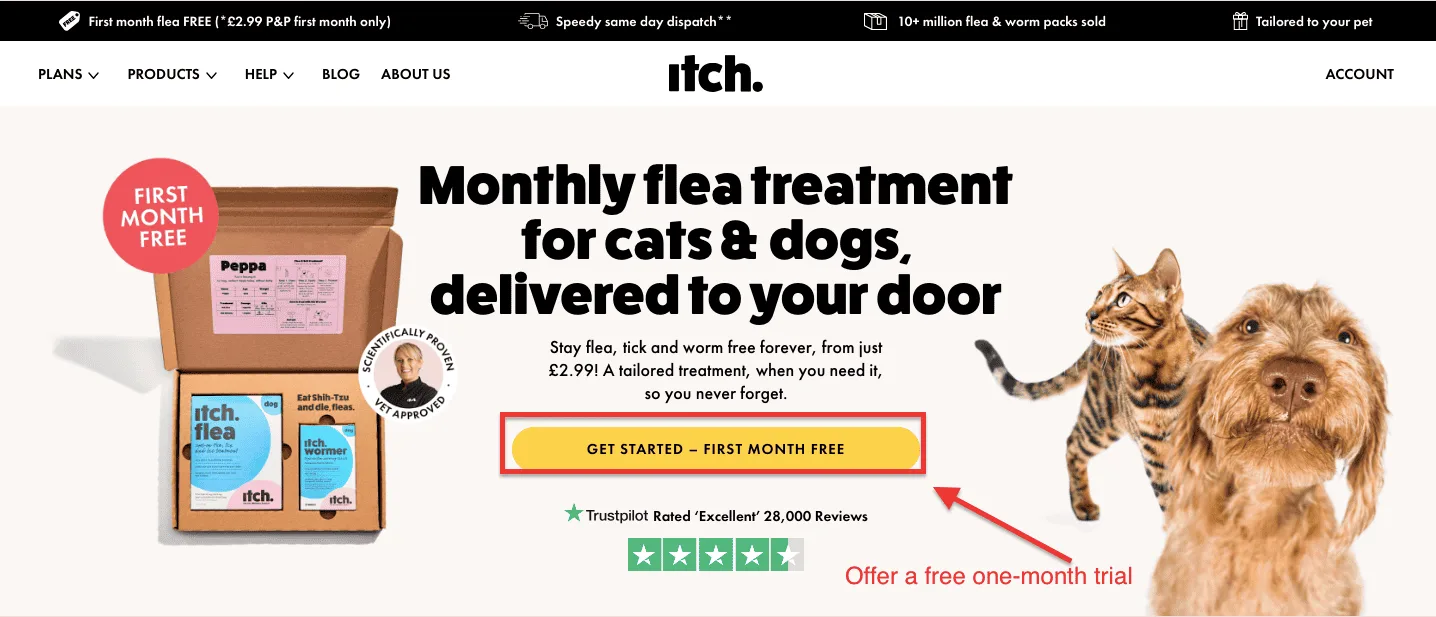
Itch has mastered the "risk-free introduction" by offering a full month of free flea treatment. This strategy works because it addresses the two biggest killers of subscription conversion: skepticism and friction. The logic is counterintuitively simple — when the product is good, the best way to sell it is to get it through the door first. The subscription sells itself.
The "Zero-Risk" Entry: Remove the primary barrier by absorbing the cost of the first month — let the service's quality serve as your sales pitch.
Incentivized Onboarding: Use high-contrast CTAs like "Get Started – First Month Free" to minimize hesitation at the signup stage.
Build Habitual Value: A one-month trial lets the customer experience the convenience and efficacy of the product before a paid subscription is ever mentioned.
10. Run a Tiered Loyalty Program: It Makes 50% of Shoppers Spend More Than They Planned
Studies show that 50% of consumers actively change their purchasing behavior specifically to reach a higher loyalty tier — meaning a well-designed tiered program doesn't just reward your existing spend patterns, it reshapes them in your favor.
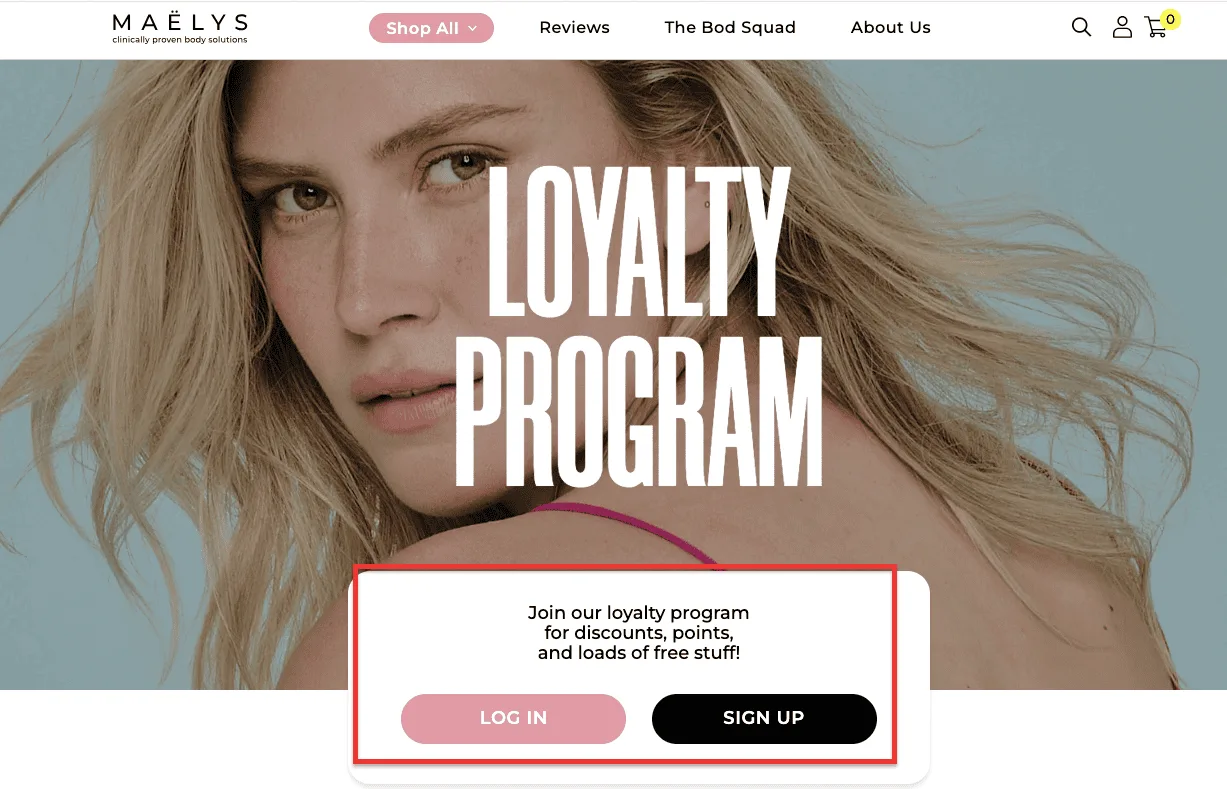
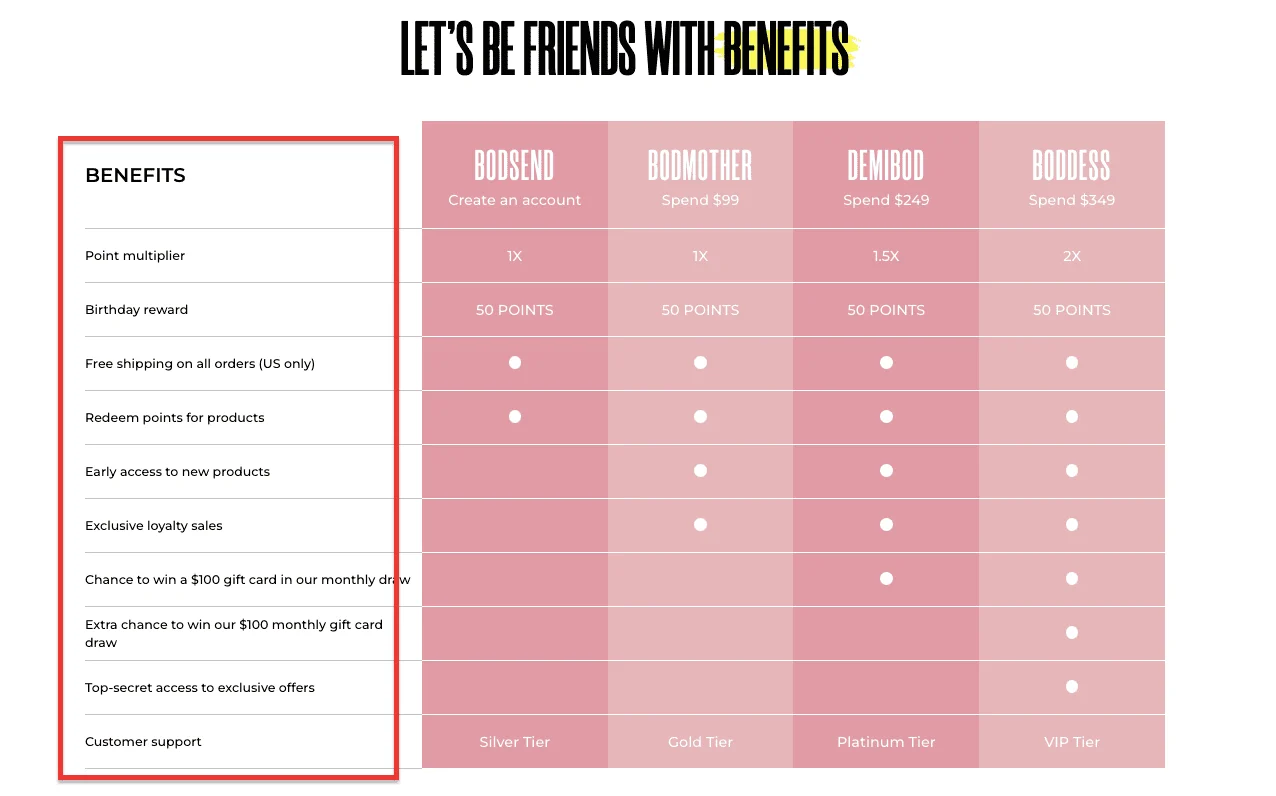
Maëlys has crafted a tiered system that feels less like a corporate ledger and more like an exclusive social club. By categorizing users into tiers — Bodsend, Bodmother, Boddess — they move the needle from simple points to identity and belonging. The genius is in the aspiration gap: the gap between where you are and the next tier is always visible, always reachable, and always worth more than the effort to get there.
Low-Barrier Entry: Require nothing more than account creation for the first tier — capture zero-party data while welcoming the user into the ecosystem.
Incentivized Progression: As spend increases, shift rewards from basic perks to high-value prizes — point multipliers, exclusive access, surprise gifts.
Aspiration Through Exclusivity: Reserve a premium perk for higher tiers only (like a monthly gift card draw), creating an aspirational loop that drives lifetime value.
11. The Gift Card Giveaway: The Lead Generation Tool Growing at 16% a Year
The e-gift card segment is the fastest-growing category in the US gift card market, expanding at a 16.23% CAGR through 2034.
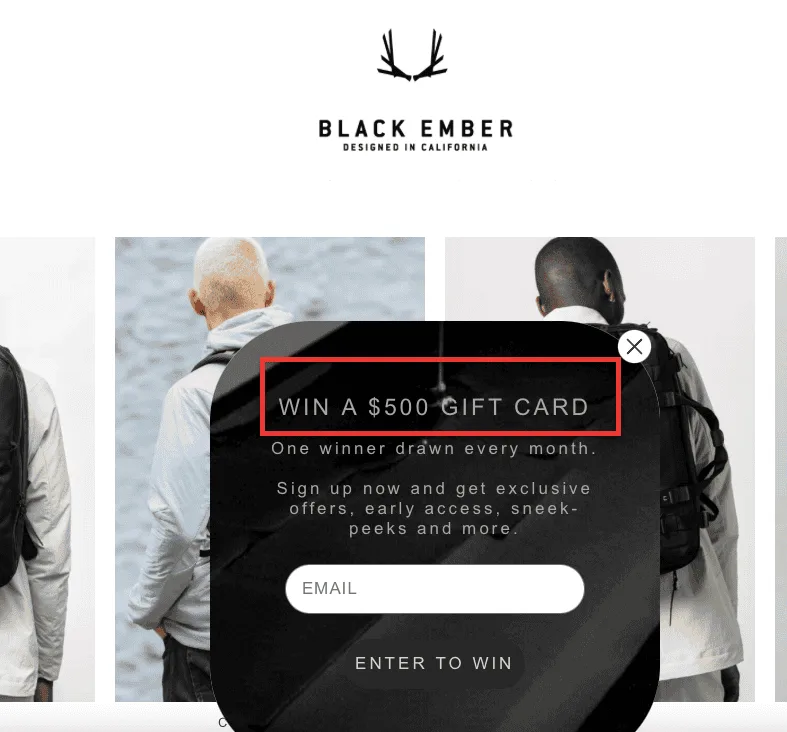
Black Ember has mastered the high-value exchange by running a monthly $500 gift card giveaway. This strategy replaces a vague promise of "future updates" with a concrete, high-value prize — dramatically lowering the barrier to email signup while building a database of high-intent leads who are already signaling interest in premium gear. The key word is monthly: recurring giveaways build a habit, not just a list.
High Value, Real Stakes: The reward must feel genuinely worth the trade. A $10 coupon doesn't generate the same attention as a $500 gift card.
Monthly Cadence: Recurring giveaways build subscriber habits — entrants start to feel like regular participants, not passive recipients.
Segment Your Winners: Use gift card giveaway entrants as a high-intent list for targeted post-entry nurture sequences.
12. Run a Mystery Offer: The Promotion That Sells Itself
Research published in the Journal of Consumer Research found that uncertainty — not novelty — is the primary driver of conversation about a product, meaning a well-run mystery offer generates word-of-mouth that a straightforward discount simply can't.
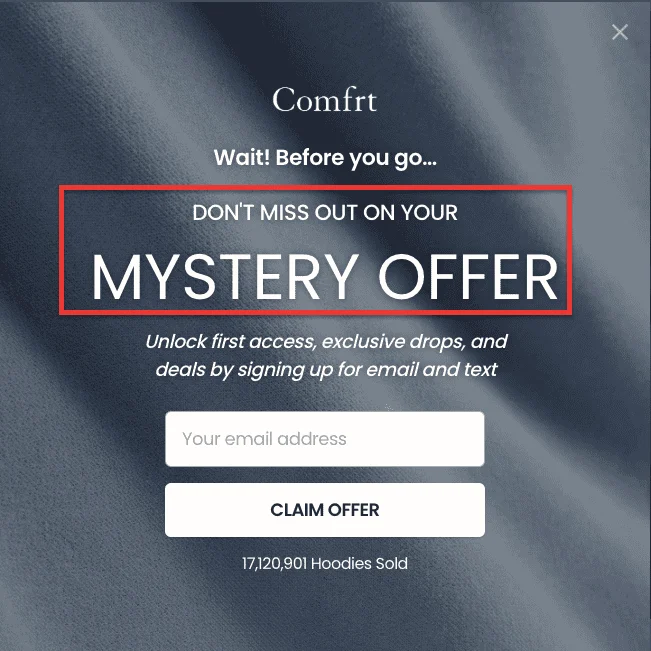
Comfrt uses a "Mystery Offer" exit-intent popup instead of a static discount. Rather than a simple 10% off, they invite users to "unlock" their deal by providing an email address. By the time the user reveals their prize, they're significantly more invested in the purchase — because they participated in getting it.
The Curiosity Gap Hook: Use vague but enticing language — "Unlock Your Mystery Offer" — to trigger a psychological need for closure.
High-Stakes Exit Intent: Deploy mystery offers when a user is about to leave. The pattern interrupt is far stronger than a traditional discount.
Value Anchoring Through Social Proof: Pair the mystery with credibility signals (like "17 million hoodies sold") to reassure users the reward is backed by a brand worth trusting.
13. Use a Scratch Card: 60% of US Shoppers Buy More From Brands That Make Them Play
Banner blindness is costing US eCommerce founders sales every day — and roughly 60% of customers say they are more likely to buy from a brand if they have enjoyed its gamified content.
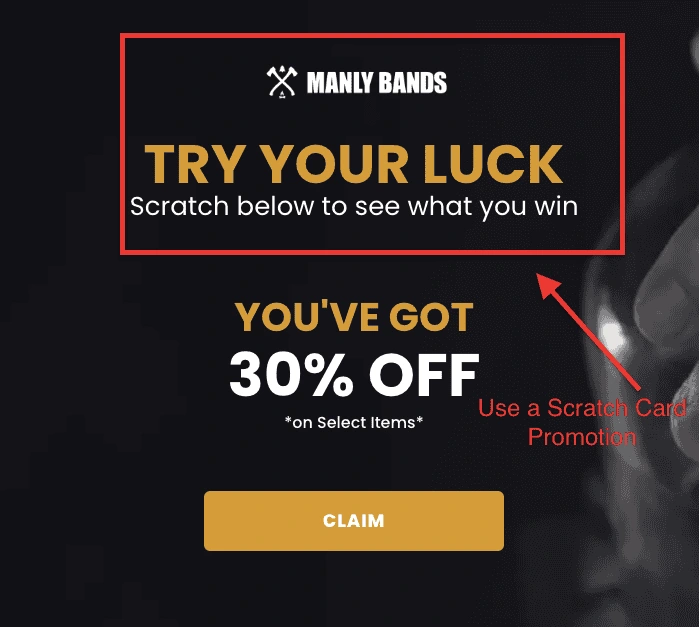
Manly Bands bypasses banner blindness by inviting users to "Try Your Luck" with a scratch card. The strategy works because it transforms a passive viewing experience into an active, tactile one. It isn't just a coupon anymore — it's their coupon, won through a moment of genuine engagement. Ownership of the reward precedes ownership of the product.
Active vs. Passive Engagement: A scratch card requires an action, which creates psychological ownership of the reward before it's even revealed.
Deploy as Exit Intent: The novelty of the scratch card is a strong enough pattern interrupt to stop a leaver without a hard sell.
Cap the Reward Ceiling: Ensure your best possible outcome (e.g., 25% off) is still profitable at your average order value.
14. Gamified Incentives: The Strategy That Lifts Customer Engagement by 40%
According to a Gartner study, brands using gamification in customer journeys can increase engagement by up to 40%.
A "Spin to Win" wheel transforms a standard newsletter signup into a high-stakes moment. OddBalls shows how a simple spin-to-win giveaway can break banner blindness and turn passive browsers into engaged subscribers. The discount isn't just a handout — it's a hard-won prize. That psychological difference matters more than the discount percentage itself.
Engagement via Play: Use interactive elements like wheels or scratch cards to break the banner blindness of typical popups.
Low Friction, High Reward: Keep entry requirements simple — usually just an email — while offering perceived value that feels significantly higher than a flat discount.
Psychological Anchoring: Showing potential wins (10% off) anchors expectations to a reward, making users more likely to complete checkout to "claim" their prize.
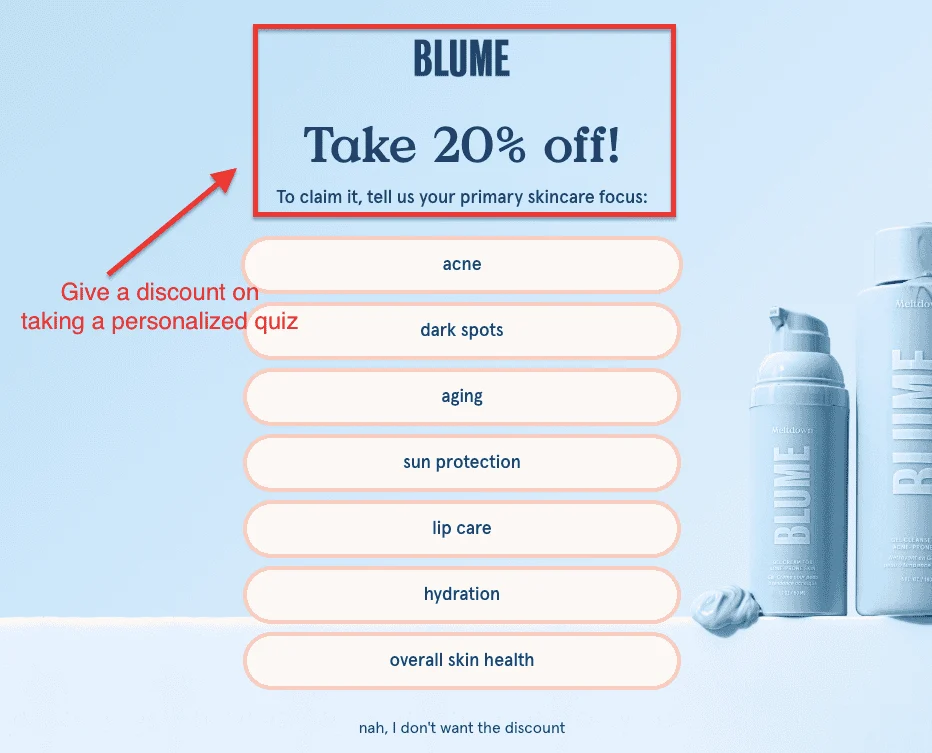
15. Offer an Incentive for Taking a Personalized Quiz: Converts at 30–40%
Interactive content like personalized quizzes converts at 30–40% — compared to 5–10% for static landing pages — and generates zero-party data that most paid ad platforms can't buy at any price.
A quiz doesn't just help customers find the right product — it makes them feel understood. The combination of personalization and a tangible reward (a discount, a curated product list, a free sample) creates a hand-raising moment: the customer actively opts into a relationship with your brand. That opt-in is qualitatively different from a cold signup — it comes loaded with expressed preferences and purchase intent.
Keep It Under 5 Questions: Every additional question reduces completion rates. Cut anything that doesn't directly affect the recommendation.
Gate the Result, Not the Quiz: Let the customer see their results — then ask for an email to "save" or "receive" them. This converts better than gating the experience upfront.
Use Quiz Data for Segmentation: The preferences collected are more valuable than the lead itself. Feed this data directly into your email and SMS flows.
The Promotion Health Check: Audit Before You Go Live
Running a promotion without a health check is like launching a product without testing it. Most promotions fail not because the idea was wrong, but because one of these five dimensions was broken. Score each dimension as Green or Red before launch. Two or more Reds means redesign the promotion before spending a dollar.
Dimension
Green Light
Red Flag
Margin Protection
Discount covered by saved ad spend or COGS buffer
Gross margin drops below 30% after promotion
Friction Level
Offer claimed in 1-2 clicks; no code required
Multi-step process easily forgotten or abandoned
Urgency Authenticity
Hard deadline tied to a real event (holiday, launch)
Evergreen "limited time" timer that resets daily
AOV Impact
Offer triggers add-ons, bundles, or tier upgrades
Single-item focus with no upsell logic attached
Post-Purchase Retention
Includes loyalty points or next-order incentives
One-and-done mechanism with no return visit logic
The Expert Rule
A promotion with Green scores on Margin Protection and Post-Purchase Retention will almost always pay for itself over 90 days, even if the short-term conversion lift is modest.
Conversely, a Red Flag promotion that generates a revenue spike can still destroy your business. Prioritize the long view.
The Bottom Line
There's a version of promotional strategy that looks like throwing discounts at the wall and seeing what sticks. And there's this version where you match the right tier to the right goal, audit it before launch, and measure the right outcomes afterward.
Tier 1: When you need revenue this week. Tier 2: When you need customers to buy more. Tier 3 is when you need customers to come back. The 15 promotions in this guide aren't a menu to work through; they're a toolkit. The tier they belong to tells you when to pick them up.
Start with the Selection Matrix. Run the Health Check. Then launch. And if you want a second pair of eyes on your promotion strategy before it goes live, that's exactly what the Convertcart audit is for.





.avif)
.svg)


.svg)

.svg)
.svg)
