Buying jewelry online is rarely a purely functional decision. Shoppers want to feel confident in the quality, emotionally connected to the piece, and certain that the purchase is worth it.
High-converting jewelry descriptions guide shoppers from curiosity to confidence through the right mix of clarity, emotion, trust, and experience design.
The eCommerce Jewelry Description Conversion Structure
Tier
What It Solves
Key Levers to Optimize
Impact on Conversion
Tier 1 Conversion-Critical (Must-Haves)
Removes doubt and friction at the exact moment of decision
Tier 1: Conversion-Critical Jewelry Descriptions (The Make-or-Break Layer)
Most jewelry descriptions fail long before shoppers ever reach the add-to-cart button.
Not because the product is unattractive. But because hesitation enters the buying journey too early.
My auditing teams at Convertcart have repeatedly noticed the same pattern across high-ticket jewelry brands: when product descriptions lack clarity on sizing, materials, craftsmanship, or trust details, shoppers open new tabs instead of moving toward checkout.
A beautiful ring suddenly feels risky. A premium necklace starts feeling overpriced. And even emotionally driven categories like gifting lose momentum.
That’s why Tier 1 is the make-or-break layer of every effective product description for jewelry.
The highest-converting brands treat descriptions less like decorative copywriting and more like conversion infrastructure.
We have also seen that specificity consistently outperforms vague luxury language.
Instead of:
“Premium quality metal”
Use:
“925 sterling silver with rhodium coating for tarnish resistance.”
Clarify dimensions, weight, skin-safe materials, clasp type, and how the earrings look when worn daily.
Similarly, strong product descriptions translate features into outcomes: “lightweight enough for all-day wear” converts better than simply listing metal composition.
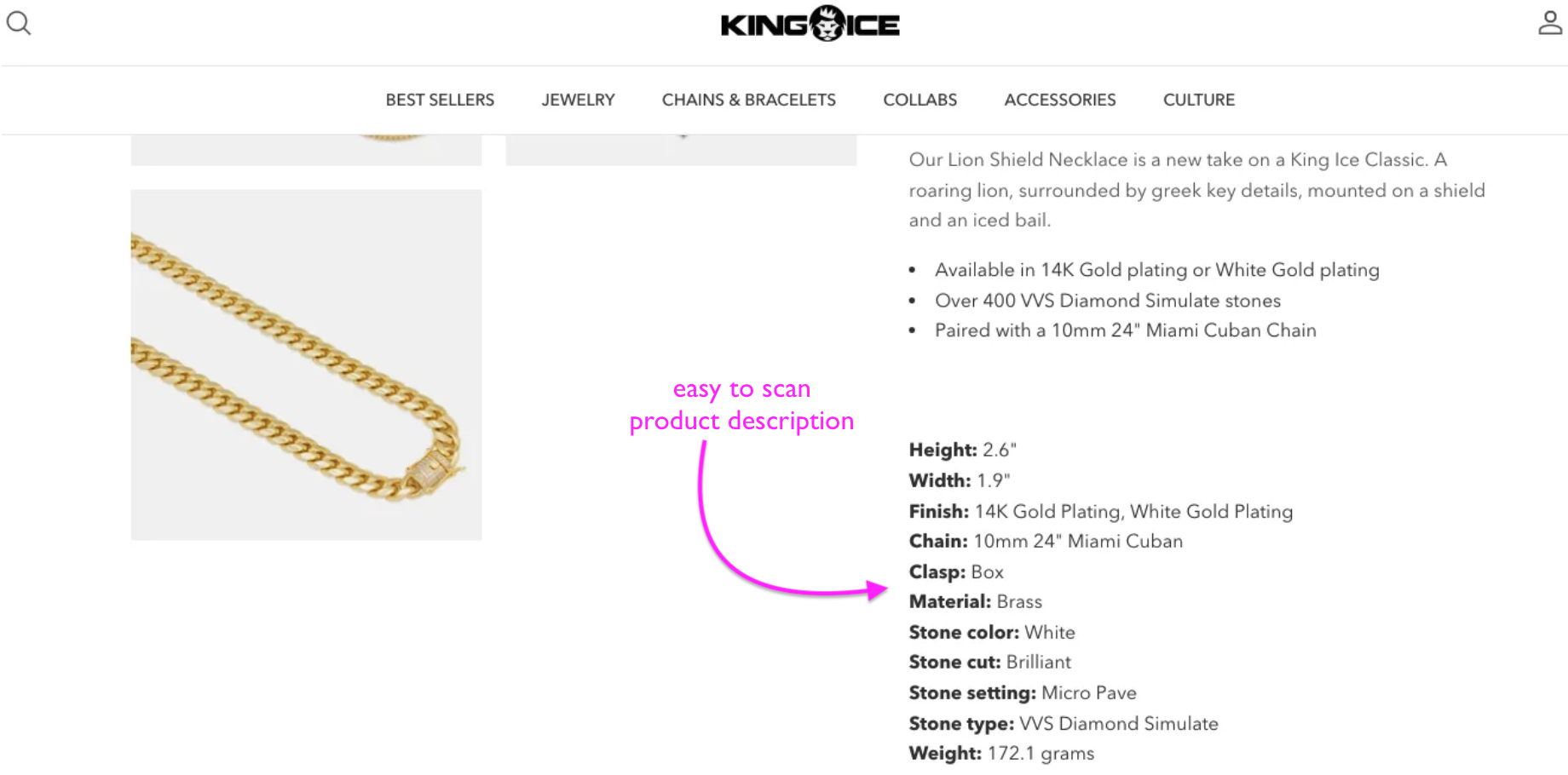
My teams have also seen that scanability directly impacts mobile conversions.
Dense text blocks consistently underperform compared to structured descriptions with short sections, bullets, icons, and quick-glance trust cues.
We like how King Ice writes their product descriptions for easy scannability:
The best-performing jewelry product description template layouts surface key details that shoppers actively search for, such as shipping timelines, warranty coverage, ethical sourcing, gemstone authenticity, and care instructions.
A strong online jewelry store description example doesn’t just describe the product beautifully. It reduces uncertainty so effectively that purchasing begins to feel safe, easy, and justified.
That’s the real job of modern jewelry description writing examples, and every successful description for the jewelry business today.
Tier 2 is where strong jewelry descriptions stop being informational and start becoming persuasive.
Once Tier 1 removes hesitation, Tier 2 increases desire.
Across jewelry CRO audits at Convertcart, one trend shows up repeatedly: shoppers respond far better to descriptions that help them imagine the product in real life instead of simply describing its specs.
This is especially true for emotional purchases like anniversary gifts, bridal jewelry, milestone purchases, and self-gifting moments.
For example, a weak product description for jewelry might say:
“Gold tennis bracelet with cubic zirconia stones.”
But higher-converting PDPs frame the experience:
“A lightweight gold tennis bracelet designed to catch light subtly during dinners, weddings, and everyday styling.”
That small shift changes how the product feels psychologically.
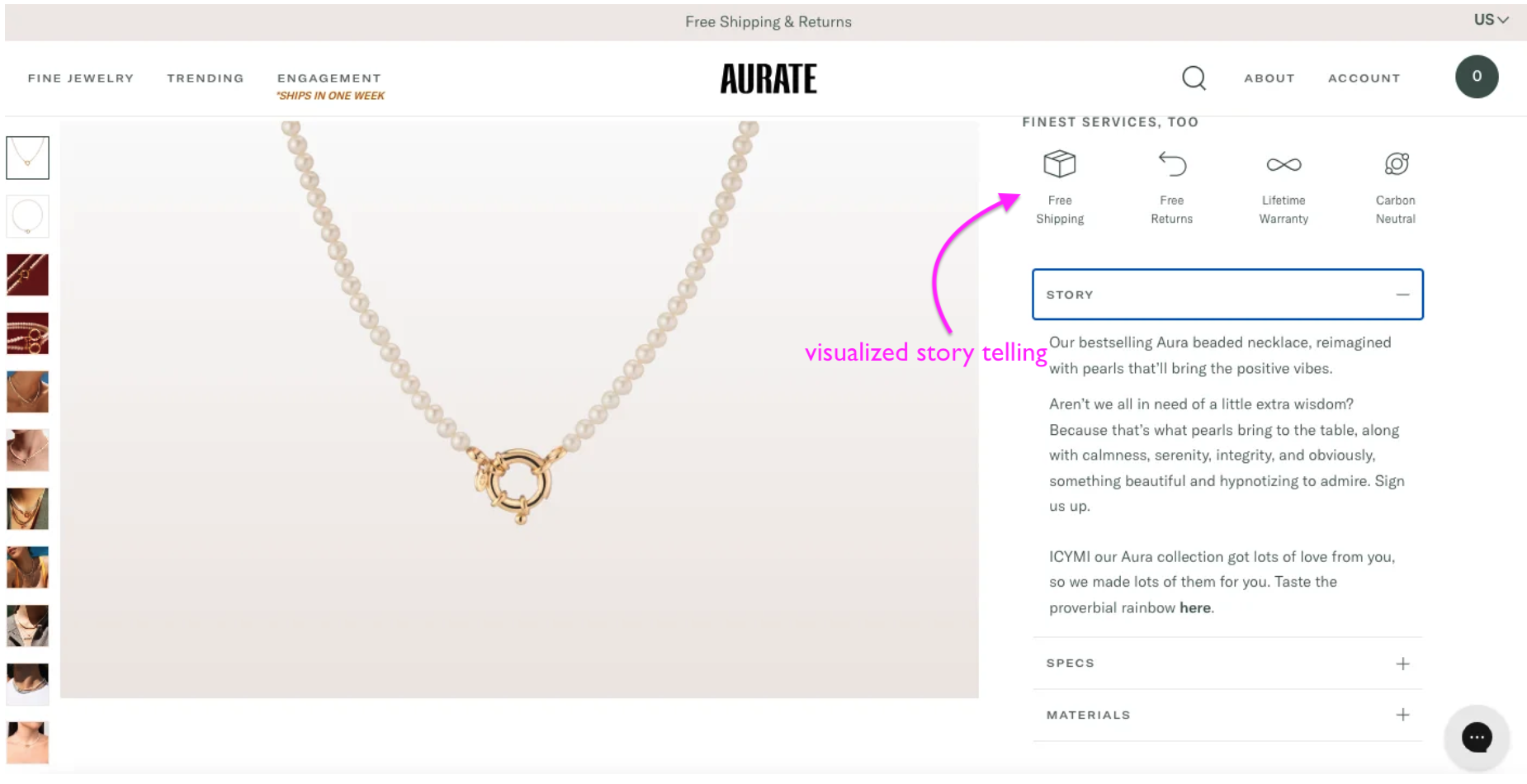
See how Aurate does it:
The strongest-performing brands also use visualization to reduce the imagination gap.
Instead of generic phrases like “elegant statement earrings,” effective earrings product description copy explains how the piece sits, moves, and complements outfits:
“Designed with a slim drop silhouette that frames the jawline beautifully without feeling heavy during long events.”
Conversion research from our optimization work also shows that shoppers engage more deeply when descriptions include natural use cases.
A necklace becomes easier to justify when positioned for occasions that buyers already imagine themselves shopping for:
“Perfect for layered office styling, destination weddings, or meaningful gifting moments.”
Similarly, emotional storytelling consistently lifts perceived value in luxury categories.
An effective jewelry product description template often connects craftsmanship with emotion:
“Hand-finished detailing inspired by vintage heirloom jewelry meant to be worn for years, not seasons.”
The best jewelry description writing examples don’t sound like catalog entries.
They help shoppers picture confidence, gifting reactions, compliments, and memorable occasions before the purchase even happens.
For a ready-made framework on shifting from "materials" to "provenance" in your copy, our luxury product page breakdown includes a full value ladder plus real examples from Golden Goose and Aquazzura.
Tier 3: Revenue Drivers (Turning Purchase Intent Into Higher-Value Orders)
By the time shoppers reach Tier 3, the goal shifts from persuasion to expansion.
At this stage, the product already feels trustworthy and desirable. Now the opportunity is increasing cart value without creating friction. In jewelry eCommerce, this matters more than many brands realize because shoppers often arrive with emotionally driven intent but flexible spending limits.
Conversion analysis across jewelry PDP experiments at Convertcart has shown that buyers are far more likely to increase spend when upgrades feel curated instead of aggressively upsold.
For example, a simple jewelry description for a solitaire necklace may convert well on its own. But pairing it with a styled recommendation like:
“Complete the look with matching pavé earrings.”
often increases bundle purchases naturally because the shopper can instantly visualize the full set.
Cadette is the perfect example of collection nudges + upsells without friction:
The strongest-performing product description for jewelry pages also uses premium anchoring strategically.
Instead of presenting only one option, high-converting brands introduce premium variants that reshape value perception.
For instance: “Available in sterling silver, 14K gold vermeil, and solid 14K gold.”
Even when shoppers choose the mid-tier option, the premium variant creates a price context that makes the original selection feel more reasonable.
Many effective online jewelry store description example pages subtly use this pricing psychology without making the experience feel sales-heavy.
Flexible payment messaging also plays a major role in accelerating decisions for higher-ticket jewelry.
Optimization reviews across luxury and gifting brands have consistently shown that shoppers respond positively when affordability is reframed clearly inside descriptions:
“Own it today for $42/month with interest-free installments.”
The best jewelry description writing examples don’t stop at describing the product itself.
They strategically guide shoppers toward larger purchases, faster decisions, and higher perceived value, all while keeping the experience elegant enough for a premium description for a jewelry business.
Tier 4: Trust Amplifiers (Reducing Doubt Before It Kills the Purchase)
For jewelry brands, trust is rarely built through one big promise.
It’s usually built through small details that quietly remove uncertainty.
During Convertcart conversion audits, one pattern has become increasingly obvious: shoppers, especially in premium jewelry categories, actively look for reassurance signals before committing.
They want proof behind the product, not just polished branding.
That’s why Tier 4 focuses on trust amplification inside the jewelry description itself.
Traceability has become especially important for higher-value purchases.
Instead of vague claims like “ethically sourced,” stronger PDPs explain where materials come from and how they’re verified:
“Crafted using recycled 14K gold and conflict-free lab-grown diamonds.”
Similarly, transparency around craftsmanship consistently improves buyer confidence.
High-performing product descriptions for jewelry pages often explain details that many brands overlook:
“Hand-set stones inspected individually for alignment and finish quality.”
These specifics make the product feel more credible and justify premium pricing more effectively than generic luxury language ever could.
Care instructions also play a surprisingly important role in conversion psychology.
Brands that proactively explain maintenance reduce the fear of damaging expensive jewelry after purchase.
For example, a strong earrings product description may include:
“Store in a dry pouch after use and avoid direct contact with perfumes to preserve shine longer.”
That kind of guidance subtly communicates longevity, quality, and post-purchase support.
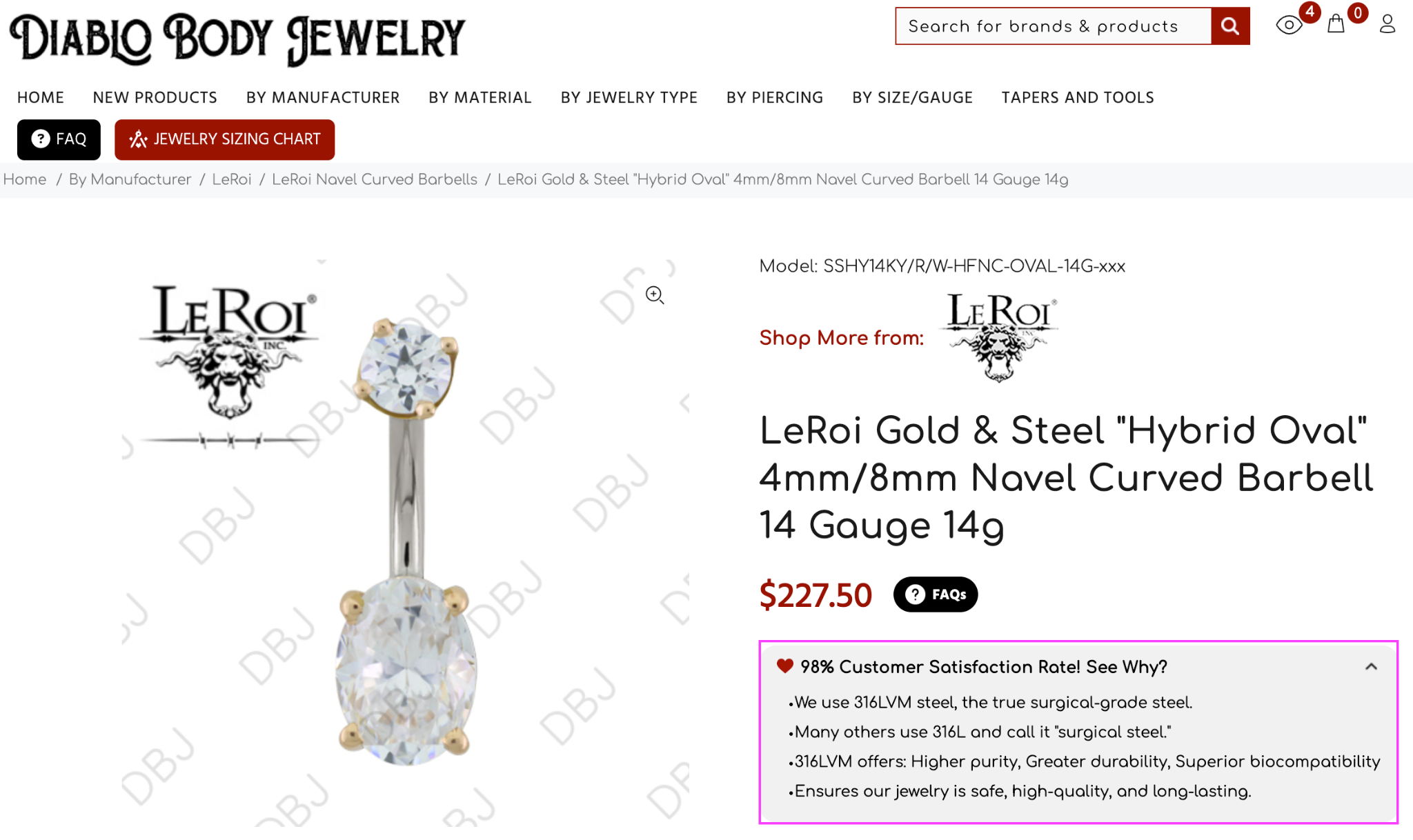
Convertcart Case Study - Diablo Jewelry
During a Convertcart PDP experiment for a premium body jewelry brand, we tested an expandable trust reassurance module placed directly below pricing.
Instead of hiding quality reassurance inside FAQs or separate policy pages, the PDP surfaced customer satisfaction data, material-grade explanations, and durability messaging directly within the buying flow.
The variation resulted in a 12% increase in website conversions, largely by reducing hesitation around product quality and long-term wearability.
Even the strongest jewelry descriptions can underperform when the browsing experience feels overwhelming.
By Tier 5, the focus is no longer just copy. It’s how the information is presented, discovered, and navigated across the PDP experience.
Through ongoing jewelry CRO evaluations at Convertcart, one trend consistently stands out: shoppers engage more deeply with product pages that reduce cognitive effort.
Luxury buyers especially don’t want to “work” to understand a product.
That’s why layout decisions matter more than most brands assume.
For example, high-converting product descriptions for jewelry pages often use collapsible sections for shipping, sizing, materials, and care instructions instead of displaying one long wall of text.
This keeps PDPs visually cleaner while still making important information easy to access, including customer service.
See how Jenny Bird does it:
Icons also improve scanability significantly on mobile.
Instead of burying details inside paragraphs, effective PDPs surface trust and convenience visually:
“Hypoallergenic,” “30-Day Returns,” “Free Shipping,” or “Lifetime Warranty” paired with simple icons often outperform text-heavy explanations alone.
Microcopy is another overlooked conversion lever. Small phrases placed near CTAs frequently reduce hesitation at critical moments.
For instance:
“Gift-ready packaging included.”
or
“Designed for everyday wear.”
can quietly reinforce purchase intent without interrupting the shopping flow.
Our optimization findings have also shown that navigation and interlinking directly impact revenue per visitor for jewelry stores with larger catalogs.
Strong online jewelry store description example pages guide shoppers naturally toward complementary collections:
“Pair with our matching emerald tennis bracelet.”
or
“Explore the complete bridal collection.”
Instead of forcing shoppers back into search mode, these pathways extend discovery seamlessly.
The best jewelry product description template experiences don’t feel cluttered, aggressive, or overly designed. They feel intuitive.
That’s what separates average PDPs from premium jewelry description writing examples that keep shoppers exploring longer, trusting faster, and purchasing more confidently within a modern description for jewelry business.
⚠️
Find the real reasons behind your low conversion rate
"Designed for milestone gifting and everyday layering."
Visualization
Can shoppers imagine wearing it?
"Beautiful drop earrings"
"Slim drop silhouette that frames the jawline without feeling heavy."
Use Cases
Are occasions and styling suggestions included?
No context provided
"Perfect for weddings, office wear, and anniversary gifting."
Upsells & Pairing
Are matching products or collections recommended naturally?
No product pathways
"Complete the look with matching pavé earrings."
Premium Anchoring
Are premium variants positioned strategically?
Single option only
"Available in sterling silver, vermeil, and solid gold."
Payment Flexibility
Are installment options surfaced clearly?
Hidden financing info
"Own it today for $42/month interest-free."
Care Instructions
Does the description reduce post-purchase anxiety?
No maintenance guidance
"Store separately to preserve shine and avoid scratches."
Microcopy
Are subtle conversion nudges present near CTAs?
Generic CTA only
"Gift-ready packaging included."
Navigation & Interlinking
Can shoppers continue exploring easily?
Dead-end PDP experience
"Explore the complete bridal collection."
SEO for Jewelry Descriptions (Where Visibility Drives Purchase Intent)
Many jewelry brands still separate SEO writing from conversion writing.
But through Convertcart’s jewelry PDP audits, one thing has become clear: the best-performing pages do both at the same time. They rank because they match shopper search intent, and they convert because they answer buying questions clearly.
A common mistake is relying on broad phrases like “luxury jewelry” or “premium accessories.”
Stronger jewelry descriptions use specific, high-intent keywords that shoppers actually search for before buying.
For example, instead of:
“Elegant gold earrings”
Use:
“14K gold huggie hoop earrings for sensitive ears.”
Instead of:
“Minimalist necklace”
Use:
“Minimalist diamond necklace for everyday layering.”
These keyword-rich descriptions improve both discoverability and clarity.
Another important insight from Convertcart optimization reviews: keyword stuffing hurts conversions.
Repeating terms like jewelry description, earrings product description, or description for jewelry business unnaturally makes PDPs feel robotic and less trustworthy.
The strongest product description for jewelry pages weaves keywords naturally into styling suggestions, specifications, gifting occasions, and trust details.
They also use smart interlinking to guide shoppers toward related collections like bridal jewelry, stacking rings, or everyday essentials.
The best SEO-driven jewelry descriptions don’t just attract traffic. They attract shoppers already close to purchasing.
Common Mistakes Jewelry Brands Make With Product Descriptions
1. Prioritizing aesthetics over clarity
One recurring issue uncovered during Convertcart jewelry audits is brands writing descriptions that sound luxurious but reveal very little.
Phrases like “timeless elegance” or “premium craftsmanship” may feel premium, but they don’t answer practical buying questions.
High-converting jewelry descriptions explain materials, sizing, durability, weight, and wearability clearly. Shoppers shouldn’t have to guess what they’re buying.
2. Writing generic descriptions across the catalog
Many stores reuse nearly identical copy for rings, necklaces, earrings, and bracelets. This weakens both SEO and conversion performance.
A strong product description for jewelry should reflect the product’s specific styling purpose, gifting occasion, or emotional appeal.
For example, bridal earrings, everyday hoops, and anniversary necklaces should never sound interchangeable.
3. Ignoring mobile browsing behavior
Convertcart optimization reviews consistently show that long unstructured text blocks reduce engagement on mobile PDPs.
Many shoppers skim jewelry pages while comparing multiple products. Dense paragraphs without bullets, icons, spacing, or collapsible sections create friction.
The best-performing jewelry product description template layouts make key details instantly scannable while still preserving a premium shopping experience.







.avif)
.svg)


.svg)

.svg)
.svg)
