
.avif)


Here’s what happens when a mid-market eCommerce brand hires a CRO manager:
Good instincts, a real backlog of hypotheses, a clear read on where shoppers are dropping off. But three months in, almost nothing concludes.
Usually this isn’t a hiring problem, or a skills gap, or a sign the strategy needs rework.
The hypotheses were fine. What happened is that every one of them needed a designer's time and a developer's sprint slot, and CRO was competing for both against a roadmap that had its own deadlines.
Our own research backs this up.
In "In-House CRO vs. Managed CRO: What Convertcart Research Reveals About Cost Per Trustworthy Experiment," we introduced Cost Per Trustworthy Experiment (CPTE), which is the total CRO investment divided by the number of experiments that actually reach a decision the business can act on.
That post covers the economics. This one covers the mechanism underneath it.
In this post, we discuss why a fully-staffed, well-funded in-house team still ends up with a bad CPTE, and what an execution system actually needs to fix it.
Here's the math from the CPTE research.
A CRO program costing $550,000 a year that ships 24 experiments costs $22,917 per experiment. The same budget shipping 48 experiments costs $11,458 per experiment, half as much, for the same spend.
What actually separates a team that ships 24 from a team that ships 48 is less obvious. It’s never the headcount.
A team can have a data analyst, a developer, a designer, a QA engineer, and a project manager- the full five-role setup the CPTE research prices at $532,017 a year- and still ship 24 experiments instead of 48.
What usually happens is that the developer and designer aren't dedicated to CRO.
They're shared with the product roadmap, and CRO loses that contest most weeks, not because anyone decided CRO didn't matter, but because nobody protected the time.
The real question is what determines whether that $532,017 produces 24 trustworthy experiments a year or 48, not whether you can afford the team in the first place.
In the next section, we get into exactly that.
CPTE tells you the outcome: what you paid for each trustworthy experiment. It doesn't tell you why one team's number is twice as good as another's at the same budget.
That's what the Velocity Matrix is for. Think of CPTE as the scoreboard and the Matrix as the mechanism that decides the score.
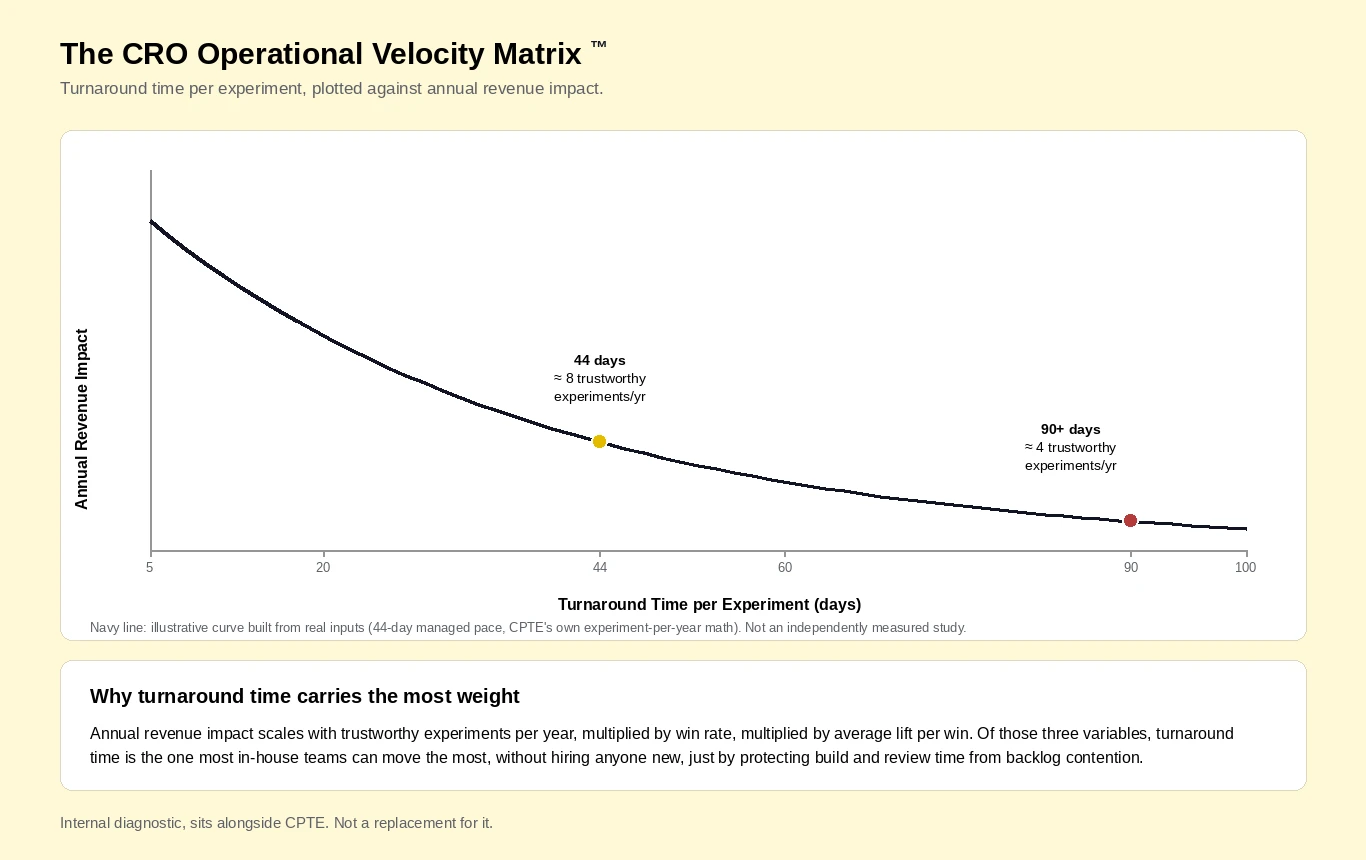
It's a simple two-axis model: turnaround time per experiment, measured from hypothesis to trustworthy conclusion, plotted against annual revenue impact.
We anchored the fast end of that axis in real numbers.
Our own managed CRO work averages 11 days from onboarding to launch and 44 days from onboarding to a trustworthy conclusion- actual client data, not a target.
The slow end is what happens when a hypothesis queues behind unrelated engineering and design priorities instead, which is exactly the pattern described in the section above.
Turnaround time carries this much weight for a specific reason. Annual revenue impact scales with three things multiplied together: trustworthy experiments per year, win rate, and average lift per win.
Of those three, turnaround time is the one most in-house teams can actually move, and they can move it a lot, without hiring anyone new.
A team concluding a trustworthy experiment every 44 days runs roughly 8 a year.
A team stuck at 90-plus days because of backlog contention runs about 4, at the same headcount, the same $532,017, and presumably a similar win rate.
That's not a small gap. It's half the learning, for the same money, in the same year.
Worth being direct about what this is and isn't. The 8-versus-4 example is an illustrative extrapolation built on real inputs: our own real timing data and the CPTE research's own math, not a separately measured study.
The Matrix doesn't replace CPTE, and turnaround time isn't the only variable that matters. What it adds is an explanation for why two teams spending the same money can end up with very different scoreboards.
Every hypothesis has to survive the same journey to become a trustworthy experiment: get prioritized, get designed, get built, get QA'd, go live, run to a real conclusion, and get acted on.
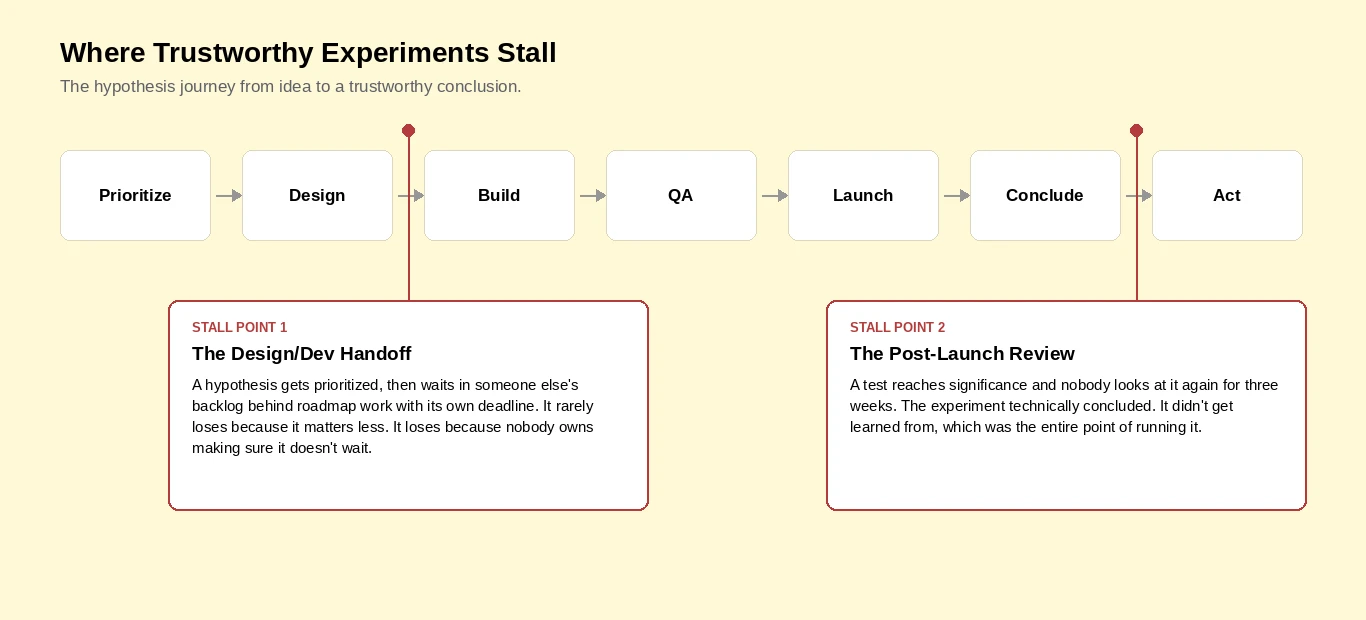
There are two points in that journey that account for most of where trustworthy experiments die. The first is the design and development handoff.
A hypothesis gets prioritized, and then it sits. Not because it's a bad idea, but because it's now waiting in someone else's backlog, behind roadmap work that has its own deadline and its own stakeholder.
CRO doesn't usually lose that fight because it's less important. It loses because it's rarely anyone's job to make sure it doesn't wait.
The second is the post-launch review. A test reaches statistical significance on a Tuesday, and nobody looks at it again for three weeks.
By the time someone does, the moment to act on it has partly passed; a merchandising decision was already taken without it, or the team's attention has moved somewhere else.
The experiment technically concluded. But nobody learned anything from it, unfortunately.
The truth is that this isn’t a design problem. A strong designer and a strong developer can still produce a bad CPTE if the system around them has no owner and no protected time for the handoff itself.
The good news is that this does not require a bigger team. It requires a system around the one you already have.
A protected build allocation: Not more headcount, a fixed slice of existing design and development time that CRO doesn't have to renegotiate for every single sprint. Even a small allocation, held consistently, beats a larger one that gets deprioritized whenever something else feels urgent.
A prioritization queue backed by committed capacity: A backlog ranked by impact and effort only matters once there's a guaranteed slot to prioritize into. Without that, prioritization is just a spreadsheet nobody acts on.
A trustworthy-conclusion bar set before the test starts: Decide the success metric and the sample size you need at the hypothesis stage, not after the test is already live. This is the same standard CPTE itself uses to define a trustworthy experiment, and setting it early is what keeps “we don't have enough data to be sure” from becoming the default outcome.
A fast, scheduled decision loop: A test that concludes on a Tuesday needs a standing review before the following Tuesday, not whenever someone happens to remember it. It's the single biggest lever against the post-launch stall described above.
A shared record of what was tested and what was learned: The next hypothesis should build on the last result instead of re-litigating a question the team already answered six months ago.
Gloves.com ran more than 95 experiments with us, spanning product discovery, mobile shopping, delivery uncertainty, promotions, and navigation. Of those, 41% reached a trustworthy conclusion the business could act on.
That 41% is the number that matters here, not the 95. Plenty of programs run a lot of tests. Fewer produce a result worth acting on four times out of ten. Two experiments make the mechanism concrete.
Category-page abandonment was high on mobile, and a hypothesis about surfacing product details faster turned into a mobile Quickview experiment.
It reached a trustworthy conclusion and shipped a 9.27% increase in conversion rate.
Shoppers hesitating at checkout over when their order would actually arrive turned into a real-time shipping countdown, aimed directly at that delivery uncertainty.
That one reached a trustworthy conclusion too, and the number of users completing their orders rose 22%.
Neither of those started as a bigger idea than what most in-house teams already have sitting in a backlog somewhere.
What made the difference was a system that got each one from hypothesis to a trustworthy, actionable conclusion, and then did it again, continuously, instead of once in a while.
The $532,000 question was never really about whether you can afford an in-house CRO team.
It's about whether that team has a system that gets a hypothesis to a trustworthy conclusion before the backlog quietly eats it.
Turnaround time is the lever most in-house programs haven't touched yet, and it's usually the one already sitting closest to hand.
If you're deciding between building that system in-house or handing the execution to a team that's already built it, CRO360 is worth a look, and our research on "In-House CRO vs. Managed CRO" walks through the full cost comparison.
For more on the specific ways CRO programs stall without a system behind them, our post on eCommerce CRO mistakes covers the same failure pattern from a different angle.
Want a read on where your own program's turnaround time actually stands? We'll walk through your last few experiments and show you exactly where they stalled.
Usually because the roadmap depends on design and development time the team doesn't actually control. The strategy is rarely the problem. The handoff to build and ship a test is.
It's a realistic starting point for the five core roles, a data analyst, a developer, a UX designer, a QA engineer, and a project manager, based on average US salaries.
That figure doesn't include tooling, recruiting, onboarding, or the ramp time before the team is fully productive.
Test volume measures activity. Cost Per Trustworthy Experiment measures whether that activity produced evidence the business can actually act on.
A program can look busy and still produce a weak CPTE if most tests end inconclusive.
There's no universal number, since it depends on traffic and the effect size you're testing for, but 44 days is a real benchmark from our own managed CRO client data.
If a team is regularly taking 90 or more days, backlog contention is the more likely cause than the test itself needing that long to reach significance.
Usually a system first. Most of the in-house programs we've seen stall aren't short on people.
They're short on protected time, a committed decision loop, and a clear bar for what counts as a trustworthy result.
Subscribe for more articles like this!

.svg)


.svg)

.svg)
.svg)
2026 Convertcart, All Rights Reserved
33/1, Castle Street, Ashok Nagar, Bengaluru, India