A high-converting Shopify checkout page minimizes friction, builds trust, and helps shoppers complete their purchase as quickly as possible.
Instead of adding more features, effective Shopify checkout optimization focuses on reducing unnecessary decisions, providing clear guidance, offering trusted payment methods, and reassuring customers before they pay.
The highest-converting Shopify stores consistently optimize four areas:
friction removal, clarity, trust, and completion.
Whether you're using Shopify's standard checkout or Shopify Plus with Checkout Extensibility, these principles help prioritize the changes that have the biggest impact on conversion rate.
You've done the hard part. A shopper has discovered your product, added it to their cart, and clicked Checkout.
Yet this is where many Shopify stores lose revenue.
Every extra field, unexpected charge, missing payment option, or moment of uncertainty gives shoppers another reason to leave before completing their purchase. Even stores with strong traffic and compelling product pages can see conversions suffer because of avoidable checkout friction.
The challenge is knowing which checkout improvements actually move the needle. Not every customization increases conversions, and Shopify's checkout capabilities differ depending on your plan.
In this guide, you'll learn how to identify the highest-impact checkout improvements, understand what can be customized on standard Shopify versus Shopify Plus, and see real optimization experiments that increased completed orders while reducing checkout abandonment.
The Shopify Checkout Conversion Framework: 4 Stages That Increase Conversions
The Shopify Checkout Conversion Framework is a four-stage model for improving Shopify checkout conversion rates.
Instead of focusing on individual tactics, it helps you optimize the checkout experience in the order that has the biggest impact on completed purchases: friction removal, clarity, trust, and completion.
Many Shopify stores invest in upsells, discounts, or urgency before fixing the checkout itself. But even the best offers struggle to convert if the buying experience feels slow, confusing, or untrustworthy.
The highest-converting Shopify checkout pages follow a clear progression.
They remove unnecessary effort first, guide shoppers confidently through each step, address buyer concerns before payment, and make completing the purchase as fast as possible.
1. Friction Removal
Goal: Make it easy to start and effortless to continue.
Before shoppers think about trust or payment, they need a checkout that feels simple to use. Every unnecessary field, click, or decision adds friction and increases the likelihood of abandonment.
Focus on: Guest checkout, Shop Pay and autofill, fewer form fields, faster page load times, and eliminating unnecessary steps.
Why this matters: Most checkout abandonment happens because completing the purchase feels like too much work. Reducing effort early keeps shoppers moving toward payment.
2. Clarity & Flow
Goal: Guide shoppers confidently from cart to confirmation.
Once friction is removed, the next challenge is uncertainty. Shoppers should always know where they are, what information they need to provide, and what happens next.
Focus on: A clean mobile-first layout, clear progress indicators, visible order summaries, transparent shipping costs, taxes, delivery estimates, and intuitive form design.
Why this matters: When the checkout process is predictable and easy to follow, shoppers spend less time second-guessing and more time completing their purchase.
3. Trust & Reassurance
Goal: Remove doubts before shoppers reach the payment button.
Even shoppers who intend to buy can hesitate if they question payment security, shipping reliability, or return policies. Your checkout should answer these concerns before they become objections.
Focus on: Security indicators, return and shipping policies, reassuring microcopy, customer support access, trusted payment methods, and localized currency and language.
Why this matters: Trust reduces purchase anxiety. The more confident shoppers feel about their order, the more likely they are to complete it.
4. Completion & Acceleration
Goal: Make completing the purchase the easiest decision.
Once shoppers are ready to pay, your checkout should help them finish with as little effort as possible. Every additional delay or unnecessary decision creates another opportunity to abandon the purchase.
Focus on: Express payment methods, smart default selections, saved customer information, mobile-friendly payment flows, and one-click checkout where available.
Why this matters: The final step should feel fast and effortless. A streamlined payment experience turns purchase intent into completed orders.
How to Optimize Your Shopify Checkout Page Using the 4-Stage Framework
1. Enable Guest Checkout to Remove Friction
Goal: Let first-time shoppers complete their purchase without unnecessary barriers.
Guest checkout is one of the simplest ways to reduce checkout abandonment. Requiring customers to create an account adds an extra decision at the point where they should be focused on completing their purchase.
To enable guest checkout in Shopify:
Go to Settings → Checkout
Open Customer accounts
Select Accounts are optional
This allows shoppers to place an order without creating an account while still giving them the option to sign up later.
To reduce friction even further, enable Shop Pay. Returning customers can securely save their shipping and payment information, making future purchases significantly faster.
Pro tip: Add reassuring microcopy near the checkout button, such as:
"No account required. Checkout as a guest and receive your receipt by email."
Why it works: Removing unnecessary steps shortens the path to purchase and reduces one of the most common reasons shoppers abandon checkout.
2. Localize Your Shopify Checkout for Every Market
Goal: Make checkout feel familiar, regardless of where shoppers are buying from.
International customers expect prices, shipping information, payment methods, and delivery expectations that match their location. Showing unfamiliar currencies, shipping options, or unclear duties creates uncertainty and increases abandonment.
With Shopify Markets, you can customize the checkout experience for different regions by displaying:
Local currencies
Region-specific shipping methods
Duties and taxes upfront
Local payment options
Market-specific messaging
For example, Canadian shoppers can see CAD pricing and local carriers, while U.S. customers view USD pricing and domestic shipping options.
Shopify also supports localized pickup experiences by automatically showing the nearest pickup location when available.
Why it works: A checkout that feels local builds confidence, reduces confusion, and helps shoppers complete their purchase without second-guessing unexpected costs or delivery details.
3. Build Trust Before Shoppers Reach the Payment Button
Goal: Eliminate last-minute doubts that prevent shoppers from completing their purchase.
A shopper reaching the payment page has already decided they want your product. What often stops them from buying isn't price—it's uncertainty. Questions like "Is this payment secure?", "What if I need to return it?", or "Can I trust this store?" can quickly turn purchase intent into abandonment.
To build confidence during checkout, focus on adding reassurance where shoppers need it most.
Prioritize:
Trust badges and payment security indicators
Clear return, refund, and warranty policies
Customer ratings and reviews
Easy access to live chat or customer support
Transparent shipping and delivery information
Place these trust signals close to the Pay Now button so shoppers don't have to search for reassurance before completing their purchase.
Convertcart Experiment: How Trust Signals Reduced Checkout Abandonment by 11%
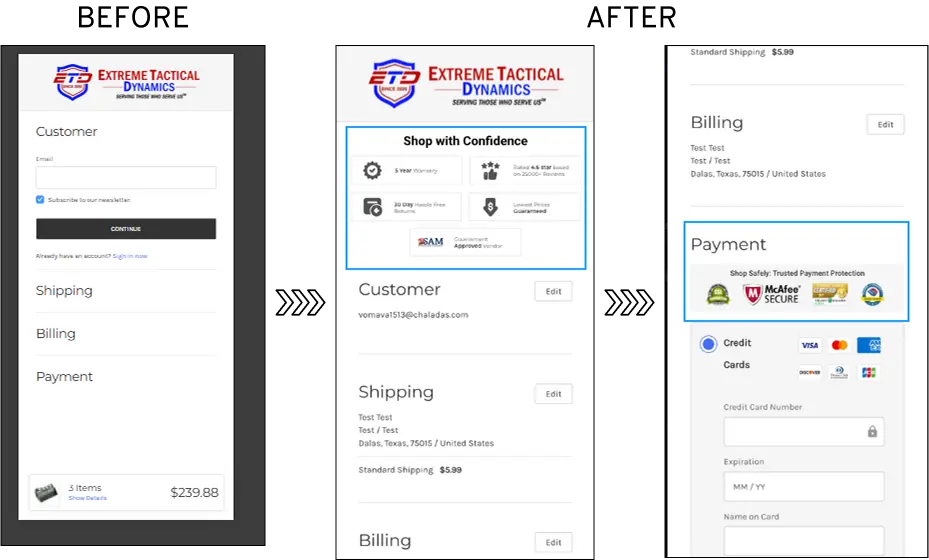
Extreme Tactical Dynamics was losing 41% of shoppers during checkout.
The problem wasn't pricing or product demand—it was a lack of reassurance at the exact moment customers were about to pay.
Instead of redesigning the checkout, ConvertCart introduced reassurance exactly where shoppers hesitated:
Visible payment security badges
Clear return and warranty messaging
Customer ratings placed beside the payment section
+10.67%
Desktop Conversions
+5.10%
Mobile Conversions
11%
Reduction in Checkout Abandonment
Key takeaway: Shoppers rarely abandon checkout because they suddenly stop wanting the product. More often, they leave because unanswered questions create uncertainty. Placing trust signals exactly where doubts arise can significantly increase completed orders.
⚠️
Wondering why shoppers abandon your Shopify checkout?
Checkout friction that's causing shoppers to abandon their purchase
Trust gaps that create hesitation before payment
Shipping and payment improvements that can increase completed orders
Mobile checkout issues that slow down conversions
Prioritized recommendations based on expected conversion impact
"The report was deep and super insightful. Can't believe it's free."
Logan Christopher
CEO, Empire Herbs
4. Make Shipping & Payment Choices Easy
Goal: Help shoppers complete their purchase without second-guessing the final step.
By the time shoppers reach payment, they've already decided to buy. Your job is to remove any last-minute uncertainty by making shipping and payment options clear, familiar, and easy to compare.
Offer multiple shipping options—such as Standard, Express, and Local Pickup—along with estimated delivery dates and transparent pricing. Highlight the recommended option so shoppers can choose confidently without comparing every detail.
For payments, prioritize accelerated checkout methods like Shop Pay, Apple Pay, and Google Pay, while clearly displaying major credit and debit card options. The fastest payment methods should be the easiest to find.
Why it works: Clear shipping information and familiar payment methods reduce decision fatigue, helping shoppers complete their purchase faster and with greater confidence.
Convertcart Experiment: How Shipping Transparency Increased Conversions
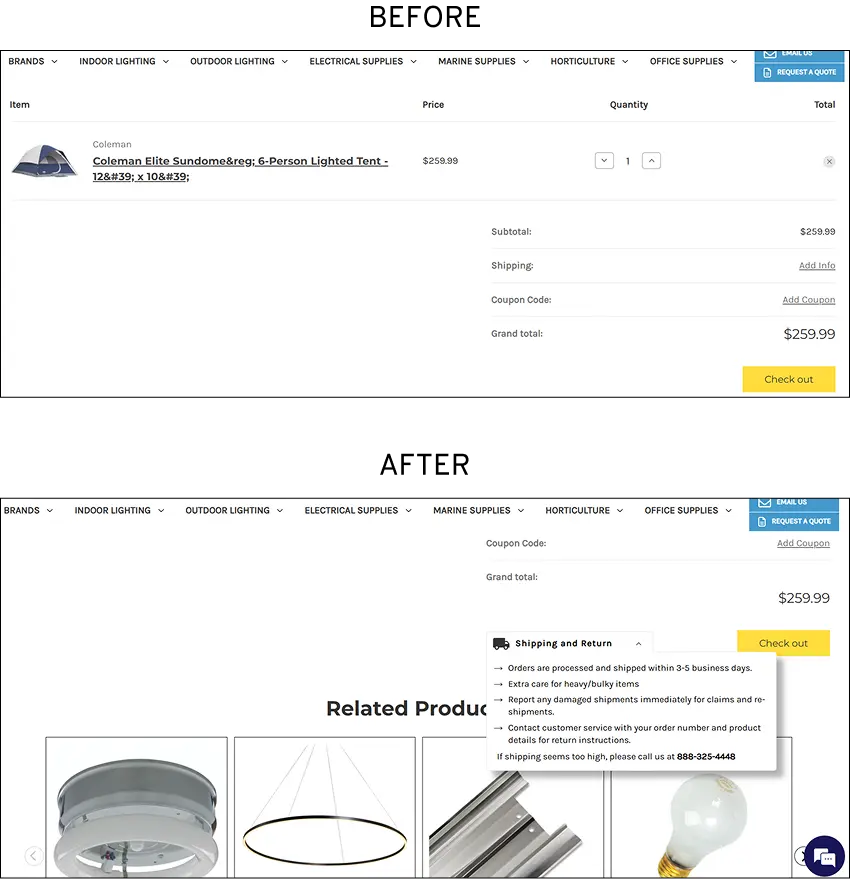
Lighting & Supplies discovered that shoppers weren't abandoning checkout because of the products—they were hesitating because shipping expectations weren't clear.
Nearly 42% of shoppers abandoned checkout, and user research showed that 14% were confused about shipping information.
Instead of redesigning the checkout, ConvertCart focused on making shipping expectations clear before shoppers reached the payment button.
Added clear shipping badges
Displayed estimated delivery timelines
Made shipping costs visible earlier in the checkout journey
42%
Checkout Abandonment Before Optimization
14%
Shoppers Confused About Shipping
+4.41%
Website-wide Conversion Rate
Key takeaway: Shipping transparency is a conversion tool. When shoppers understand delivery costs and timelines before paying, they complete checkout with greater confidence and fewer abandoned carts.
Put It All Together: What a High-Converting Shopify Checkout Page Looks Like
A high-converting Shopify checkout page removes friction before shoppers notice it. Every element should help customers move from cart to confirmation with as little effort and uncertainty as possible.
As a final checklist, your Shopify checkout should:
Enable guest checkout and accelerated payment methods like Shop Pay, Apple Pay, and Google Pay.
Minimize form fields and clearly indicate checkout progress.
Display trust signals, return policies, and customer reassurance close to the payment section.
Offer transparent shipping costs, delivery estimates, and multiple fulfillment options.
Prioritize a clean, mobile-first layout with fast loading and distraction-free design.
Use Shopify Checkout Extensibility (for Shopify Plus) to test custom content, conditional messaging, and checkout enhancements without compromising performance.
Remember: The best Shopify checkout customizations are the ones shoppers barely notice. Every improvement should reduce effort, answer questions before they're asked, and make completing the purchase feel like the easiest next step.
Customizing your Shopify checkout isn't about adding more features. It's about making it easier for shoppers to finish their purchase. Start by reducing friction with guest checkout, shortening forms where possible, and making your payment and shipping options easy to understand. Then add trust signals like secure payment badges, return policies, and delivery information where shoppers are most likely to have questions.
If you're on Shopify Plus, you can take customization further with Checkout Extensibility, UI extensions, and custom checkout experiences. If you're on a standard Shopify plan, you can still improve your Shopify checkout page by optimizing the content, layout, and customer experience.
2. How do I reduce Shopify checkout abandonment?
The best way to reduce Shopify checkout abandonment is to remove the reasons shoppers hesitate before they pay. That usually means avoiding forced account creation, showing shipping costs and delivery estimates upfront, offering familiar payment methods like Shop Pay, Apple Pay, and Google Pay, and making the checkout as simple as possible.
Trust also plays a big role. Security badges, return policies, and customer support information help reassure shoppers at the final step. Even small improvements can make a noticeable difference because shoppers who reach checkout already have strong buying intent.
3. Can I customize my Shopify checkout without Shopify Plus?
Yes. Every Shopify plan lets you customize your checkout with your brand logo, colors, fonts, payment methods, and customer contact settings. Those changes alone can improve the checkout experience and help increase conversions.
Shopify Plus gives you additional flexibility through Checkout Extensibility. You can add custom checkout components, personalized messaging, UI extensions, and conditional experiences without replacing Shopify's core checkout. Whether you're on Shopify or Shopify Plus, focusing on clarity, trust, and ease of use will have the biggest impact on conversions.
4. Which trust signals should I add to my Shopify checkout?
The most effective Shopify checkout trust signals are the ones that answer customer questions before they become objections. Secure payment badges, SSL security indicators, return and refund policies, delivery estimates, shipping information, customer support details, and money back guarantees all help shoppers feel more confident about completing their purchase.
Where you place these trust signals matters just as much as which ones you use. Display them close to the payment section so shoppers can see them at the moment they're deciding whether to place their order.
5. What makes a Shopify checkout page high-converting?
A high-converting Shopify checkout page makes buying feel simple. Shoppers can quickly understand their shipping options, trust that their payment is secure, choose their preferred payment method, and complete their purchase without unnecessary steps or distractions.
The highest-converting Shopify checkout pages all have a few things in common. They remove friction, answer common questions before shoppers have to ask them, work seamlessly on mobile devices, and make the next step obvious from start to finish. When checkout feels effortless, more shoppers become customers.
Subscribe for more articles like this!
Thank you - we'll see you in your inbox soon!
Oops! Something went wrong while submitting the form.
Read by 5000+ ecommerce store owners
Subscribe for more articles like this!
Thank you - we'll see you in your inbox soon!
Oops! Something went wrong while submitting the form.





.avif)
.svg)


.svg)

.svg)
.svg)
