A high-converting checkout page removes uncertainty faster than it creates effort. Instead of persuading shoppers to buy, it helps shoppers who have already decided to purchase complete their order without hesitation.
The highest-converting checkout pages reduce cognitive load, make progress obvious, display trust signals where doubts arise, keep pricing transparent, and eliminate unnecessary friction throughout the payment process.
Every checkout optimization should support one goal: helping shoppers finish their purchase quickly, confidently, and with as few decisions as possible.
Great checkout pages aren't built by adding every best practice. They're built by solving the right shopper doubts at the right moment.
That's why we've organized these checkout page examples around the conversion problems they solve, not just the features they include.
Along the way, we'll show you how our team evaluates checkout pages and where we consistently find the biggest conversion opportunities.
How to Evaluate a Checkout Page: The Convertcart Framework
A high-converting checkout page can be evaluated across five dimensions: cognitive load control, trust signal density, flow and momentum, doubt reframing, and revenue expansion.
Together, these dimensions determine how easily shoppers complete their purchase, how confident they feel during checkout, and how much revenue your checkout ultimately generates.
The Convertcart Checkout Evaluation Framework was developed from checkout audits across 500+ US ecommerce brands.
Each of the five dimensions is scored out of five points, producing a checkout score out of 25 that highlights where friction is hurting conversions the most.
Editor's note: This scoring method was developed by our in-house CRO team that consults eCommerce stores to improve their conversion rates.
22–25: Your checkout is a genuine competitive advantage with minimal conversion friction.
16–21: Your checkout performs well but has specific friction points that are likely suppressing conversions.
Below 15: Your checkout contains significant usability and persuasion gaps that are likely contributing to higher checkout abandonment.
Next, we'll apply this framework to five real checkout pages, score each one across all five dimensions, and explain exactly what they do well and where they leave conversion opportunities on the table.
5 High Converting Checkout Page Examples
Example 1: Modern Mammals — Score: 19/25
Niche: Men's personal care | Key lesson: The paradox of easy cancellations
Dimension
Score
Verdict
Cognitive Load
4/5
Clean, minimal fields.
Trust Signals
5/5
Cancellation transparency is rare and excellent.
Flow & Momentum
3/5
Could streamline mobile further.
Doubt Reframing
4/5
The cancellation link reframes commitment risk.
Revenue Expansion
3/5
Limited upsell presence.
Most stores are genuinely frightened of anything that resembles a cancellation policy. The prevailing logic is that showing an exit door invites people to walk through it.
Modern Mammals, a men's shampoo brand, has come to a rather different conclusion.
Their checkout page places a clear, accessible cancellation link alongside the standard refund and privacy information. It is not the first thing you see, nor the last; it sits in the quiet middle of the page, neither hidden nor announced with fanfare.
This is, it turns out, exactly right. The psychological reality of checkout is that shoppers experience a sharp spike in what behavioural economists call "loss aversion," the sense that they might be making a mistake that cannot be undone.
When a brand makes exit feel easy, the decision to stay feels less consequential, which paradoxically makes it easier to make.
What to steal: Add a quietly placed cancellation or returns link near your payment section. A/B test between a plain link and warmer copy like "Easy to cancel, see policy." The warmer version typically outperforms.
Where they could improve: The mobile experience has room for further simplification. On smaller screens, even a small amount of layout complexity can disrupt the forward momentum that converts.
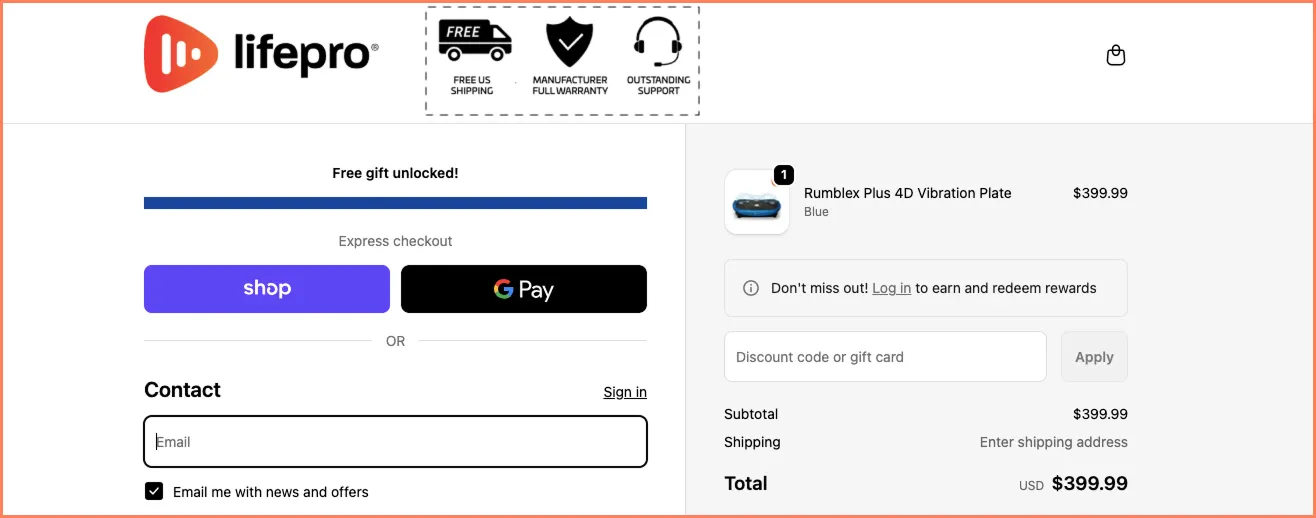
Example 2: Lifepro — Score: 22/25
Niche: Wellness equipment | Key lesson: Trust badges that actually do work
Dimension
Score
Verdict
Cognitive Load
4/5
Well-structured first fold.
Trust Signals
5/5
Exceptional — specific differentiators, not generic badges.
Flow & Momentum
4/5
Strong linear flow.
Doubt Reframing
5/5
Free shipping, warranty, support visible at decision point.
Revenue Expansion
4/5
Solid but could personalise add-ons further.
There is a common belief in eCommerce that the primary job of the first fold of a checkout page is to display familiar payment method logos. The idea is that seeing a Visa or PayPal mark reassures the shopper that the transaction is legitimate.
This is not wrong, exactly.
But Lifepro, a wellness equipment brand, has understood something more nuanced: that shoppers at checkout are frequently in comparison mode.
They have, in many cases, the same product open in two or three other tabs. What they are looking for is not simply proof of payment security; they already have that from the payment icons, but a reason to choose this store over the others.
Lifepro answers this by placing their genuine brand differentiators: free shipping, manufacturing warranty, and pre- and post-purchase support, at the very top of the checkout page.
These are not generic trust badges. They are specific, verifiable claims about what makes this purchase better than the alternative sitting in tab three.
What to steal: Before choosing your trust signals, survey your customer reviews and live chat logs for the three biggest hesitations shoppers express. Then, the engineer trusts content that speaks directly to those specific doubts. Generic badges are fine. Badges that answer real objections are significantly better.
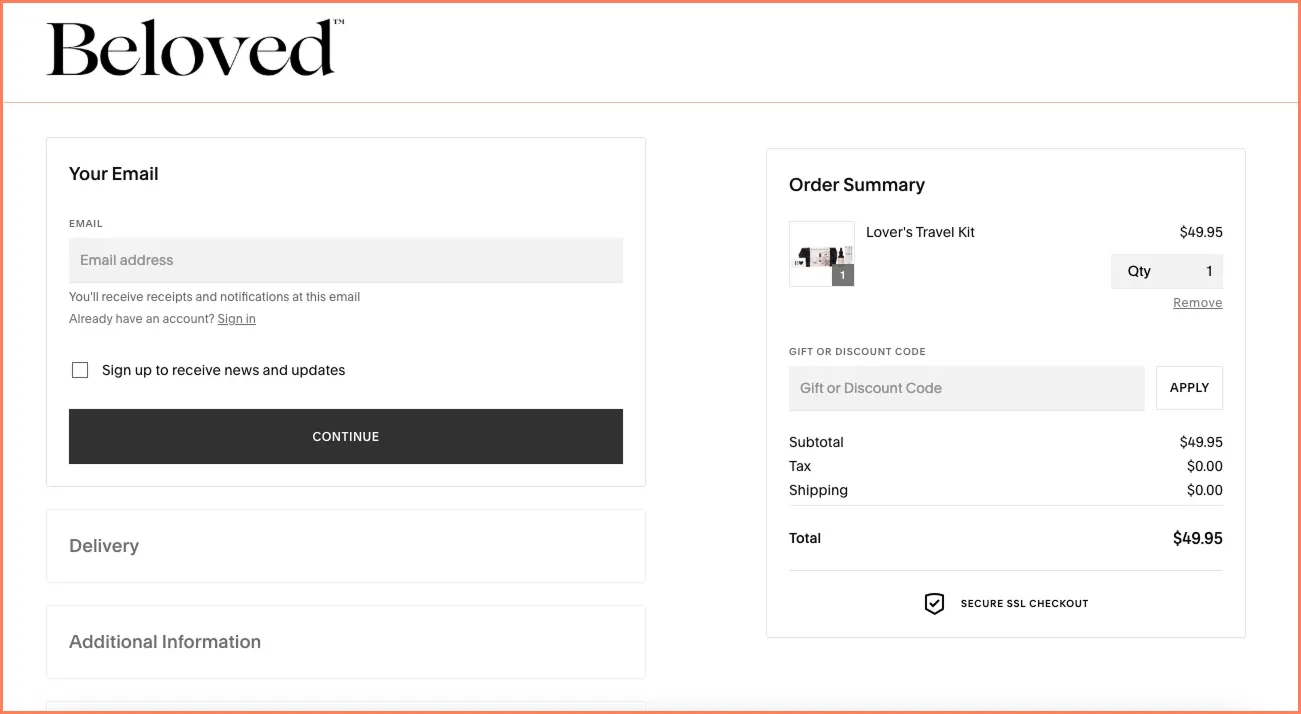
Niche: Sexual wellness | Key lesson: Collapsed sections and the gift of not knowing what's next
Dimension
Score
Verdict
Cognitive Load
5/5
Best-in-class progressive disclosure.
Trust Signals
3/5
Present but not strategically placed.
Flow & Momentum
5/5
Exceptional — shoppers always know exactly where they are.
Doubt Reframing
3/5
Could work harder on pre-payment reassurance.
Revenue Expansion
4/5
Clean add-on placement.
Money is, in the final analysis, a deeply stressful thing to hand over. Checkout is the moment when this stress reaches its peak.
The shopper must fill in fields, confirm details, enter card numbers, and do all of this while battling the sneaking suspicion that something might go wrong, that they might be making an error, and crucially, that they have no idea how much longer this is going to take.
Beloved, a sexual wellness brand, has solved this final problem elegantly.
Their checkout uses collapsed sections that open progressively as the shopper completes each step. You fill in shipping; the next section unfolds. You confirm payment; the next step appears.
At no point are you confronted with the full scope of what remains.
This is, it turns out, a remarkably effective psychological trick.
Psychologists studying task completion have long known that people are more likely to finish tasks when they feel they are making constant progress.
Beloved's checkout creates exactly this feeling. Each completed section is a small victory, and the next step is always just one click away.
What to steal: If you have a multi-section checkout, consider collapsing everything except the active step. Always end each completed section with a small, accessible "edit" link, so shoppers want to know they can go back, even if they rarely do. That knowledge alone reduces anxiety.
Where they could improve: Trust signal placement is somewhat passive. Moving returns and security messaging closer to the payment field, the highest-anxiety moment would likely yield a meaningful uplift.
Example 4: Melinda Maria — Score: 21/25
Niche: Jewellery | Key lesson: Spending anxiety and the power of the gift frame
Dimension
Score
Verdict
Cognitive Load
4/5
Clean, well-organised.
Trust Signals
4/5
Strong, niche-appropriate social proof.
Flow & Momentum
4/5
Linear and focused.
Doubt Reframing
5/5
The gifting nudge is genuinely clever and niche-perfect.
Revenue Expansion
4/5
Gift wrap as a seamless add-on is smart.
More than 70% of shoppers who reach checkout carry with them a background hum of spending anxiety. They want the product. They have gone as far as putting it in a cart and clicking "Checkout." And yet some part of their brain is asking, with increasing urgency, "Is this a reasonable way to spend money?"
Melinda Maria, a jewellery brand, has found a remarkably effective answer to this question, not by reducing the price, not by offering a discount, but by reframing what the purchase is for. Their checkout page includes a gift-wrapping nudge that transforms a personal indulgence into an act of generosity.
This is what we call "doubt reframing," the practice of changing not the purchase itself, but the story the shopper tells themselves about why they're making it.
Spending money on yourself can feel frivolous. Spending money on a beautifully wrapped gift for someone else feels entirely defensible, even virtuous.
The execution is important here. The gift wrap nudge appears as a simple, non-intrusive option within the checkout flow, not a pop-up, not a separate page, not a decision that requires significant deliberation. It adds to the order without increasing cognitive overhead.
What to steal: Think about how your product can be reframed at the point of purchase. In most niches, there is a legitimate gifting angle. Set a minimum cart value to trigger the nudge. $60 is a reasonable starting point to keep it feeling relevant rather than desperate.
Example 5: Wuffes — Score: 21/25
Niche: Pet health supplements | Key lesson: The right kind of social proof (not just any kind)
Dimension
Score
Verdict
Cognitive Load
4/5
Clean and well-prioritised.
Trust Signals
5/5
Authoritative proof matched to science-backed product.
Flow & Momentum
4/5
Smooth and focused.
Doubt Reframing
5/5
The human guarantee face creates remarkable reassurance.
Revenue Expansion
3/5
Add-on opportunities are underutilised.
There is a great deal of muddled thinking in eCommerce about social proof. The standard advice is to "add reviews to your checkout page," which is a bit like being told to "add vegetables to your diet," technically correct, but insufficiently specific to be particularly useful.
Wuffes, a pet health supplement brand, has understood something more precise: that the type of social proof must match the nature of the product and the psychological state of the shopper. Their products are science-backed supplements for dogs.
The shopper who has reached checkout is not merely wondering whether other people liked the product — they are wondering whether it will actually work for their pet, possibly a senior dog with specific health concerns.
Wuffes' checkout page responds to this with authoritative social proof, not just star ratings, but expert endorsements and guarantee-backed assurances, presented with human faces.
The faces are not incidental. Research on trust in online transactions consistently shows that human images near conversion points increase the likelihood of completion.
What makes this especially smart is the specificity. The guarantee isn't a generic "you'll love it." It speaks to the concern that drives the purchase: that this will actually help my dog.
What to steal: Before choosing your checkout social proof, ask one question: What is the shopper's primary fear at the moment of payment? Then find the specific kind of proof that addresses exactly that fear, not proof in general, but proof that speaks to the doubt that is most likely to make them close the tab.
Where they could improve: The add-on and cross-sell section is underutilised for a brand with a natural product range (joint health, anxiety, digestion). Contextual add-ons matched to the item in the cart could meaningfully increase AOV with minimal friction.
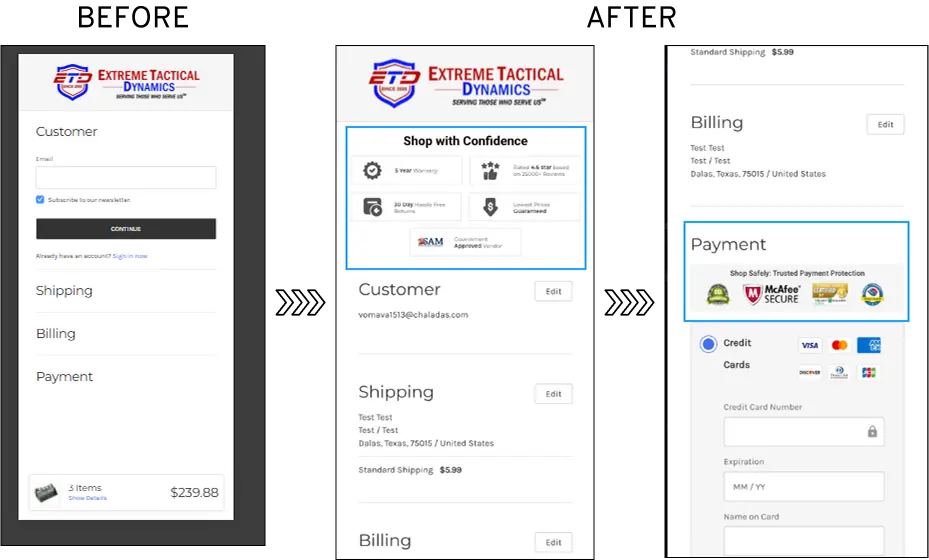
Convertcart Experiment: Using Trust Signals to Reduce Checkout Abandonment
Problem
Many shoppers reached checkout but hesitated before completing their purchase. The biggest barrier was a lack of confidence at the final step.
Hypothesis
Showing trust signals beside the payment section would reassure shoppers at the moment of purchase and increase completed orders.
What We Changed
Security badges, return guarantees, and reassurance messaging were moved beside the payment section, where shoppers naturally seek confirmation before placing an order.
Results
+10.67% increase in desktop conversions +5.10% increase in mobile conversions 11% reduction in checkout abandonment
Framework Dimension
Trust Signal Density — 5/5
Checkout Lesson
Trust signals have the greatest impact when they're shown exactly where shoppers decide whether to complete payment. Instead of scattering badges throughout checkout, place them beside the payment section to eliminate last-minute doubts.
Why It Worked
Entering payment information is the highest-risk moment in the checkout journey. Visible reassurance reduces perceived risk, increases confidence, and makes shoppers more comfortable completing their purchase.
Product discovery – barriers that prevent shoppers from finding items
Category/collection pages – improvements that drive deeper product exploration
Product page – what to optimize to convert 2–3x more buyers
Cart – ways to ease hesitation and speed up purchase decisions
“The report was deep and super insightful. Can’t believe it’s free.”
Logan Christopher CEO, Empire Herbs
What Do High-Converting Checkout Pages Have in Common?
Having applied the framework to five very different brands in five very different niches, some patterns are worth noting not because they constitute universal laws, but because they appear reliably enough to deserve attention.
High-scoring checkouts address doubt rather than ignoring it
The common instinct is to remove anything from a checkout page that might give a shopper a reason to pause. Modern Mammals, Melinda Maria, and Wuffes all take the opposite approach: they acknowledge the shopper's anxiety and respond to it directly. The result, counterintuitively, is more momentum, not less.
Trust signals are most effective when they are specific
Generic security badges have some value. Specific, verifiable claims about shipping, warranty, and returns have considerably more. The difference is that specific claims answer real questions; generic badges merely signal legitimacy.
Cognitive simplicity is the foundation on which everything else builds
None of the other dimensions function well if the checkout page is too complex to navigate comfortably. Beloved's collapsed sections are the clearest illustration of this by controlling what the shopper sees at any given moment, they make every subsequent element more effective.
Revenue expansion works best when it requires no deliberation. The add-ons and cross-sells that perform at checkout are the ones that shoppers can add with a single click without stopping to think. The moment an add-on requires reading, comparing, or deciding, it has already lost most of its conversion potential.
A Final Thought Before You Go...
The remarkable thing about checkout pages is how much work they are expected to do in a very short time.
In the space of perhaps sixty seconds, a checkout page must reassure, simplify, persuade, retain, and convert while simultaneously not doing anything annoying enough to make the shopper change their mind.
The brands that do this best are not the ones that follow a checklist.
They are the ones who have thought carefully about who their shopper is, what that shopper is afraid of at the moment of payment, and what they can say or show that will make them feel like the obvious thing to do.
The framework above is a map. The territory is your specific customer, in your specific niche, deciding on your specific product.
Before redesigning your checkout, score it using the Convertcart Checkout Evaluation Framework.
The biggest conversion gains rarely come from adding more features. They come from removing the doubts that stop shoppers from clicking "Place Order."
Frequently Asked Questions
1. What are the 5 dimensions of the Convertcart Checkout Evaluation Framework?
The Convertcart Checkout Evaluation Framework scores checkout pages across five dimensions that directly influence purchase completion and checkout conversion rates:
Cognitive Load Control: Reduces the effort required to complete checkout by limiting visible form fields, supporting autofill, and revealing optional information only when needed.
Trust Signal Density: Builds purchase confidence through security badges, transparent return and cancellation policies, payment reassurance, and authentic social proof.
Flow & Momentum: Maintains checkout progress with guest checkout, clear progress indicators, mobile-friendly design, and inline error validation.
Doubt Reframing: Addresses last-minute hesitation by reinforcing purchase value, reducing perceived risk, and answering common shopper concerns.
Revenue Expansion: Increases average order value with contextual cross-sells, embedded add-ons, and clearly communicated free shipping thresholds without disrupting checkout.
Each dimension is scored out of 5 points, giving your checkout an overall score out of 25.
2. How do I score my own checkout page?
Evaluate your checkout experience as if you were a first-time customer, ideally using an incognito browser on a mobile device. Score your checkout across the five dimensions of the ConvertCart Checkout Evaluation Framework, assigning up to 5 points for each category based on how well your checkout reduces friction and builds shopper confidence.
22–25: Your checkout is a competitive advantage with minimal conversion friction.
16–21: Your checkout performs well but has specific issues that may be limiting conversions.
Below 15: Your checkout likely contains significant friction that is increasing checkout abandonment and reducing completed purchases.
This score provides a practical starting point for prioritizing checkout optimization efforts.
3. What should every high-converting checkout page include?
A high-converting checkout page should make completing a purchase feel simple, predictable, and low risk. Essential elements include guest checkout, a clear progress indicator, transparent pricing and shipping costs, visible trust signals, multiple payment options, mobile-friendly forms, inline error validation, and easy access to return or cancellation policies.
The best checkout pages also minimize unnecessary form fields, avoid distractions, and answer common shopper concerns before they become reasons to abandon the purchase.
4. What causes shoppers to abandon checkout?
The most common causes of checkout abandonment include unexpected shipping costs, forced account creation, lengthy or confusing forms, hidden fees, limited payment options, concerns about payment security, slow page performance, and uncertainty about returns or delivery timelines.
High-converting checkout pages reduce these friction points by making costs transparent, simplifying the checkout flow, reinforcing trust throughout the purchase process, and helping shoppers complete their order with as few decisions as possible.
5. What is a good checkout abandonment rate?
There is no single "good" checkout abandonment rate because it varies by industry, device, product category, and customer intent. Rather than focusing only on benchmarking against industry averages, measure where shoppers abandon your checkout and identify the friction causing those drop-offs.
Consistently high checkout abandonment often indicates issues such as unexpected costs, unnecessary form fields, weak trust signals, or a complicated checkout flow. Improving these areas typically has a greater impact on conversion rates than increasing traffic alone.
Subscribe for more articles like this!
Thank you - we'll see you in your inbox soon!
Oops! Something went wrong while submitting the form.
Read by 5000+ ecommerce store owners
Subscribe for more articles like this!
Thank you - we'll see you in your inbox soon!
Oops! Something went wrong while submitting the form.







.avif)
.svg)


.svg)

.svg)
.svg)
